
AI drug discovery models are starving for physical data, forcing fierce competitors to pool their proprietary secrets.
AI models are only as good as their training data. In the race to design custom antibodies, tech developers and pharma giants alike have hit a hard wall. They lack the massive, standardized physical interaction datasets needed to make their algorithms work in the real world.
Now, a new alliance suggests the industry is realizing it cannot solve this bottleneck alone.
The Shared Data Bet
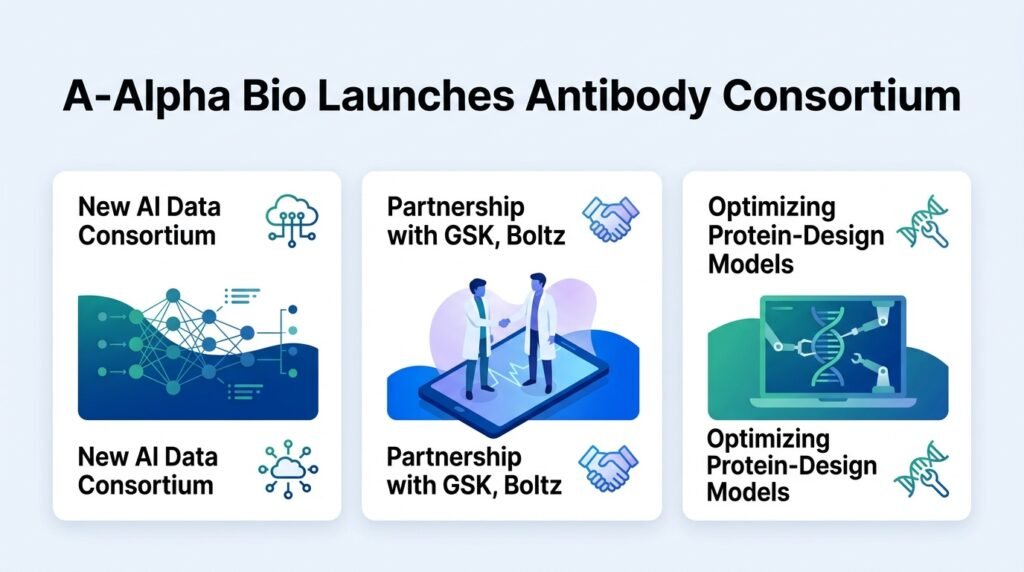
A-Alpha Bio is launching the Atlas Consortium. Instead of hoarding data or relying on fragmented, private learning models, rivals like GSK, Boltz, Cradle, and Dyno Therapeutics are paying to collaboratively fund and share massive datasets.
The group will use A-Alpha Bio’s platform to generate standardized data. The goal is to feed next-generation protein-design models like Boltz-2.
This is a sharp shift in strategy. Historically, pharma companies treated biological data as their ultimate proprietary moat.
But a siloed moat is useless if the AI training on it remains inaccurate.
The Generalization Trap
Will this actually work?
Predicting how proteins bind in the messy reality of the human body is notoriously difficult. Standardized lab data helps, but biology is rarely standard.
If these pooled datasets fail to capture the chaotic variety of physical interactions, the resulting AI models will still design useless molecules. For now, the consortium proves that in the AI era, data volume beats individual secrecy.