
We are rapidly crossing the line from AI that merely transcribes or suggests to AI that actively decides and operates. As I look at this week’s developments, the shift toward autonomous clinical agents is forcing a major reckoning on safety, regulatory boundaries, and clinical trust.
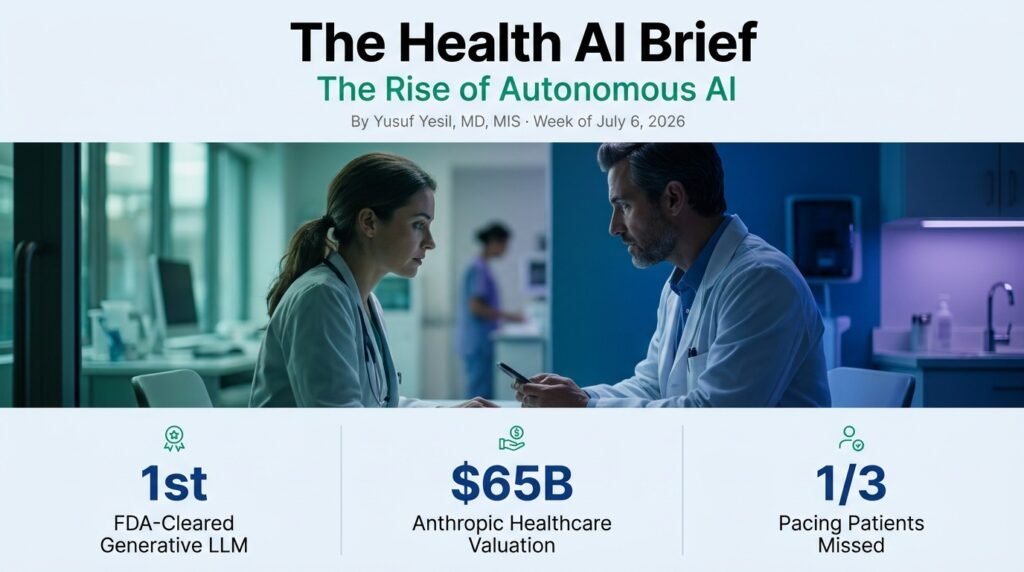
🔹 What the First FDA-Cleared LLM Actually Does — The FDA cleared its first patient-facing generative AI tool, but the algorithm is not the one writing your prescription.
This is a massive milestone for builders in this space, but notice how the clearance is tightly bound to non-diagnostic tasks. If you are designing clinical tools, remember that the FDA is still drawing a very hard line at autonomous decision-making.
🔹 Anthropic’s $65 Billion Valuation Tests Healthcare AI — A massive $65 billion funding round positions Anthropic to dominate clinical AI, but the real test is whether hospitals will trust its models with patient lives.
When I was building Yesil Health, I realized that capital is easy compared to hospital IT integration. Anthropic has the compute, but winning the clinical bedside requires solving the trust and liability puzzle.
🔹 Digital twins predict cardiac pacing success — A new digital twin model shows that one-third of heart failure patients fail cardiac therapy because surgeons are aiming at the wrong target.
For clinicians, this is a beautiful blend of physics and physiology. Simulating the heart before cutting can save thousands of patients from invasive, ineffective procedures.
🔹 When AI Bots Negotiate Your Medical Care — The shift from chatbots that answer questions to autonomous agents that execute medical tasks is happening faster than our safety guardrails can adapt.
If you are building in this space, beware: autonomous negotiation with insurers sounds like a dream, but the potential for catastrophic, unmonitored errors is incredibly high.
🔹 AI judges reward long answers over correct ones — Using artificial intelligence to grade medical answers backfires because algorithms prefer long-winded fluff over actual clinical accuracy.
This is a classic RLHF failure mode that developers must address. If we use LLMs to evaluate other LLMs, we risk optimizing for style over life-saving clinical substance.