⚡ Quick Summary
The WHO Skin NTDs App is a groundbreaking tool designed to assist frontline health workers in low- and middle-income countries with diagnosing skin neglected tropical diseases (NTDs). Enhanced with artificial intelligence, this app has demonstrated impressive performance metrics, including a 99.8% top-5 sensitivity across various skin conditions.
🔍 Key Details
- 📱 App Development: Created by the World Health Organization (WHO) and UniversalDoctor.
- 🧠 Technology: Incorporates an AI-powered visual classifier (VC) using a convolutional neural network (DenseNet-121).
- 📊 Diseases Identified: Trained to identify 12 out of 13 skin NTDs.
- 🏆 Performance Metrics: Achieved 99.8% top-5 sensitivity and over 75% top-1 accuracy for most diseases.
🔑 Key Takeaways
- 🌍 Addressing a Major Challenge: Skin NTDs are a significant public health issue in resource-limited settings.
- 💡 AI Integration: The app’s AI component enhances diagnostic capabilities for frontline health workers.
- 📈 High Sensitivity: The VC achieved a remarkable 99.8% sensitivity in identifying skin NTDs.
- 🔍 Precision Variability: Some conditions, like chromoblastomycosis and sporotrichosis, showed lower precision.
- 🚀 Future Development: Continued enhancement and validation of the app are essential for global implementation.
- 🩺 Clinical Integration: The app aims to be integrated into clinical workflows to improve healthcare delivery.
📚 Background
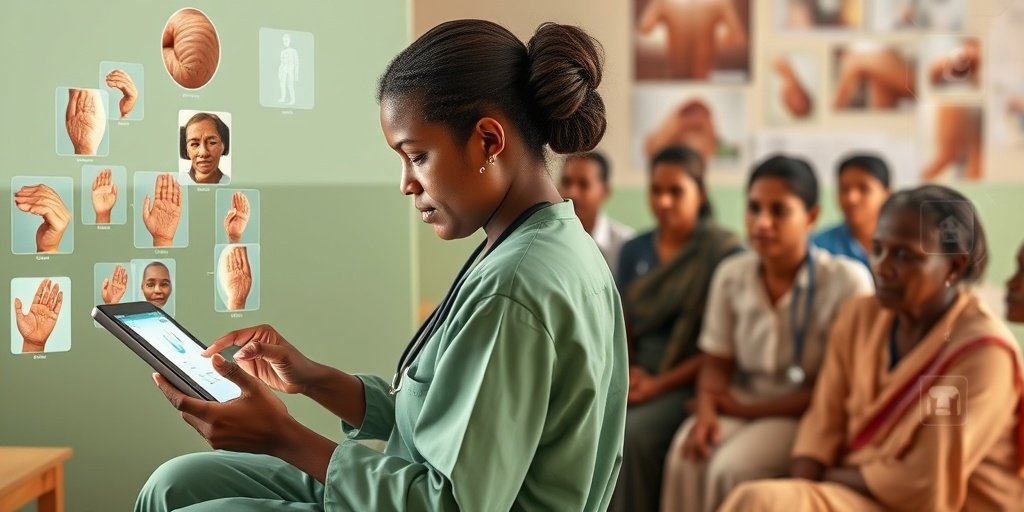
Skin neglected tropical diseases (NTDs) pose a significant challenge to public health, particularly in low- and middle-income countries where healthcare resources are limited. Frontline health workers often lack the necessary dermatological training to effectively diagnose and treat these conditions. The WHO Skin NTDs App was developed to bridge this gap, providing a digital resource that empowers health workers with the knowledge and tools they need to combat these diseases.
🗒️ Study
The WHO Skin NTDs App was initially designed as a digital adaptation of a WHO training guide. It has since evolved to include a clinical decision support tool and an AI-powered visual classifier. The study aimed to evaluate the performance of the VC, which was trained to identify a range of skin NTDs using advanced machine learning techniques.
📈 Results
The AI-powered VC demonstrated exceptional performance in internal evaluations, achieving a top-5 sensitivity of 99.8% across all diseases. Most diseases had a top-1 accuracy exceeding 75%, indicating a strong capability for accurate diagnosis. However, certain underrepresented conditions exhibited lower precision, highlighting areas for further improvement.
🌍 Impact and Implications
The WHO Skin NTDs App represents a significant advancement in the fight against skin NTDs, particularly in underserved areas. By leveraging artificial intelligence, this tool not only enhances the diagnostic capabilities of frontline health workers but also has the potential to improve patient outcomes significantly. The integration of such technology into clinical practice could transform healthcare delivery in regions most affected by these diseases.
🔮 Conclusion
The WHO Skin NTDs App is a promising innovation in the realm of public health, showcasing the potential of artificial intelligence to enhance healthcare delivery. As the app continues to develop and undergo external validation, it holds the promise of becoming an invaluable resource for frontline health workers in combating skin neglected tropical diseases. The future of healthcare in resource-limited settings looks brighter with such advancements!
💬 Your comments
What are your thoughts on the integration of AI in healthcare tools like the WHO Skin NTDs App? We would love to hear your insights! 💬 Leave your comments below or connect with us on social media:
The World Health Organization Skin Neglected Tropical Diseases App: A dynamic capacity building training tool enhanced with artificial intelligence.
Abstract
Skin neglected tropical diseases (NTDs) remain a major public health challenge in low- and middle-income countries, where frontline health workers (FHWs) often lack dermatological training. In response, the World Health Organization (WHO) created the Skin NTDs App-developed by UniversalDoctor-to support FHWs in resource-limited settings. Initially created as a digital adaptation of a WHO’s training guide, the App evolved by incorporating another clinical decision support tool (CDST) from until No Leprosy Remains and an artificial intelligence (AI)-powered visual classifier (VC). Our purpose is to describe the WHO Skin NTDs App and evaluate its AI-powered VC. The VC was trained to identify 12 skin NTDs out of 13 through a convolutional neural network (DenseNet-121). Performance was assessed through sensitivity, specificity, accuracy, precision, F1-score, and per-class sensitivity from top-1 through top-5. The VC demonstrated high performance in internal evaluations, achieving 99.8% top-5 sensitivity across all diseases and top-1 accuracy above 75% for most diseases. Some underrepresented conditions (e.g., chromoblastomycosis, sporotrichosis) showed lower precision. In conclusion, the AI-powered WHO Skin NTDs App is a promising digital tool for capacity-building of FHW in underserved areas. Continued development, external validation, and integration into clinical workflows will be critical to assess its performance globally.
Author: [‘Serrano Pons J’, ‘Romero-Lopez A’, ‘Muñoz I’, ‘Carrion C’, ‘Fuster-Casanovas A’, ‘Lemaire J’, ‘Vaquero F’, ‘Garcia M’, ‘Anwar S’, ‘Hsu C’, ‘Villagrán Essmann SP’, ‘Wilder-Smith AB’, ‘Mule CM’, ‘Ruiz-Postigo JA’]
Journal: J Invest Dermatol
Citation: Serrano Pons J, et al. The World Health Organization Skin Neglected Tropical Diseases App: A dynamic capacity building training tool enhanced with artificial intelligence. The World Health Organization Skin Neglected Tropical Diseases App: A dynamic capacity building training tool enhanced with artificial intelligence. 2026; (unknown volume):(unknown pages). doi: 10.1016/j.jid.2026.03.043