⚡ Quick Summary
This literature review explores the transformative impact of machine learning (ML) and deep learning (DL) on optical spectroscopy for breast cancer diagnosis, highlighting advancements that enable noninvasive and accurate differentiation between healthy and cancerous tissues. The integration of AI-driven models has achieved diagnostic accuracies of up to 94% in subtype classification.
🔍 Key Details
- 📊 Timeframe: 2015-2025
- 🔬 Spectroscopic modalities: Raman, fluorescence, diffusive optical spectroscopy (DOS), photoacoustic spectroscopy (PAS)
- 🤖 AI models used: Convolutional neural networks (CNNs), support vector machines (SVMs), logistic regression
- 🏆 Diagnostic accuracy: Up to 94% in subtype classification
🔑 Key Takeaways
- 💡 Machine learning and deep learning are revolutionizing breast cancer diagnostics.
- 🔍 Optical spectroscopy provides a noninvasive method for detecting malignancy-associated biochemical changes.
- 📈 AI integration enhances the accuracy of differentiating between healthy and cancerous tissues.
- 🏥 Diagnostic accuracies can reach up to 94% for specific breast cancer subtypes.
- ⚠️ Challenges include data variability, model interpretability, and clinical integration barriers.
- 🌟 Future directions emphasize the need for explainable AI (XAI) and large-scale, diverse datasets.
- 🔗 Potential benefits include standardized diagnostics and reduced unnecessary biopsies.
- 🌍 Study conducted by a team of researchers in the field of medical technology.
📚 Background
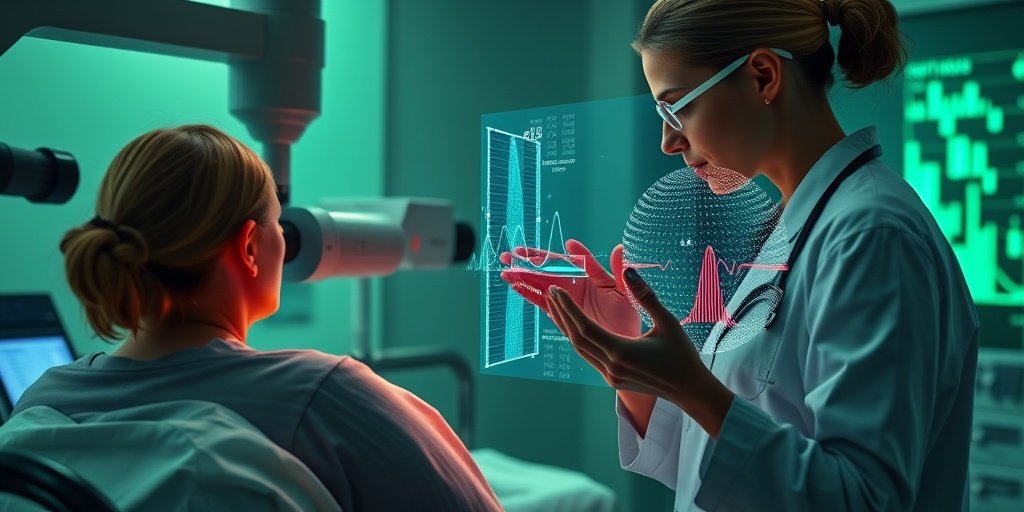
Breast cancer remains one of the leading causes of cancer-related deaths among women worldwide. Traditional diagnostic methods often involve invasive procedures such as biopsies, which can be uncomfortable and anxiety-inducing for patients. The integration of machine learning and optical spectroscopy presents a promising avenue for enhancing diagnostic accuracy while minimizing patient discomfort.
🗒️ Study
This review synthesizes advancements from peer-reviewed studies conducted between 2015 and 2025, focusing on how ML and DL techniques have been applied to various spectroscopic modalities. The authors critically assess the integration of AI-driven models with optical spectroscopy to improve the detection of biochemical changes associated with malignancy.
📈 Results
The findings indicate that the combination of AI models with spectroscopic techniques can achieve diagnostic accuracies of up to 94% in classifying breast cancer subtypes, such as luminal A and HER2-positive. The analysis of spectral biomarkers, including hemoglobin, lipids, and collagen, plays a crucial role in this enhanced diagnostic capability.
🌍 Impact and Implications
The integration of ML/DL-enhanced spectroscopy has the potential to standardize breast cancer diagnostics, reduce unnecessary biopsies, and personalize treatment monitoring. By addressing challenges such as data variability and model interpretability, this approach could significantly improve clinical outcomes and reshape the landscape of precision oncology.
🔮 Conclusion
This review highlights the incredible potential of machine learning and optical spectroscopy in revolutionizing breast cancer diagnosis. As we move forward, the emphasis on explainable AI and multimodal data fusion will be essential in bridging translational gaps and enhancing early detection. The future of breast cancer diagnostics looks promising, with the potential for improved patient outcomes and personalized treatment strategies.
💬 Your comments
What are your thoughts on the integration of machine learning in breast cancer diagnostics? We would love to hear your insights! 💬 Leave your comments below or connect with us on social media:
Machine learning enhanced optical spectroscopy for breast cancer diagnosis: A review.
Abstract
This literature review examines the transformative role of machine learning (ML) and deep learning (DL) in enhancing optical spectroscopy for breast cancer diagnosis. By synthesizing advancements from peer-reviewed studies (2015-2025), we evaluate how ML/DL integration improves the detection of malignancy-associated biochemical changes, enabling noninvasive, rapid, and accurate differentiation between healthy and cancerous tissues. This review highlights key spectroscopic modalities, such as Raman, fluorescence, diffusive optical spectroscopy (DOS), and photoacoustic spectroscopy (PAS), and their integration with AI-driven models, such as convolutional neural networks (CNNs), support vector machines (SVMs), and logistic regression. These techniques achieve diagnostic accuracies of up to 94% in subtype classification (e.g., luminal A, HER2-positive) by analyzing spectral biomarkers such as hemoglobin, lipids, and collagen. Challenges such as data variability, model interpretability, and clinical integration barriers are critically assessed. These findings underscore the potential of ML/DL-enhanced spectroscopy to standardize diagnostics, reduce unnecessary biopsies, and personalize treatment monitoring. Future directions emphasize the need for explainable AI (XAI), multimodal data fusion, and large-scale, diverse datasets to bridge translational gaps. By addressing technical, ethical, and regulatory hurdles, this integration promises to advance early detection, improve clinical outcomes, and reshape precision oncology.
Author: [‘Nakul M’, ‘Rao SD’, ‘Karnati M’, ‘Aziz F’, ‘Bhaskar DP’, ‘Dehury B’, ‘Mazumder N’]
Journal: Lasers Med Sci
Citation: Nakul M, et al. Machine learning enhanced optical spectroscopy for breast cancer diagnosis: A review. Machine learning enhanced optical spectroscopy for breast cancer diagnosis: A review. 2026; 41:(unknown pages). doi: 10.1007/s10103-026-04882-9