

⚡ Quick Summary
This review highlights the use of machine learning (ML) techniques in the assessment of infections in diabetic foot ulcers (DFUs), a common and severe complication of diabetes. The integration of ML with digital sound imaging shows promise in enhancing early detection and reducing diagnostic variability, potentially leading to better patient outcomes.
🔍 Key Details
- 📊 Focus: Infection assessment in diabetic foot ulcers
- 🧩 Techniques: Machine learning combined with digital sound imaging
- ⚙️ Applications: Ulcer classification, tissue segmentation, and longitudinal wound monitoring
- 🏆 Clinical utility: Telemedicine, remote monitoring, and decision support
🔑 Key Takeaways
- 💡 Early detection of infections in DFUs is crucial to prevent severe complications.
- 🤖 Machine learning can enhance traditional clinical assessments by identifying infection-related visual features.
- 📈 Encouraging performance of ML systems in identifying infection patterns has been observed.
- 🌍 Potential for use in community and resource-limited settings is significant.
- ⚠️ Limitations include image variability and lack of standardized protocols.
- 🔍 Further research is needed for large-scale validation and integration into clinical workflows.
- 👩⚕️ ML should complement clinical expertise rather than replace it in managing diabetic foot infections.
📚 Background
Diabetic foot ulcers (DFUs) are a serious complication of diabetes mellitus, often leading to infections that can result in hospitalization, lower-limb amputation, and increased mortality rates. The challenge lies in the early and accurate detection of infections, which is typically reliant on subjective visual evaluations. This can lead to inconsistencies and delays in diagnosis, underscoring the need for improved assessment methods.
🗒️ Study
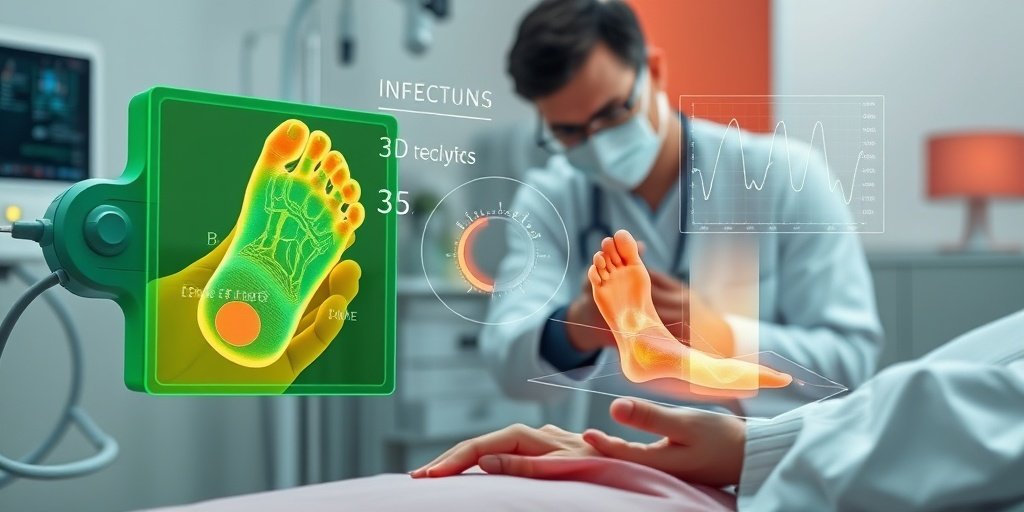
This review critically evaluates recent advancements in the application of machine learning for infection assessment in DFUs. It discusses various image-based ML approaches that focus on detecting visual features associated with infections, such as erythema, purulent exudate, necrosis, and tissue discoloration. The study also explores models for ulcer classification and tissue segmentation, emphasizing their potential in clinical settings.
📈 Results
The findings indicate that ML-based systems have shown promising performance in identifying infection-associated patterns in DFU images. These systems may help reduce diagnostic variability and support earlier clinical interventions, which is crucial for improving patient outcomes. However, challenges such as dataset bias and limited clinical validation remain.
🌍 Impact and Implications
The integration of machine learning into the assessment of diabetic foot infections could significantly enhance clinical practice. By providing more accurate and timely diagnoses, healthcare providers can improve patient management and potentially reduce the incidence of severe complications. This is particularly relevant in community and resource-limited settings, where access to specialized care may be restricted.
🔮 Conclusion
The application of machine learning in the assessment of infections in diabetic foot ulcers represents a breakthrough technology that could transform clinical practice. While the results are encouraging, further large-scale studies and regulatory validation are essential for widespread adoption. Ultimately, machine learning should be viewed as a supportive tool that enhances clinical expertise in managing diabetic foot infections.
💬 Your comments
What are your thoughts on the integration of machine learning in the assessment of diabetic foot ulcers? We would love to hear your insights! 💬 Share your comments below or connect with us on social media:
Clinical applications of machine learning for infection assessment in diabetic foot ulcers.
Abstract
Diabetic foot ulcers (DFUs) represent one of the most severe complications of diabetes mellitus and are frequently complicated by infection, which significantly increases the risk of hospitalization, lower-limb amputation, and mortality. Early and accurate detection of infection in DFUs is therefore critical; however, clinical assessment remains challenging and is largely based on subjective visual evaluation. Inter-observer variability, atypical inflammatory responses in patients with diabetes, and inconsistent wound documentation contribute to delayed or inaccurate diagnoses. In recent years, digital sound imaging combined with machine learning (ML) techniques has emerged as a promising adjunct to traditional clinical assessment. This review summarizes and critically evaluates recent advances in the application of ML for infection assessment in DFUs. We review image-based ML approaches designed to detect infection-related visual features, including erythema, purulent exudate, necrosis, and tissue discoloration, as well as models developed for ulcer classification, tissue segmentation, and longitudinal wound monitoring. In addition, we discuss the clinical utility of ML-assisted tools in telemedicine, remote monitoring, and decision support, particularly in community and resource-limited settings. Current limitations, including image variability, dataset bias, lack of standardized imaging protocols, and limited clinical validation, are also addressed. Overall, ML-based systems have demonstrated encouraging performance in identifying infection-associated patterns in DFU images and may help reduce diagnostic variability and support earlier clinical intervention. Nevertheless, further large-scale prospective studies, regulatory validation, and integration into clinical workflows are required before widespread adoption. Machine learning should be viewed as a supportive tool that complements, rather than replaces, clinical expertise in the management of diabetic foot infections.
Author: [‘Lysnychka K’, ‘Rostoka L’, ‘Burmistrova Y’, ‘Halabitska I’, ‘Petakh P’, ‘Kamyshnyi O’]
Journal: Front Physiol
Citation: Lysnychka K, et al. Clinical applications of machine learning for infection assessment in diabetic foot ulcers. Clinical applications of machine learning for infection assessment in diabetic foot ulcers. 2026; 17:1776883. doi: 10.3389/fphys.2026.1776883