⚡ Quick Summary
This comprehensive review highlights the transformative role of Artificial Intelligence (AI) in the detection and management of prostate cancer, emphasizing its ability to enhance diagnostic accuracy and personalize treatment strategies. By integrating AI with advanced imaging techniques, the study reveals a potential shift towards a new standard of care characterized by greater precision and efficiency.
🔍 Key Details
- 📊 Focus: Utilization of AI in prostate cancer detection and management
- 🧩 Technologies: Deep learning algorithms, multiparametric MRI (mpMRI), digital pathology
- 🏆 Key Innovations: Automated Gleason grading, risk stratification, personalized treatment planning
- 🌐 Challenges: Prospective validation, data equity, regulatory approval
🔑 Key Takeaways
- 🤖 AI enhances the interpretation of mpMRI, improving lesion detection and reducing unnecessary biopsies.
- 📈 Deep learning algorithms provide automated and consistent Gleason grading, minimizing inter-observer variability.
- 💡 AI streamlines radiotherapy planning through automated contouring and predicting patient outcomes.
- 🔍 Multimodal AI models synthesize imaging, biomarker, and clinical data for robust predictive tools.
- 🌍 AI is paving the way for a new standard of care in prostate cancer characterized by precision and personalization.
- ⚠️ Challenges remain in the areas of validation and regulatory approval for AI technologies.
📚 Background
Prostate cancer management has historically faced challenges due to the limitations of traditional screening tools, such as PSA testing, which often lead to significant rates of overdiagnosis and overtreatment. The advent of advanced imaging techniques like multiparametric MRI (mpMRI) has improved diagnostic pathways, but the integration of AI is now catalyzing a paradigm shift across the entire continuum of care.
🗒️ Study
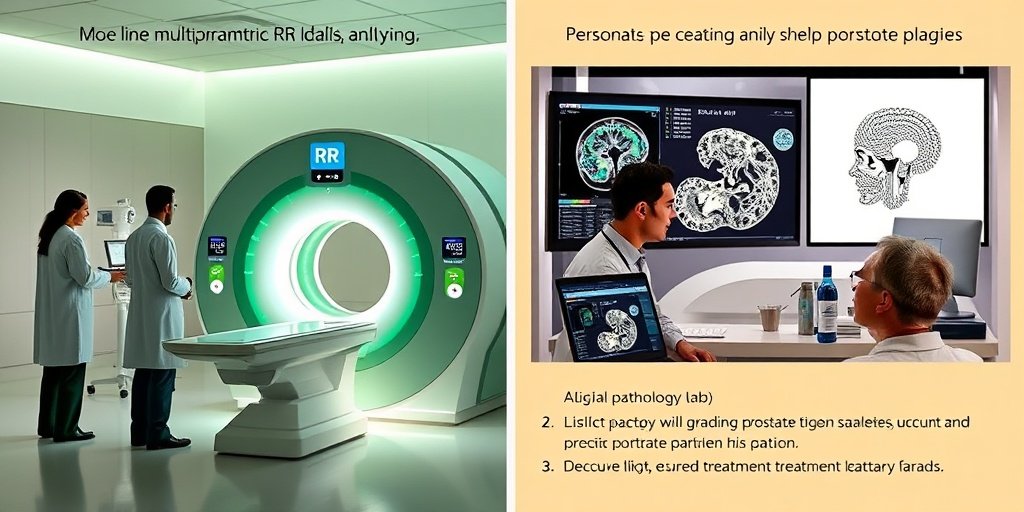
This review meticulously examines the innovations brought about by AI in the screening and diagnosis of prostate cancer. It discusses how deep learning algorithms enhance the interpretation of mpMRI, improve lesion detection, and facilitate risk stratification, thereby reducing the need for unnecessary biopsies. Furthermore, it highlights the role of AI in digital pathology, where it automates Gleason grading, thus refining prognostication.
📈 Results
The integration of AI technologies has shown promising results in enhancing diagnostic accuracy and personalizing treatment strategies. For instance, AI-driven tools have been pivotal in streamlining radiotherapy planning, predicting patient outcomes, and minimizing inter-observer variability in Gleason grading. These advancements signify a move towards a more efficient and precise approach to prostate cancer management.
🌍 Impact and Implications
The implications of this review are profound. By leveraging AI, healthcare professionals can achieve greater precision in prostate cancer detection and management, ultimately leading to improved patient outcomes. The potential for AI to create robust predictive tools through multimodal data synthesis could revolutionize clinical decision-making, making it more personalized and effective.
🔮 Conclusion
This comprehensive review underscores the transformative potential of AI in prostate cancer detection and management. As we continue to explore the integration of AI technologies in healthcare, it is crucial to address the challenges of validation and regulatory approval to fully realize the benefits of these innovations. The future of prostate cancer care looks promising, with AI paving the way for a new standard characterized by precision and personalization.
💬 Your comments
What are your thoughts on the integration of AI in prostate cancer detection and management? We would love to hear your insights! 💬 Leave your comments below or connect with us on social media:
Utilization of artificial intelligence in prostate cancer detection: a comprehensive review of innovations in screening and diagnosis.
Abstract
Prostate cancer management has long been challenged by the limitations of traditional screening tools like PSA testing, which contribute to significant rates of overdiagnosis and overtreatment. While advanced imaging such as multiparametric MRI (mpMRI) has improved the diagnostic pathway, the integration of Artificial Intelligence (AI) is now catalyzing a paradigm shift across the entire continuum of care. This comprehensive review details the transformative role of AI in prostate cancer. In diagnostics, deep learning algorithms enhance the interpretation of mpMRI by improving lesion detection, segmentation, and risk stratification, thereby reducing unnecessary biopsies. In digital pathology, AI provides automated and consistent Gleason grading, minimizing inter-observer variability and refining prognostication. In the therapeutic domain, AI is crucial for personalizing treatment by streamlining radiotherapy planning through automated contouring, predicting patient outcomes and toxicity, and enabling the development of adaptive therapy strategies for advanced disease. Multimodal AI models that synthesize imaging, biomarker, and clinical data are creating robust predictive tools for superior clinical decision support. Despite formidable challenges related to prospective validation, data equity, and regulatory approval, AI is paving the way for a new standard of care characterized by greater precision, efficiency, and personalization.
Author: [‘Rajih E’, ‘Bakhsh A’, ‘Borhan WM’, ‘Alqahtani SAM’]
Journal: Front Immunol
Citation: Rajih E, et al. Utilization of artificial intelligence in prostate cancer detection: a comprehensive review of innovations in screening and diagnosis. Utilization of artificial intelligence in prostate cancer detection: a comprehensive review of innovations in screening and diagnosis. 2025; 16:1670671. doi: 10.3389/fimmu.2025.1670671