⚡ Quick Summary
The recent symposium at the 2024 Temerty Centre for AI Research and Education in Medicine highlighted the transformative potential of multimodal artificial intelligence (AI) in healthcare, while also addressing significant challenges in its adoption. Key applications discussed include early diagnosis in sepsis and cardiology, emphasizing the need for responsible implementation to enhance patient outcomes.
🔍 Key Details
- 📅 Event: 2024 Temerty Centre symposium, June 17, 2024
- 🌐 Location: Toronto, Canada
- 🧠 Focus: Multimodal AI in healthcare
- 🔍 Applications: Early diagnosis of sepsis and cardiology
- ⚠️ Challenges: Data heterogeneity, integration complexities
🔑 Key Takeaways
- 🤖 Multimodal AI can process diverse data types, enhancing clinical decision-making.
- ⚙️ Key barriers include fusion techniques, model selection, and generalization.
- ⚖️ Fairness and safety are critical considerations for responsible AI deployment.
- 🌍 International collaboration is essential for equitable healthcare solutions.
- 💡 Federated learning is a promising technology to reduce bias in AI models.
- 🏥 Successful implementation could significantly improve patient outcomes globally.
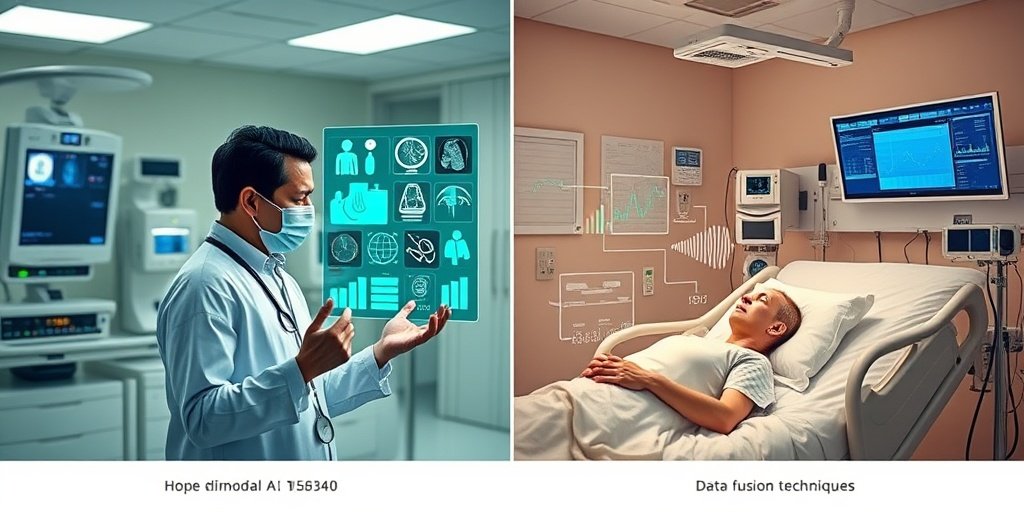
📚 Background
The integration of multimodal AI in healthcare represents a significant advancement in how clinicians can utilize various data modalities—such as patient history, clinical signs, imaging, and laboratory results—to enhance decision-making processes. However, the path to effective clinical adoption is fraught with challenges, primarily due to the complexities of data integration and the need for robust AI models that can generalize across diverse patient populations.
🗒️ Study
The symposium convened experts to discuss the current landscape of multimodal AI applications in healthcare. Notable discussions included the use of AI for the early diagnosis of conditions like sepsis and advancements in cardiology. The participants identified key barriers to implementation, including the need for effective fusion techniques and model selection that ensure fairness and safety in AI applications.
📈 Results
Insights from the symposium revealed that while multimodal AI holds great promise, significant hurdles remain. The discussions underscored the importance of developing fusion techniques that can effectively integrate various data types and the necessity for models that can generalize well across different clinical settings. The emphasis on federated learning as a strategy to mitigate bias was particularly noteworthy, highlighting a pathway toward more equitable healthcare solutions.
🌍 Impact and Implications
The implications of successfully integrating multimodal AI into clinical practice are profound. By addressing the identified challenges, healthcare systems can leverage AI to enhance diagnostic accuracy and improve patient outcomes on a global scale. The potential for AI to transform clinical practice is immense, paving the way for more personalized and effective healthcare solutions.
🔮 Conclusion
The discussions at the symposium illustrate the transformative potential of multimodal AI in healthcare, alongside the critical challenges that must be addressed for responsible adoption. As we move forward, it is essential to prioritize strategies that promote fairness, safety, and equity in AI deployment, ensuring that these technologies benefit all patients. The future of healthcare could be significantly enhanced through the responsible integration of AI technologies.
💬 Your comments
What are your thoughts on the integration of multimodal AI in healthcare? We would love to hear your insights! 💬 Join the conversation in the comments below or connect with us on social media:
Responsible adoption of multimodal artificial intelligence in health care: promises and challenges.
Abstract
Clinicians rely on various data modalities-such as patient history, clinical signs, imaging, and laboratory results-to improve decision making. Multimodal artificial intelligence (AI) systems are emerging as powerful tools to process these diverse data types; however, the clinical adoption of multimodal AI systems is challenging because of data heterogeneity and integration complexities. The 2024 Temerty Centre for AI Research and Education in Medicine symposium, held on June 17, 2024, in Toronto, Canada, explored the potential and challenges of implementing multimodal AI in health care. In this Review, we summarise insights from the symposium. We discuss current applications, such as those used in early diagnosis of sepsis and cardiology, and identify key barriers, including fusion techniques, model selection, generalisation, fairness, safety, security, and international considerations on the responsible deployment of multimodal AI in health care. We outline practical strategies to overcome these obstacles, emphasising technologies such as federated learning to reduce bias and promote equitable health care. By addressing these challenges, multimodal AI can transform clinical practice and improve patient outcomes worldwide.
Author: [‘Azarfar G’, ‘Naimimohasses S’, ‘Rambhatla S’, ‘Komorowski M’, ‘Ferro D’, ‘Lewis PR’, ‘Gates D’, ‘Shara N’, ‘Gascon GM’, ‘Chang A’, ‘Mamdani M’, ‘Bhat M’, ‘Alliance of Centers of Artificial Intelligence in Medicine working group’]
Journal: Lancet Digit Health
Citation: Azarfar G, et al. Responsible adoption of multimodal artificial intelligence in health care: promises and challenges. Responsible adoption of multimodal artificial intelligence in health care: promises and challenges. 2025; (unknown volume):100917. doi: 10.1016/j.landig.2025.100917