⚡ Quick Summary
This study developed and evaluated deep learning-based 3D models for the automated segmentation of dental hard tissues and pulp in pediatric CBCT scans with mixed dentition. The 3D_fullres ResEncM architecture demonstrated the highest accuracy, particularly in segmenting permanent teeth.
🔍 Key Details
- 📊 Dataset: 151 CBCT scans, including 105 internal and 46 external scans
- 🧩 Features used: Expert-annotated images for training and validation
- ⚙️ Technology: Multi-architecture deep learning models (CNN, Transformer, Mamba)
- 🏆 Performance metrics: DSC, IoU, HD95, segmentation volume, processing time
🔑 Key Takeaways
- 📊 ResEncM achieved the highest accuracy across all structures and age groups.
- 💡 Permanent teeth segmentation was most reliable in ages 6-9 with a DSC of 0.9859.
- 👶 Primary teeth segmentation accuracy decreased in older children, particularly ages 10-13.
- 🏆 U-Mamba Bot excelled in pulp segmentation, while U-Mamba Enc performed well for primary structures.
- 📉 External validation showed ResEncM maintained a DSC of 0.8464.
- ⏱️ UNETR was the fastest model, processing in 0.48 minutes.
- 🌍 All models demonstrated high volumetric correlations and no significant volume bias.
- 🤖 AI-assisted analysis can enhance workflow efficiency in pediatric dental imaging.
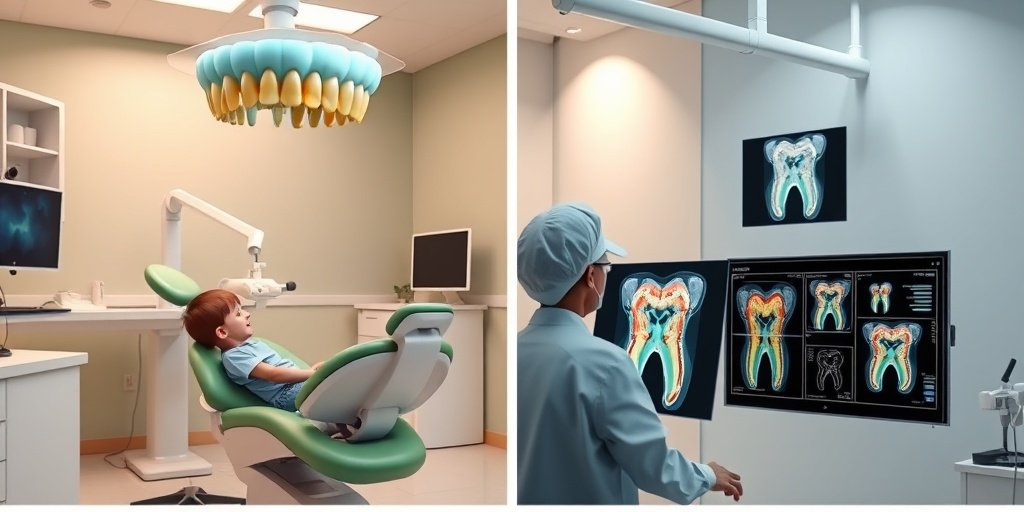
📚 Background
The segmentation of dental hard tissues and pulp in pediatric patients is crucial for effective diagnosis and treatment planning. Traditional methods can be time-consuming and subjective. The integration of deep learning technologies into dental imaging presents an opportunity to automate and enhance the accuracy of these processes, particularly in cases involving mixed dentition.
🗒️ Study
This study analyzed a total of 151 CBCT scans, utilizing a combination of internal and external datasets. The researchers developed fully supervised multi-task models to segment pulp, primary, and permanent dental structures. Six different architectures were evaluated to determine their effectiveness in segmentation tasks.
📈 Results
The 3D_fullres ResEncM architecture emerged as the top performer, achieving remarkable accuracy in segmenting permanent teeth. The results indicated a DSC of 0.9859 for ages 6-9 and 0.9825 for ages 10-13. In contrast, primary teeth segmentation was less accurate, particularly in older children, highlighting the need for further refinement in this area.
🌍 Impact and Implications
The findings from this study have significant implications for pediatric dentistry. By streamlining the segmentation process through automated methods, dental professionals can enhance their workflow efficiency, particularly in managing developing teeth and complex orthodontic or surgical cases. This research lays the groundwork for incorporating AI-assisted analysis into routine pediatric dental imaging, potentially improving patient outcomes.
🔮 Conclusion
The study highlights the potential of deep learning models in revolutionizing the segmentation of dental structures in pediatric patients. The strong performance of the nnU-Net ResEncM, along with the specialized capabilities of U-Mamba Bot and U-Mamba Enc, suggests a promising future for automated CBCT segmentation. Continued research in this area is essential to further enhance accuracy and applicability in clinical settings.
💬 Your comments
What are your thoughts on the integration of AI in pediatric dental imaging? We would love to hear your insights! 💬 Leave your comments below or connect with us on social media:
Multi-Architecture Deep Learning for CBCT Segmentation of Dental Hard Tissues and Pulp in Mixed Dentition.
Abstract
OBJECTIVE: To develop and evaluate deep learning-based 3D models (CNN, Transformer, and Mamba architectures) for automated segmentation of pulp, primary, and permanent dental structures in pediatric CBCT scans with mixed dentition.
METHODS: A total of 151 CBCT scans were analyzed, comprising 105 internal dataset scans(29,478 images) and 46 external scans. Expert-annotated internal data were used for model development with 78 for training/validation and 27 for testing. Fully supervised multi-task models were trained to segment pulp, primary and permanent hard tissue structures. Six architectures (ResEncM, U-Mamba Bot/Enc, WNet, UNETR, SegResNet) were evaluated using DSC, IoU, HD95, segmentation volume, and processing time.
RESULTS: Within the internal dataset, 3D_fullres ResEncM achieved the highest accuracy across structures and age groups. Permanent teeth were segmented most reliably (ages 6-9: DSC 0.9859 ± 0.0086, HD95 0.2035 ± 0.0925; ages 10-13: DSC 0.9825 ± 0.0100, HD95 0.2825 ± 0.0525), while primary teeth were less accurate, particularly in older children (10-13 years: DSC 0.8855 ± 0.1557, HD95 4.4201 ± 6.5116). U-Mamba Bot and U-Mamba Enc performed well, with U-Mamba Bot excelling in pulp segmentation and U-Mamba Enc in primary structures. WNet, UNETR, and SegResNet were less consistent, especially for primary teeth in older children. In external validation, ResEncM maintained the highest DSC (0.8464 ± 0.1226) and lowest HD95 (4.9078 ± 4.9058). All models showed no significant volume bias (p > 0.05) and high volumetric correlations (ρ ≥ 0.997). UNETR was fastest (0.48 ± 0.38 min), followed by U-Mamba Bot (0.60 ± 0.40 min).
CONCLUSION: nnU-Net ResEncM showed the strongest overall performance, while U-Mamba Bot and U-Mamba Enc excelled in pulp and primary-tooth segmentation. All three models performed well across age groups, with primary tooth segmentation more accurate in younger children. External testing confirmed adequate performance, though lower than on the internal dataset, supporting the feasibility of automated CBCT segmentation.
CLINICAL SIGNIFICANCE: Automated segmentation of pulp and hard dental structures can streamline CBCT assessment and enhance workflow efficiency in managing developing teeth and complex orthodontic or surgical cases. This study provides a framework for incorporating AI-assisted analysis into pediatric dental imaging by including both primary and developing permanent dentition, as well as anomalous cases.
Author: [‘Baraka M’, ‘Elbadry E’, ‘Abourida O’, ‘Albaradi A’, ‘Wagih Y’, ‘Gamal M’, ‘Torki M’]
Journal: J Dent
Citation: Baraka M, et al. Multi-Architecture Deep Learning for CBCT Segmentation of Dental Hard Tissues and Pulp in Mixed Dentition. Multi-Architecture Deep Learning for CBCT Segmentation of Dental Hard Tissues and Pulp in Mixed Dentition. 2026; (unknown volume):106344. doi: 10.1016/j.jdent.2026.106344