⚡ Quick Summary
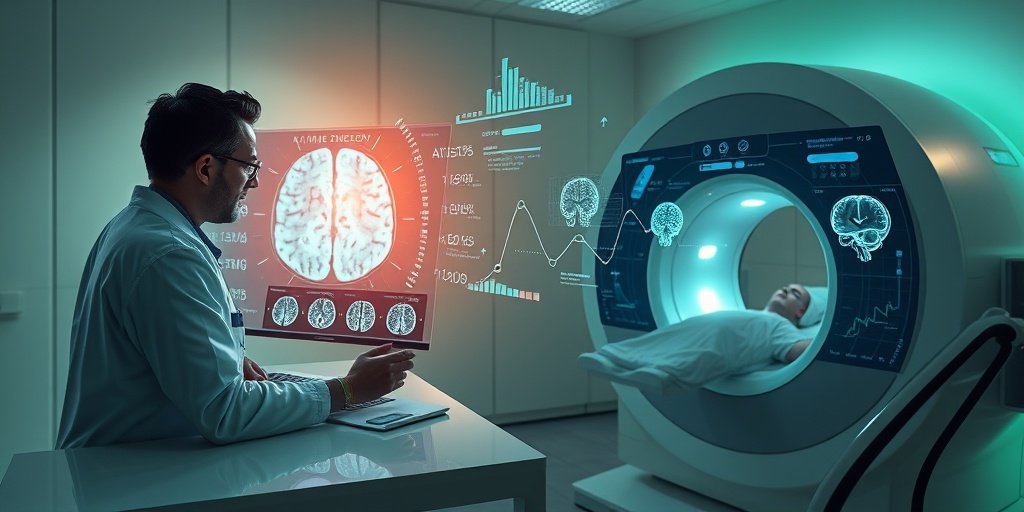
This study developed a radiomics-based MRI model to differentiate between brain parenchymal tuberculoma (BT) and brain metastases (BM) from lung cancer. The model demonstrated an impressive AUC of 0.986 for patient-level diagnosis, significantly enhancing diagnostic accuracy.
🔍 Key Details
- 📊 Dataset: 175 patients (97 with BT, 78 with BM), 1014 lesions analyzed
- 🧩 Features used: MRI sequences including T1-weighted imaging with contrast (T1WI+C) and fluid-attenuated inversion recovery (FLAIR)
- ⚙️ Technology: Radiomics and SHAP analysis for model interpretability
- 🏆 Performance: T1WI+C model AUC: 0.932 (training), 0.933 (testing); RMCM AUC: 0.986 (training), 0.958 (testing)
🔑 Key Takeaways
- 🧠 Radiomics models can effectively distinguish between BT and BM, addressing diagnostic challenges.
- 📈 The T1WI+C model outperformed the FLAIR model in diagnostic accuracy.
- 🔍 Incorporating clinical features into the RMCM significantly enhances diagnostic performance.
- 💡 SHAP analysis provided insights into the model’s interpretability, highlighting key contributing features.
- 🏥 Study conducted at Hangzhou Red Cross Hospital from January 2018 to March 2024.
- 📅 Retrospective study design with a training-test split of 7:3.
- 🌍 Potential for broader applications in clinical decision-making for brain lesions.
📚 Background
Differentiating between brain parenchymal tuberculoma and brain metastases is crucial for effective treatment, yet current diagnostic methods often fall short due to overlapping clinical and imaging features. This study addresses the need for improved diagnostic tools in neuro-oncology, particularly for patients with lung cancer.
🗒️ Study
The research involved a comprehensive analysis of MRI images from 175 patients treated at Hangzhou Red Cross Hospital. The study aimed to develop a robust radiomics-based model that could accurately differentiate between BT and BM, utilizing advanced imaging techniques and machine learning methodologies.
📈 Results
The study found that the T1WI+C model achieved an impressive AUC of 0.932 in the training set and 0.933 in the test set, indicating high diagnostic performance. The RMCM, which integrated clinical and radiological features, reached an AUC of 0.986 in training and 0.958 in testing, showcasing its potential as a reliable diagnostic tool.
🌍 Impact and Implications
The findings from this study could significantly impact clinical practice by providing a more accurate and interpretable tool for differentiating between BT and BM. This advancement not only enhances diagnostic accuracy but also supports better clinical decision-making, ultimately improving patient outcomes in neuro-oncology.
🔮 Conclusion
This research highlights the transformative potential of radiomics-based MRI models in the field of neuro-oncology. By effectively distinguishing between BT and BM, these models pave the way for more personalized treatment approaches. Continued exploration and validation of such technologies are essential for advancing patient care in this critical area.
💬 Your comments
What are your thoughts on the use of radiomics in differentiating brain lesions? We would love to hear your insights! 💬 Leave your comments below or connect with us on social media:
MRI quantitative imaging biomarkers in differentiating brain parenchymal tuberculoma and lung cancer brain metastases.
Abstract
BACKGROUND: Brain parenchymal tuberculoma (BT) and brain metastases (BM) originating from lung cancer often exhibit overlapping clinical and imaging features, making accurate differentiation challenging. Current diagnostic approaches remain suboptimal.
PURPOSE: This study aimed to develop a radiomics-based MRI model to differentiate BT from BM and enhance model interpretability using Shapley Additive Explanations (SHAP) analysis.
MATERIAL AND METHODS: This retrospective study involved 175 patients (97 with BT and 78 with BM) treated at Hangzhou Red Cross Hospital from January 2018 to March 2024, encompassing 1014 lesions (581 in BT and 433 in BM). Patients were randomly divided into training (n = 122) and test sets (n = 53) in a 7:3 ratio. MRI images were segmented and preprocessed for radiomics feature extraction. Feature selection was performed using recursive feature elimination. Logistic regression models were developed based on features from contrast-enhanced T1-weighted imaging (T1WI+C) and fluid-attenuated inversion recovery (FLAIR) sequences. Three predictive models were assessed using the area under the receiver operating characteristic curve (AUC): the optimal radiomics model, a combined clinical-radiological model, and an integrated radiomics and multi-clinical model (RMCM).
RESULTS: Following feature selection, the FLAIR and T1WI+C models retained six and four essential radiomic features, respectively. At the lesion level, the T1WI+C model achieved superior performance (AUC: 0.932 in the training set; 0.933 in the test set) compared to the FLAIR model (AUC: 0.824 and 0.869, respectively). At the patient level, the RMCM, incorporating eight clinical-radiological features such as CEA, age, and peritumoral edema, showed superior diagnostic performance (AUC: 0.986 in training; 0.958 in testing). SHAP analysis highlighted the radiomics score as the key contributor to its diagnostic value.
CONCLUSIONS: A radiomics model based on T1WI+C MRI sequences effectively distinguishes BT from BM. Incorporating clinical and radiological features into the RMCM further improves diagnostic accuracy, offering a robust, interpretable tool to aid clinical decision-making.
Author: [‘Wang A’, ‘Qiu X’, ‘Chen Q’, ‘Qiu Y’, ‘Wang Y’, ‘Hu Y’, ‘Wang J’, ‘Zhan M’, ‘Zhu H’]
Journal: Eur J Med Res
Citation: Wang A, et al. MRI quantitative imaging biomarkers in differentiating brain parenchymal tuberculoma and lung cancer brain metastases. MRI quantitative imaging biomarkers in differentiating brain parenchymal tuberculoma and lung cancer brain metastases. 2025; 30:1239. doi: 10.1186/s40001-025-03476-5