Testing AI mental health screening in Nigeria.
An AI screening tool tested in Nigeria shows that local language translation and human oversight can bridge massive gaps in mental health care.
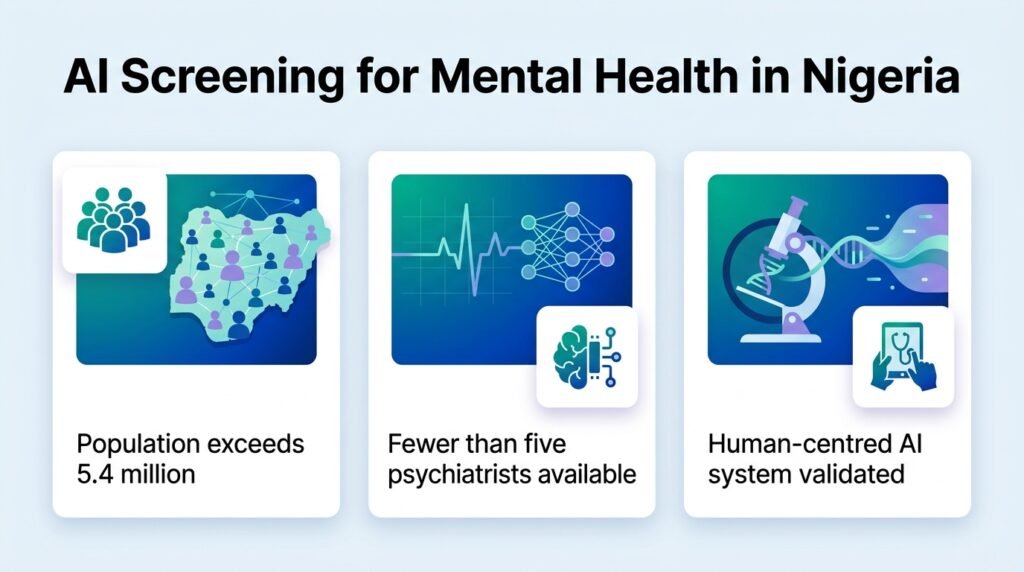
How do you scale mental health care when five million people share fewer than five psychiatrists? This is the stark reality in Sokoto State, Nigeria. It forces us to rethink how AI tools should be deployed in under-resourced regions.
The LUMANA field validation suggests that the future of global health AI is not fully autonomous. Instead, success lies in tight human-AI integration and deep cultural tailoring. This mirrors similar co-design efforts in East Africa, such as Kenya’s Imarisha Afya ya Akili chatbot.
The human guardrail requirement
The study, conducted in January 2026, enrolled **20** stakeholders. Of these, **17** completed evaluations using **eight** clinical scenarios. The results show a strong preference for human oversight.
While **83%** of the 136 AI outputs were acceptable out of the box, **17%** required human modification. Crucially, **100%** of evaluators agreed that any mention of self-harm or suicide must trigger human clinician involvement. Furthermore, **82%** of participants noted that religion and culture are vital to building trust in the tool.
This feedback highlights why generic, Western-centric models fail in local contexts. AI cannot simply be dropped into a new region without adjusting for local belief systems. If the software does not respect religious and cultural values, patients will simply reject it, no matter how accurate the underlying algorithm is.
High marks for local language
LUMANA succeeded largely because of its strong linguistic performance in the local Hausa language. High-quality translation is critical for patient safety and trust.
- The system scored **9.9/10** for Hausa transcription.
- It achieved **9.9/10** for Hausa-to-English translation.
- English-to-Hausa summary generation scored **9.2/10**.
- Clinicians felt comfortable with the workflow in **88%** of the scenarios.
These high linguistic scores are impressive. They show that localized language processing is no longer a major technical barrier. This aligns with broader efforts like India’s Sanjeevani × AI platform, which also emphasizes localized clinical intelligence. The high comfort rate of **88%** in workflow integration suggests that frontline workers are eager for digital support. However, this comfort is contingent on the AI acting as an assistant, not a replacement.
The limits of simulation
We must remain cautious about these findings. The validation relied on a small convenience sample of **17** evaluators reacting to pre-written scenarios. It did not test the tool during live, unpredictable clinical encounters.
Before a wider rollout, the system needs three key upgrades. It requires clearer distress protocols, less stigmatizing language, and automatic escalation for psychotic symptoms. Only after these fixes are tested in real-world pilots can we truly judge its safety.
Read the full study in medRxiv.