Overview
Recent advancements in the field of bionic prosthetics have been made by researchers at the Medical University of Vienna and Imperial College London. They have introduced a method to effectively detect nerve signals that remain after an arm amputation, enabling control of artificial limbs.
Key Findings
- The study, published in Nature Biomedical Engineering, highlights a new technique that could pave the way for next-generation prosthetics.
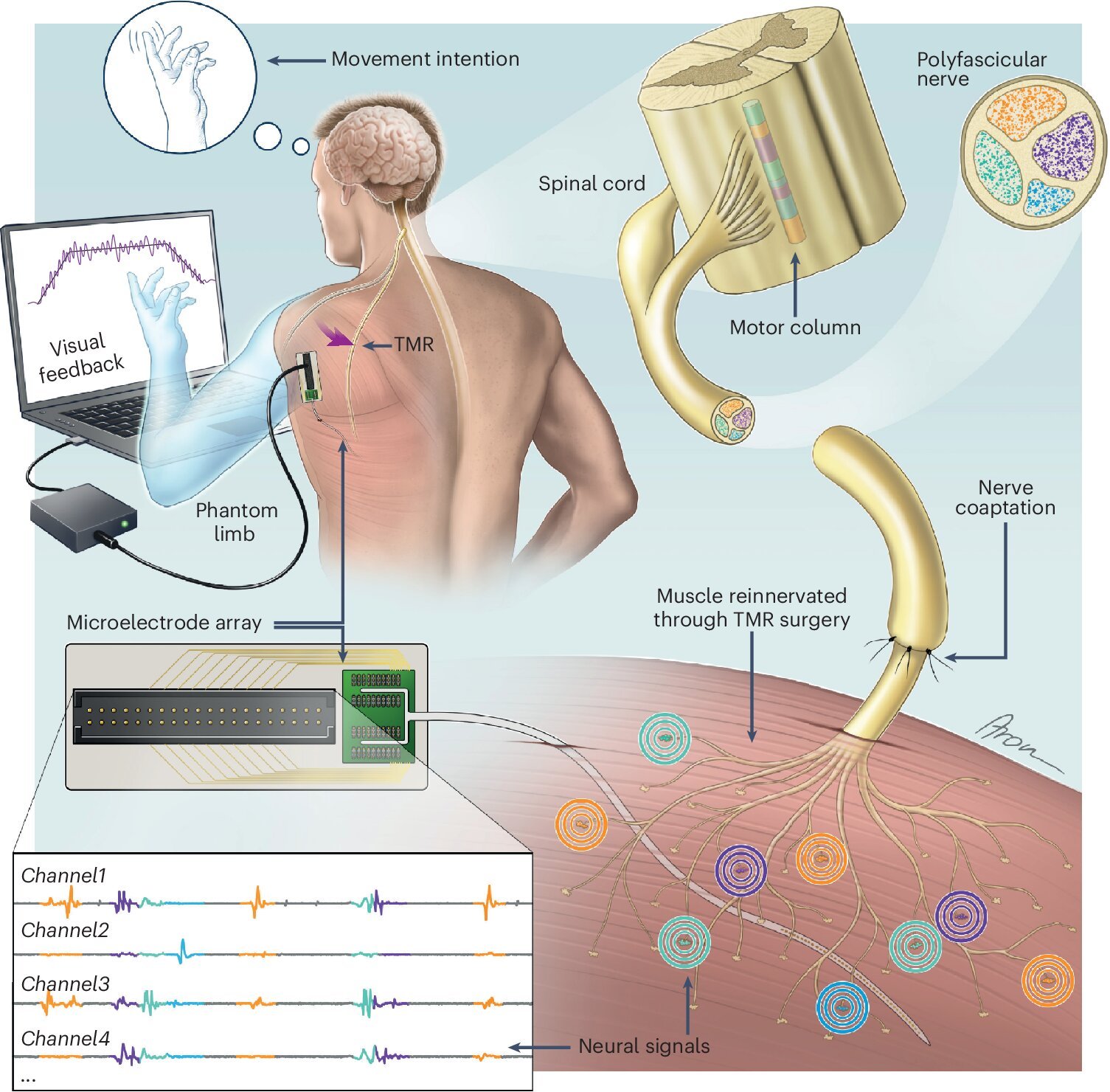
- As part of the Natural BionicS project, 40-channel microelectrodes were implanted in the muscles of three arm amputees, who had undergone targeted muscle reinnervation (TMR).
- TMR is a surgical procedure that redirects remaining nerve pathways to existing muscles, creating new interfaces for neural signal retrieval.
Methodology
By integrating surgical reinnervation with implantable microelectrodes, the researchers successfully measured the activity of individual motor neurons for the first time. This allowed them to link specific nerve signal patterns to distinct movement intentions. Participants were asked to mentally simulate various movements with their phantom arm, leading to the identification of nerve signals associated with actions such as:
- Stretching a finger
- Bending the wrist
Implications
The analysis revealed that complex movement intentions remain intact in the nervous system post-amputation and can be mathematically reconstructed. This discovery is significant for the future control of bionic prostheses, making their operation more natural and intuitive.
Future Developments
Looking ahead, the research aims to develop a bioscreen—a system that visualizes complex neural patterns of human movements. This will serve as a foundation for advanced prosthetics. Additionally, ongoing research is focused on creating wireless implants capable of transmitting nerve signals in real-time to bionic hands and other assistive devices.
For further details, refer to the study by Ferrante et al. in Nature Biomedical Engineering (2025).