⚡ Quick Summary
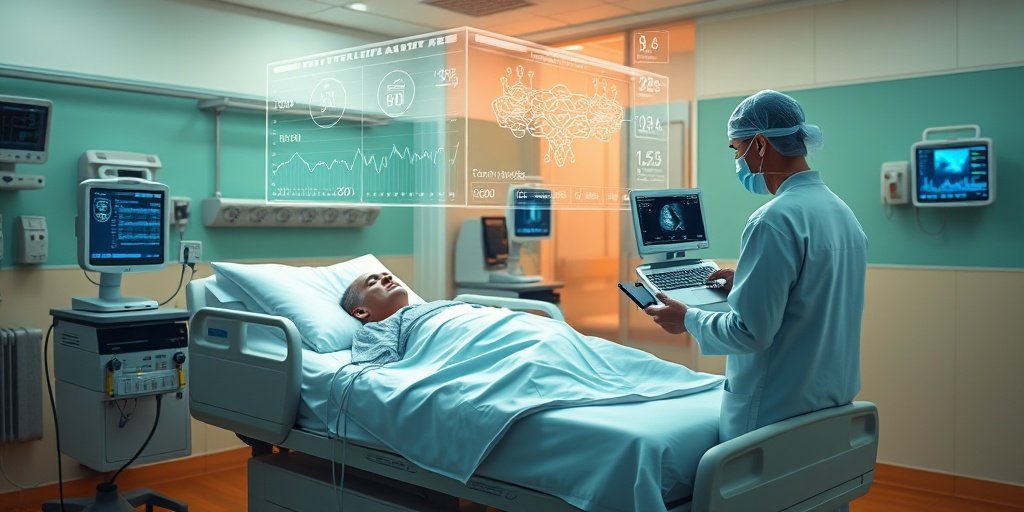
The article explores the transformative impact of technological innovation and telemedicine in critical care medicine, highlighting advancements such as AI-enhanced decision support and tele-ICU platforms. These innovations are paving the way for personalized and anticipatory care in modern intensive care units (ICUs).
🔍 Key Details
- 📊 Focus: Evolution of critical care through technology and telemedicine
- 🧩 Innovations: AI decision support, portable ultrasound, tele-ICU
- ⚙️ Environment: Data-rich, precision-focused ICUs
- 🏆 Goals: Improve diagnostic accuracy, remote access, and timely interventions
🔑 Key Takeaways
- 📈 Technological advancements are reshaping critical care practices.
- 🤖 AI-enhanced tools are improving decision-making processes in ICUs.
- 🌐 Telemedicine is facilitating remote monitoring and interventions.
- 📊 Smart ICUs are becoming more common, integrating various technologies.
- 💡 Wearable biosensors are enhancing patient monitoring capabilities.
- 🔍 Evidence-based adoption is crucial for ensuring positive patient outcomes.
- 📅 Historical milestones provide context for current innovations.
- 🌍 Global implications for healthcare delivery and patient care.
📚 Background
The field of critical care medicine is experiencing a significant transformation, driven by rapid advancements in technology and the integration of digital tools. As healthcare systems strive to provide better patient outcomes, the role of telemedicine and innovative technologies becomes increasingly vital. This evolution is not just about adopting new tools but also about fundamentally changing how care is delivered in intensive care units (ICUs).
🗒️ Study
The article reviews the historical context and current trends in critical care, focusing on how modern ICUs are evolving into data-rich environments. It discusses the integration of technologies such as AI-enhanced decision support systems, portable ultrasound, and tele-ICU platforms, which are designed to improve diagnostic accuracy and facilitate timely interventions for critically ill patients.
📈 Results
The findings indicate that the incorporation of these technologies leads to a shift toward anticipatory and personalized care. By leveraging advanced monitoring systems and predictive analytics, healthcare providers can make more informed decisions, ultimately enhancing patient outcomes in critical care settings.
🌍 Impact and Implications
The implications of this study are profound. As critical care medicine continues to embrace technological advancements, the potential for improved patient care becomes increasingly evident. The integration of telemedicine and innovative technologies not only enhances the capabilities of healthcare providers but also ensures that patients receive timely and effective interventions, regardless of their location.
🔮 Conclusion
This article highlights the transformative potential of technology in critical care medicine. By adopting innovative tools and practices, healthcare professionals can deliver more personalized and effective care to critically ill patients. The future of critical care looks promising, with technology playing a central role in enhancing patient outcomes and healthcare delivery.
💬 Your comments
What are your thoughts on the integration of technology in critical care? We would love to hear your insights! 💬 Share your comments below or connect with us on social media:
Innovation, Technology, and Telemedicine in Critical Care.
Abstract
Critical care medicine is undergoing a major transformation driven by rapid technological innovation, digital integration, and telemedicine. This article examines how modern intensive care units (ICUs) are evolving into data-rich, precision environments equipped with advanced monitoring, organ support, and predictive analytics. Innovations such as artificial intelligence-enhanced decision support, portable ultrasound, and tele-ICU platforms are expanding diagnostic accuracy, remote access, and timely interventions. By tracing historical milestones to emerging technologies like smart ICUs and wearable biosensors, this article highlights the shift toward anticipatory, personalized care. It underscores the importance of evidence-based adoption to ensure these tools improve outcomes.
Author: [‘Shaikh A’, ‘Patel D’, ‘Sakhuja A’]
Journal: Crit Care Clin
Citation: Shaikh A, et al. Innovation, Technology, and Telemedicine in Critical Care. Innovation, Technology, and Telemedicine in Critical Care. 2026; 42:347-360. doi: 10.1016/j.ccc.2025.11.003