⚡ Quick Summary
The article explores the transformative potential of Industry 6.0 in orthopaedics, emphasizing the integration of AI, robotics, and hyper-personalization to enhance surgical care. It highlights how these advancements can lead to safer, more efficient, and individualized treatment options for patients.
🔍 Key Details
- 📊 Focus: Applications of Industry 6.0 in orthopaedics
- 🧩 Technologies: AI-driven diagnostics, robotic-assisted surgery, patient-specific implants, wearable monitoring systems, AR/VR interfaces
- 📅 Literature Review: Comprehensive search conducted up to October 2025
- 🏆 Key Findings: Enhanced surgical planning, patient-specific simulations, continuous monitoring, and secure data management
🔑 Key Takeaways
- 🤖 AI and robotics enable seamless human-AI collaboration in surgeries.
- 🌐 Digital twins facilitate personalized peri-operative planning.
- 🖨️ 3D printing supports the creation of customized implants.
- 📈 IoT wearables provide real-time data for rehabilitation and recovery.
- 🔒 Blockchain ensures secure and interoperable data management.
- 💡 Industry 6.0 aims to shift orthopaedic care from reactive to preventative approaches.
- ⚠️ Challenges include high costs, regulatory gaps, and cybersecurity concerns.
- 🌍 Future potential for redefining orthopaedic care through technology integration.
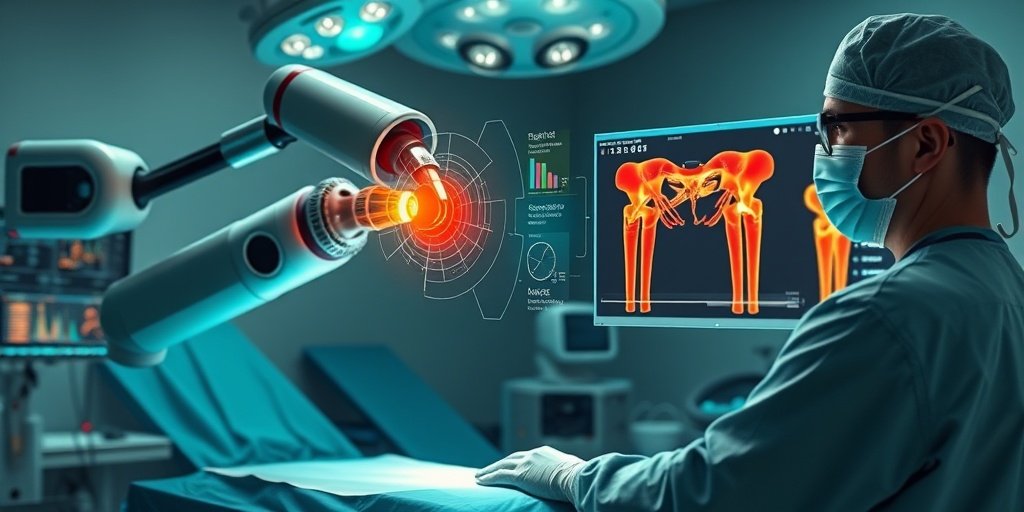
📚 Background
The evolution of technology in healthcare has reached a pivotal moment with the advent of Industry 6.0. This new paradigm integrates cutting-edge technologies such as artificial intelligence, robotics, and predictive analytics to create systems that are not only adaptive but also precision-driven. In orthopaedics, these advancements promise to enhance patient outcomes through hyper-personalized and autonomous surgical care.
🗒️ Study
The authors conducted a thorough review of existing literature on Industry 6.0 technologies relevant to orthopaedics, focusing on their current applications and future trajectories. The study synthesized findings from multiple databases, including PubMed and Scopus, to provide a comprehensive overview of how these technologies are reshaping surgical practices in trauma and orthopaedics.
📈 Results
The review revealed that AI systems and robotic platforms significantly enhance surgical planning and execution. The use of digital twins allows for patient-specific simulations, while advanced 3D printing techniques enable the creation of personalized implants. Additionally, IoT-enabled wearables and smart implants offer continuous insights into patient recovery, and blockchain technology provides a secure framework for data management.
🌍 Impact and Implications
The implications of Industry 6.0 in orthopaedics are profound. By leveraging these technologies, healthcare providers can transition from traditional, standardized interventions to a model that emphasizes hyper-personalization and preventative care. This shift not only enhances patient safety and efficiency but also paves the way for a more individualized approach to surgical care, ultimately improving patient outcomes and satisfaction.
🔮 Conclusion
The exploration of Industry 6.0 capabilities in orthopaedics highlights a significant opportunity to revolutionize surgical care. While challenges such as costs and regulatory issues remain, the potential for integrating multi-omics, predictive modeling, and human-centric design into orthopaedic practices is immense. The future of orthopaedic surgery is poised to be safer, more efficient, and tailored to the unique needs of each patient.
💬 Your comments
What are your thoughts on the integration of Industry 6.0 technologies in orthopaedics? We would love to hear your insights! 💬 Share your comments below or connect with us on social media:
Industry 6.0 capabilities in orthopaedics: Towards hyper-personalized and autonomous surgical care.
Abstract
BACKGROUND: Industry 6.0 represents the next frontier in technological evolution, integrating artificial intelligence (AI), autonomous robotics, digital twins, hyper-personalization, and predictive analytics to create adaptive, precision-driven systems. This comprehensive narrative review explores the current and emerging applications of Industry 6.0 in orthopaedics, focusing on AI-driven diagnostics, robotic-assisted surgery, patient-specific implants, wearable monitoring systems, and immersive Augmented Reality/Virtual Reality interfaces.
MATERIALS AND METHODS: A comprehensive electronic search was performed on the databases, PubMed, Embase, Scopus, and Web of Science, to identify Industry 6.0 relevant literature published up to October 2025. A narrative synthesis was undertaken to summarize its evolution, current clinical applications of each technology in trauma and orthopaedics, reported advantages, limitations, and regulatory considerations and future trajectories and integration models under the Industry 6.0 framework.
RESULTS: AI systems and Robotic platforms facilitate surgical planning with seamless, autonomous human-AI co-surgery. Digital twins allow patient-specific simulations for peri-operative planning. Advanced 3D printing and biomaterials support hyper-personalized implants and regenerative applications, while Internet of Things (IoT)-enabled wearables and smart implants provide continuous, data-driven insights into rehabilitation and recovery. Blockchain frameworks offer secure, interoperable data management.
CONCLUSION: Industry 6.0 offers a roadmap for safer, more efficient, and individualized orthopaedic surgery in the coming decade. Though barriers such as high costs, regulatory gaps, cybersecurity concerns, and integration challenges remain, the convergence of multi-omics, predictive modeling, and sustainable, human-centric design has the potential to redefine orthopaedic care from reactive, standardized intervention to hyper-personalized, autonomous, and preventative paradigms.
Author: [‘Regmi A’, ‘Jain V’, ‘Baral S’, ‘Jain VK’, ‘Iyengar KP’]
Journal: J Orthop
Citation: Regmi A, et al. Industry 6.0 capabilities in orthopaedics: Towards hyper-personalized and autonomous surgical care. Industry 6.0 capabilities in orthopaedics: Towards hyper-personalized and autonomous surgical care. 2026; 73:184-192. doi: 10.1016/j.jor.2025.11.042