⚡ Quick Summary
This study explores the potential of neuroadaptive artificial intelligence (NA-AI) and quantum-enhanced brain-computer interfaces (BCIs) to improve the assessment of consciousness in patients with disorders of consciousness (DoC). By leveraging these advanced technologies, the research aims to enhance the sensitivity, speed, and reliability of consciousness evaluations, potentially transforming clinical practices.
🔍 Key Details
- 🧠 Focus: Assessment of consciousness in patients with DoC
- ⚙️ Technologies: Neuroadaptive AI and quantum-enhanced BCIs
- 📈 Goals: Improve calibration, robustness, and personalized decoding of conscious intent
- 🔬 Study Type: Exploratory research with a focus on clinical applications
🔑 Key Takeaways
- 🤖 NA-AI can adapt in real-time to changes in individual neurophysiological signals.
- 🌌 Quantum-enhanced computation may alleviate computational bottlenecks in BCIs.
- 📊 Improved models can account for inter-individual variability in neural signals.
- 🏥 Potential for BCIs to reduce diagnostic uncertainty and improve patient outcomes.
- 🔍 Rigorous clinical validation is essential for safe deployment of these technologies.
- 💡 Ethical considerations must guide decision-making for patients unable to communicate.
- 🌍 Study published in Clin Neurol Neurosurg, highlighting its significance in neurology.
📚 Background
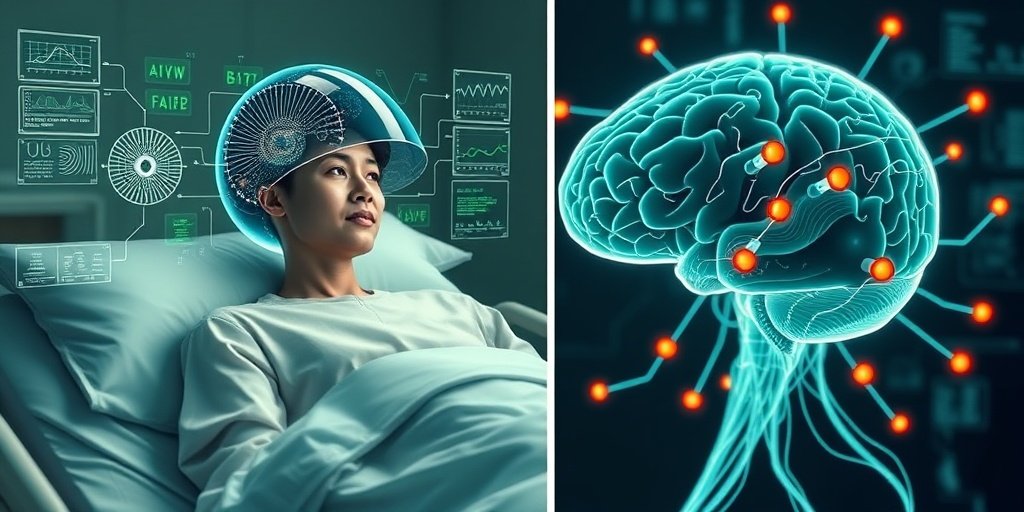
Assessing consciousness in patients with disorders of consciousness (DoC) is a complex challenge in clinical settings. Traditional methods often fall short, especially when motor impairments obscure signs of preserved awareness. The integration of advanced technologies like neuroadaptive AI and quantum computing offers a promising avenue to enhance the accuracy and reliability of these assessments, potentially leading to better patient care.
🗒️ Study
The study investigates how neuroadaptive AI can transform brain-computer interfaces (BCIs) from experimental tools into clinically scalable solutions. By continuously adjusting to the unique neurophysiological signals of each patient, these systems aim to provide a more personalized and accurate assessment of consciousness. The research also explores the role of quantum-enhanced machine learning in overcoming existing computational challenges in BCIs.
📈 Results
The findings suggest that the convergence of neuroadaptive AI and quantum computing could significantly enhance the sensitivity and speed of consciousness assessments. By enabling dynamic representations of a patient’s neurophysiology, these technologies allow for a more nuanced interpretation of neural activity, moving beyond static classifications of consciousness levels.
🌍 Impact and Implications
If validated, the integration of quantum-AI BCIs could revolutionize the way consciousness is assessed in clinical settings. This advancement has the potential to reduce diagnostic uncertainty, improve prognostication, and support ethically grounded decision-making for patients who cannot communicate. The implications for patient care and clinical practice are profound, paving the way for more informed and compassionate approaches to treatment.
🔮 Conclusion
This study highlights the transformative potential of combining neuroadaptive AI with quantum-enhanced computation in the assessment of consciousness. As research progresses, the hope is that these technologies will lead to more accurate, reliable, and ethical evaluations of consciousness in patients with DoC. The future of consciousness assessment looks promising, and further exploration in this field is essential.
💬 Your comments
What are your thoughts on the integration of AI and quantum technologies in assessing consciousness? We invite you to share your insights and engage in a discussion! 💬 Leave your comments below or connect with us on social media:
Improving consciousness assessment through neuroadaptive artificial intelligence and quantum-enhanced brain-computer interfaces.
Abstract
Accurate assessment of consciousness in patients with disorders of consciousness (DoC) remains a major clinical challenge, particularly when motor impairment masks evidence of preserved awareness. Recent advances in neuroadaptive artificial intelligence (NA-AI) may help transform brain-computer interfaces (BCIs) from experimental systems into more clinically scalable tools tailored to each patient, continuously adjusting their models in real time to changes in an individual’s (neuro)physiological signals. Generative and self-adapting AI models can account for inter-individual variability and temporal instability in neural signals, enabling faster calibration, improved robustness and personalized decoding of conscious intent. AI world-model approaches further enable realistic and dynamic representations of a patient’s neurophysiology, allowing BCIs to interpret neural activity in the context of evolving brain states rather than static classifications of consciousness levels. Emerging work in quantum-enhanced machine and deep learning suggests that some current computational bottlenecks in BCIs, including high-dimensional optimization and complex pattern discovery, may be further alleviated. We argue that the convergence of neuroadaptive AI and quantum-enabled computation could improve the sensitivity, speed and reliability of consciousness assessments. Given the exploratory stage of quantum-AI research, rigorous clinical validation and governance frameworks will be required to ensure safe deployment and improved patient outcomes. If validated, quantum-AI BCIs could reduce diagnostic uncertainty, improve prognostication and support ethically grounded decision-making for patients unable to communicate.
Author: [‘Oullier O’, ‘Roser F’, ‘Barbaste P’, ‘Vasques X’]
Journal: Clin Neurol Neurosurg
Citation: Oullier O, et al. Improving consciousness assessment through neuroadaptive artificial intelligence and quantum-enhanced brain-computer interfaces. Improving consciousness assessment through neuroadaptive artificial intelligence and quantum-enhanced brain-computer interfaces. 2026; 266:109396. doi: 10.1016/j.clineuro.2026.109396