⚡ Quick Summary
This study presents advanced neural network architectures for classifying motor-related EEG tasks, achieving an impressive classification accuracy of approximately 96%. The findings highlight the potential of these models in enhancing brain-computer interfaces (BCIs) for neurorehabilitation and assistive technologies.
🔍 Key Details
- 📊 Dataset: MILimbEEG dataset with recordings from 60 individuals
- 🧩 Tasks analyzed: Eight distinct motor movements including left and right hand closing, foot movements, and baseline
- ⚙️ Technology: Group Method of Data Handling (GMDH) neural network with eight hidden layers
- 🏆 Performance: Classification accuracy of approximately 96%
🔑 Key Takeaways
- 🧠 EEG signal classification is crucial for developing effective brain-computer interfaces.
- 💡 Advanced neural architectures like GMDH significantly improve the interpretation of EEG data.
- 📈 High precision in decoding brain activity can lead to better neurorehabilitation outcomes.
- 🔍 Comprehensive feature extraction from EEG signals enhances model performance.
- 🌟 This research contributes to the growing field of BCIs, promising new applications in assistive technologies.
📚 Background
The field of brain-computer interfaces (BCIs) has gained significant attention due to its potential to transform how individuals with motor impairments interact with their environment. Traditional methods of interpreting EEG signals have faced challenges in accuracy and reliability. However, advancements in neural network architectures offer new avenues for improving the classification of EEG data, paving the way for more effective neurorehabilitation strategies.
🗒️ Study
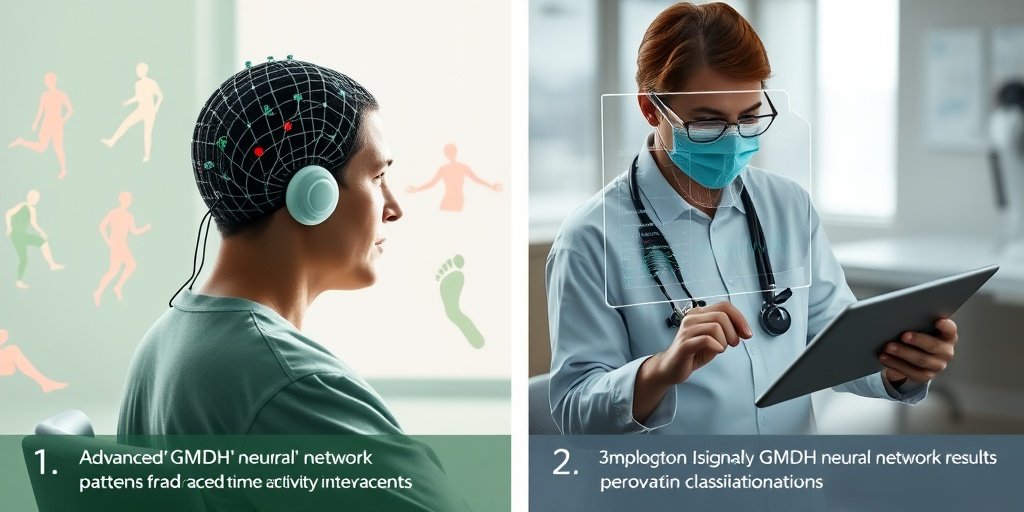
This study utilized the MILimbEEG dataset, which includes EEG recordings from 60 participants performing various motor tasks. The researchers extracted 10 critical features from each of the 16 electrodes, resulting in a total of 160 features per sample. The GMDH neural network, structured with eight hidden layers, was employed to classify these tasks, demonstrating the effectiveness of deep learning techniques in EEG signal analysis.
📈 Results
The GMDH network achieved a remarkable classification accuracy of approximately 96%, indicating its robust capability to decode EEG signals associated with specific motor actions. This high level of precision underscores the potential of advanced computational models in enhancing the interpretation of brain activity.
🌍 Impact and Implications
The implications of this research are profound. By improving the accuracy of EEG signal classification, we can enhance the functionality of brain-computer interfaces, making them more reliable for neurorehabilitation and assistive technologies. This advancement could lead to better clinical outcomes, enabling individuals with motor impairments to interact with devices more effectively and regain independence.
🔮 Conclusion
This study highlights the incredible potential of advanced neural architectures in the realm of EEG signal classification. With a classification accuracy of approximately 96%, the findings pave the way for more precise and effective brain-computer interfaces. As we continue to explore the integration of sophisticated computational models in neuroscience, the future looks promising for enhancing the quality of life for individuals with motor impairments.
💬 Your comments
What are your thoughts on the advancements in EEG signal classification for brain-computer interfaces? We invite you to share your insights and engage in a discussion! 💬 Leave your comments below or connect with us on social media:
High accuracy EEG signal classification for brain computer interfaces using advanced neural architectures.
Abstract
INTRODUCTION: This study proposes advanced neural network architectures for classifying specific motor-related electroencephalography (EEG) tasks, employing deep feature extraction techniques. We analyzed EEG data from the MILimbEEG dataset, consisting of recordings from 60 individuals as they performed eight distinct motor movements: baseline with eyes open, left-hand closing, right-hand closing, dorsiflexion and plantarflexion of both the left and right feet, as well as rest periods between tasks. The high precision achieved in this study underscores the efficacy of sophisticated computational models like the GMDH network in enhancing the interpretation of EEG signals for the development of brain-computer interfaces (BCIs). This research significantly advances the potential of EEG as a reliable modality for BCIs, effectively translating brain activity into actionable commands suitable for neurorehabilitation and assistive technologies.
METHODS: For each of the 16 electrodes used in the recordings, 10 critical features were extracted, resulting in a comprehensive set of 160 features per sample that encapsulate the intricate brain activities associated with each task. A Group Method of Data Handling (GMDH) neural network, structured with eight hidden layers and a decremental arrangement of neurons from 40 in the first to 5 in the last, was utilized to classify these tasks.
RESULTS: This network configuration achieved an impressive classification accuracy of approximately 96%, demonstrating a robust capability to accurately decode EEG signals tied to specific motor actions.
DISCUSSION: The high precision achieved in this study underscores the efficacy of sophisticated computational models like the GMDH network in enhancing the interpretation of EEG signals for the development of brain-computer interfaces (BCIs). This research significantly advances the potential of EEG as a reliable modality for BCIs, effectively translating brain activity into actionable commands suitable for neurorehabilitation and assistive technologies. Our findings contribute substantially to the BCI field, promising to improve clinical outcomes by enabling more precise and effective interaction with neurorehabilitation devices.
Author: [‘Lin D’, ‘Zhang Q’, ‘Chen H’, ‘Lu Y’, ‘Chen H’, ‘Li L’, ‘Mayet AM’, ‘Zhang G’, ‘Miao X’, ‘Qiu X’]
Journal: Front Neurosci
Citation: Lin D, et al. High accuracy EEG signal classification for brain computer interfaces using advanced neural architectures. High accuracy EEG signal classification for brain computer interfaces using advanced neural architectures. 2026; 20:1752176. doi: 10.3389/fnins.2026.1752176