⚡ Quick Summary
This study developed a predictive framework for assessing molecular adequacy in CT-guided transthoracic needle biopsy (TTNB) of lung lesions, integrating procedural variables with radiomic features. The results showed an overall molecular adequacy of 83.9%, with a significant increase to 91.2% in the prospective validation cohort.
🔍 Key Details
- 📊 Dataset: 670 CT-guided TTNB procedures in 633 patients
- 🧩 Features used: Procedural variables and radiomic features from pre-procedural CT imaging
- ⚙️ Technology: Multivariable model and radiomics integration
- 🏆 Performance: AUC of 0.86 in derivation cohort, 0.84 in validation cohort, improved to 0.88 with radiomics
🔑 Key Takeaways
- 📊 Molecular adequacy for next-generation sequencing was found to be 83.9% overall.
- 💡 Standardized procedural framework significantly improved adequacy rates (91.2% vs. 82.6%).
- 👩🔬 Radiomics integration enhanced model discrimination, particularly for subsolid lesions.
- 🏆 AUC values indicate strong predictive performance of the developed model.
- 🤖 Complication rates remained comparable across cohorts, with no increase in major complications.
- 🌍 Study conducted across two centers for robust validation.
- 🔍 Future implications for decision-support strategies in interventional radiology.
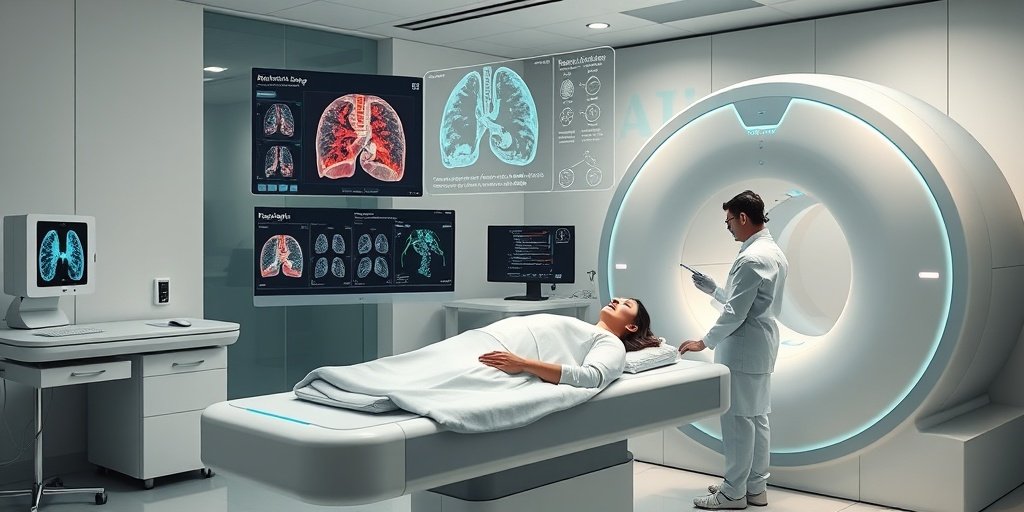
📚 Background
Lung biopsies are critical for diagnosing various lung lesions, yet achieving molecular adequacy can be challenging. Traditional methods often lack the precision needed for effective molecular testing. This study aims to bridge that gap by developing a standardized workflow that incorporates advanced imaging techniques and procedural standardization, ultimately enhancing the accuracy of lung biopsies.
🗒️ Study
The research involved a comprehensive analysis of 670 CT-guided TTNB procedures performed on 633 patients. The study was divided into a retrospective twin-center cohort for model development and internal validation, and a prospective single-center cohort for independent temporal validation. The primary endpoint was molecular adequacy for next-generation sequencing and PD-L1 testing.
📈 Results
The study revealed an overall molecular adequacy of 83.9% for next-generation sequencing. Notably, the prospective validation cohort, which adhered to a standardized procedural framework, achieved a significantly higher adequacy rate of 91.2% compared to 82.6% in the retrospective cohort. The procedural model demonstrated an AUC of 0.86 in the derivation cohort and 0.84 in the validation cohort, with radiomics integration further enhancing discrimination to 0.88.
🌍 Impact and Implications
The findings from this study have the potential to significantly improve the accuracy of lung biopsies, which is crucial for effective treatment planning in oncology. By standardizing procedures and integrating radiomics, healthcare providers can enhance the reliability of molecular testing, ultimately leading to better patient outcomes. This framework sets the stage for future advancements in interventional radiology and personalized medicine.
🔮 Conclusion
This study highlights the importance of standardization and the integration of radiomics in improving molecular adequacy in lung biopsies. The promising results pave the way for further research and development of decision-support strategies that can enhance the precision of interventional procedures. The future of lung biopsy techniques looks bright, with the potential for significant advancements in patient care.
💬 Your comments
What are your thoughts on the integration of radiomics in lung biopsy procedures? We would love to hear your insights! 💬 Leave your comments below or connect with us on social media:
From Passive Sampling to Precision Intervention: A Standardized Radiomics-Driven Workflow for Molecularly Adequate Lung Biopsy.
Abstract
PURPOSE: To develop and temporally validate a predictive framework for molecular adequacy in computed tomography (CT)-guided transthoracic needle biopsy (TTNB) of lung lesions, integrating procedural variables with radiomic features derived from pre-procedural CT imaging.
MATERIALS AND METHODS: This observational derivation-validation study included 670 CT-guided TTNB procedures performed in 633 patients. A retrospective twin-center cohort (522 procedures) was used for model development and internal validation, while a prospective single-center cohort (148 procedures) served as an independent temporal validation set. Molecular adequacy for next-generation sequencing and PD-L1 testing was the primary endpoint. A multivariable model based on procedural predictors was developed and evaluated, followed by an exploratory radiomics sub-study integrating quantitative imaging features. Model performance was assessed using area under the curve (AUC), calibration metrics, and transportability analyses. Procedural complications were classified according to the modified CIRSE classification system.
RESULTS: Overall molecular adequacy for next-generation sequencing was 83.9%. The prospective validation cohort, managed under a standardized procedural framework, demonstrated a significantly higher adequacy rate compared with the retrospective cohort (91.2% vs. 82.6%). The procedural model achieved an AUC of 0.86 in the derivation cohort and 0.84 in the validation cohort. Integration of radiomics further improved discrimination (AUC 0.88), particularly in subsolid lesions. Complication rates were comparable between cohorts, with no increase in major complications.
CONCLUSION: Molecular adequacy in CT-guided lung biopsy can be meaningfully improved through procedural standardization and further enhanced by integrating radiomics. The proposed framework provides a foundation for future prospective evaluation of decision-support strategies in interventional radiology.
Author: [‘Marinelli L’, ‘Patanè V’, ‘Monti R’, ‘Tarantino NM’, ‘Nardone V’, ‘Reginelli A’, ‘Cappabianca S’]
Journal: Cardiovasc Intervent Radiol
Citation: Marinelli L, et al. From Passive Sampling to Precision Intervention: A Standardized Radiomics-Driven Workflow for Molecularly Adequate Lung Biopsy. From Passive Sampling to Precision Intervention: A Standardized Radiomics-Driven Workflow for Molecularly Adequate Lung Biopsy. 2026; (unknown volume):(unknown pages). doi: 10.1007/s00270-026-04407-5