⚡ Quick Summary
This study introduces a deep learning-based framework for assessing gait impairments in Parkinson’s Disease (PD) using smartphone videos. The framework achieved a micro-average AUC of 0.87 and an F1 score of 0.806, demonstrating comparable performance to clinical specialists.
🔍 Key Details
- 📊 Dataset: Smartphone-recorded videos of patients with PD
- ⚙️ Technology: Deep learning framework for gait analysis
- 🏆 Performance: AUC 0.87, F1 score 0.806
- 💊 Medication assessment: Precision of 73.68% in discerning medication effects
🔑 Key Takeaways
- 📹 Smartphone technology can be leveraged for remote gait assessment in PD.
- 🤖 Deep learning shows promise in predicting PD severity effectively.
- 💡 The framework can identify fine-granular gait changes beyond traditional scales.
- 🏥 Potential applications in both clinical and home settings for monitoring disease progression.
- 🔍 Discovery of novel digital biomarkers sensitive to disease progression and medication response.
- 🌍 Implications for personalized therapies and clinical trial evaluations.
📚 Background
Gait impairments are a common and debilitating symptom of Parkinson’s Disease, often leading to significant challenges in mobility and quality of life. Traditional assessment methods can be subjective and may not capture the full spectrum of gait abnormalities. The integration of deep learning and smartphone technology offers a new avenue for more accurate and objective assessments.
🗒️ Study
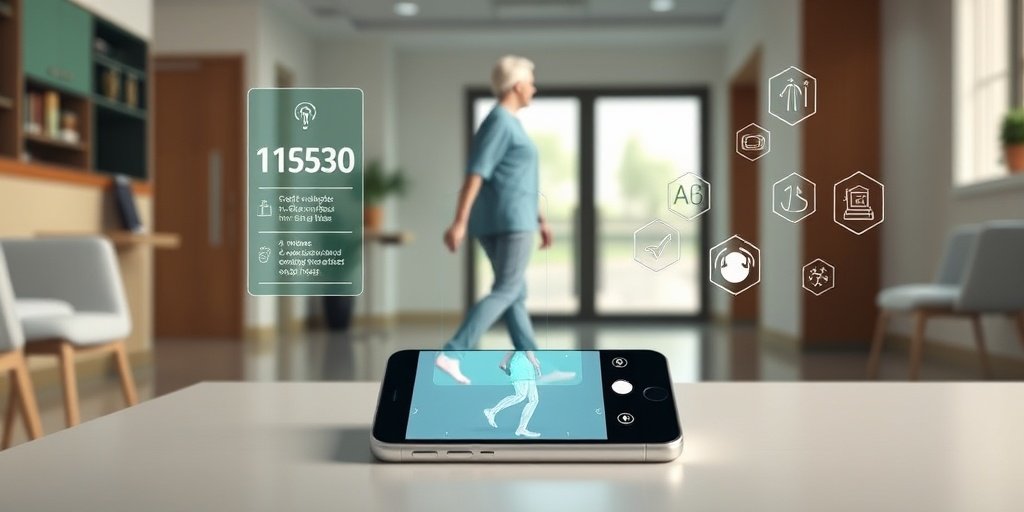
The study aimed to develop a framework that utilizes smartphone-recorded videos to assess gait impairments in individuals with PD. By employing advanced deep learning techniques, researchers sought to create a tool that could not only predict disease severity but also evaluate the effects of medications on gait.
📈 Results
The deep learning framework demonstrated impressive performance, achieving a micro-average AUC of 0.87 and an F1 score of 0.806. This performance was comparable to that of three clinical specialists, indicating that the framework can serve as a reliable tool for assessing gait impairments. Additionally, it showed a precision of 73.68% in evaluating the efficacy of medications on gait.
🌍 Impact and Implications
The findings from this study highlight the potential of using smartphone technology and deep learning for efficient gait assessment in PD. This approach could transform how clinicians monitor disease progression and medication effects, paving the way for personalized therapies and improved patient outcomes. Furthermore, the ability to conduct assessments in home settings could enhance patient engagement and adherence to treatment plans.
🔮 Conclusion
This research underscores the transformative potential of deep learning in the assessment of gait impairments in Parkinson’s Disease. By utilizing smartphone videos, healthcare professionals can achieve more accurate and timely evaluations, ultimately leading to better management of the disease. The future of gait assessment looks promising, and further exploration in this field is encouraged!
💬 Your comments
What are your thoughts on this innovative approach to assessing gait impairments in Parkinson’s Disease? We would love to hear from you! 💬 Share your insights in the comments below or connect with us on social media:
Deep learning-enabled accurate assessment of gait impairments in Parkinson’s disease using smartphone videos.
Abstract
Gait impairments are among the most prevalent and disabling symptoms in Parkinson’s Disease (PD), featuring complex and highly heterogeneous manifestations. Here, we propose a deep learning-based framework to assess gait impairments using smartphone-recorded videos. This framework demonstrated high proficiency in predicting PD severity, with a micro-average area under the receiver operating characteristic curve (AUC) of 0.87 and an F1 score of 0.806, comparable to the average performance of three clinical specialists. Additionally, it effectively discerned the comprehensive efficacy of medications on gait impairments with a precision of 73.68%. In particular, it demonstrated the ability to discriminate medication-induced fine-granular gait changes beyond the resolution of the Unified Parkinson’s Disease Rating Scale (UPDRS). Furthermore, our interpretable framework enabled the extraction of traditional clinically used motion markers and the discovery of novel digital biomarkers sensitive to disease progression and medication response. The findings underscore its great potential for efficiently assessing disease progression in both clinical and home settings, as well as evaluating disease-modifying effects in clinical trials to promote personalized therapies.
Author: [‘Han J’, ‘Tian Z’, ‘Wu J’, ‘Zhang K’, ‘Li S’, ‘Baig F’, ‘Liu P’, ‘Vaidyanathan R’, ‘Morgante F’, ‘Huo W’]
Journal: NPJ Digit Med
Citation: Han J, et al. Deep learning-enabled accurate assessment of gait impairments in Parkinson’s disease using smartphone videos. Deep learning-enabled accurate assessment of gait impairments in Parkinson’s disease using smartphone videos. 2025; (unknown volume):(unknown pages). doi: 10.1038/s41746-025-02150-8