⚡ Quick Summary
A recent study evaluated the cost-effectiveness of using AI-assisted chest radiographs for opportunistic osteoporosis screening in Japanese women aged ≥ 50. The findings revealed a cost per quality-adjusted life year (QALY) gained of ¥189,713, significantly below the accepted threshold, indicating a promising approach for early osteoporosis detection.
🔍 Key Details
- 📊 Population: Japanese women aged ≥ 50 years
- ⚙️ Technology: AI-assisted chest X-ray screening
- 💰 Cost per QALY: ¥189,713 nationwide
- 🏙️ Location: Kure City (high-fracture-incidence area)
- 📉 Lower-incidence scenario: ¥1,055,095 per QALY
🔑 Key Takeaways
- 💡 AI technology enhances the detection of osteoporosis through chest X-rays.
- 📉 Cost-effectiveness is significantly favorable compared to traditional screening methods.
- 🏆 Results show that opportunistic screening is a dominant strategy in high-fracture areas.
- 🌍 Findings are robust across various age-specific populations and scenarios.
- 🧪 Incorporation of real-world data improves the accuracy of the economic model.
- 📈 Potential for broader implementation in osteoporosis management across Japan.
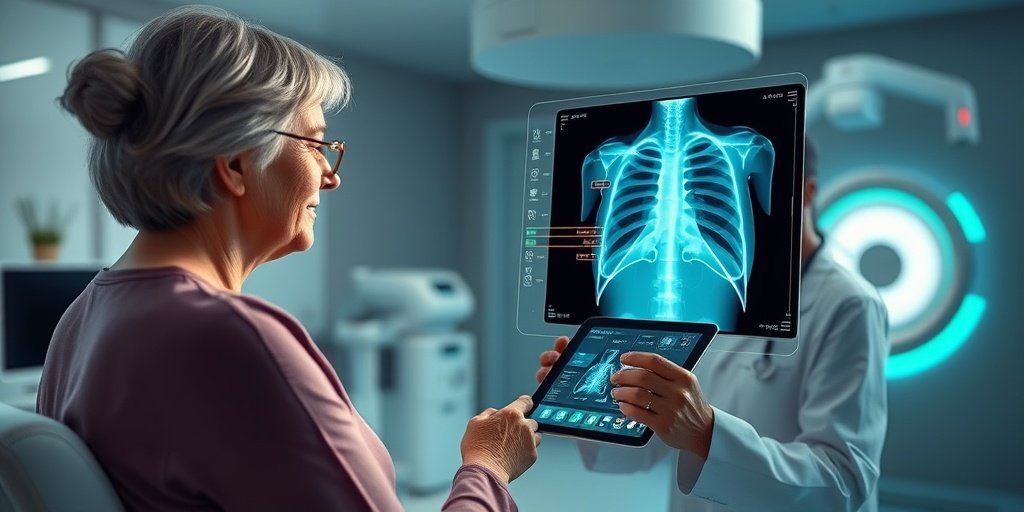
📚 Background
Osteoporosis is a prevalent condition, particularly among older women, often going undiagnosed due to the limitations of conventional screening methods. This leads to missed opportunities for early intervention and treatment. The integration of artificial intelligence (AI) into medical imaging, especially through deep learning applied to chest X-rays, presents a novel approach to enhance osteoporosis screening and improve patient outcomes.
🗒️ Study
The study employed an economic model to assess the cost-effectiveness of an AI-assisted chest X-ray screening strategy for osteoporosis in women aged 50 and older in Japan. By simulating patient trajectories based on the AI system’s diagnostic performance and aligning them with Japanese osteoporosis guidelines, the researchers aimed to quantify the economic benefits of this innovative screening method.
📈 Results
The analysis revealed that the cost per QALY gained from opportunistic osteoporosis screening was estimated at ¥189,713 nationwide, which is substantially lower than the accepted cost-effectiveness threshold of ¥5 million. In Kure City, the screening strategy was found to be dominant, yielding lower total costs while providing more QALYs. Even in a lower-incidence scenario, the cost per QALY remained below the threshold at ¥1,055,095.
🌍 Impact and Implications
The findings from this study underscore the economic viability of leveraging AI-assisted chest X-rays for incidental osteoporosis detection, particularly for older women in Japan. This approach not only enhances early detection but also aligns with healthcare cost management strategies, potentially leading to improved health outcomes and reduced healthcare expenditures in the long run.
🔮 Conclusion
This study highlights the transformative potential of AI in the realm of osteoporosis screening. By utilizing AI-assisted chest X-rays, healthcare providers can achieve more effective and cost-efficient screening, paving the way for better management of osteoporosis among older populations. Continued research and implementation of such technologies could significantly enhance public health strategies in osteoporosis prevention and treatment.
💬 Your comments
What are your thoughts on the integration of AI in osteoporosis screening? We would love to hear your insights! 💬 Share your comments below or connect with us on social media:
Cost-effectiveness of opportunistic osteoporosis screening using artificial-intelligence assisted chest radiographs in Japan.
Abstract
OBJECTIVES: Osteoporosis is often undiagnosed due to the shortcomings of conventional screening, resulting in missed chances for early treatment. Advances in artificial intelligence (AI), particularly deep learning applied to chest X-rays, offer a new opportunity for opportunistic screening. This study assesses the cost-effectiveness of this approach in Japanese women aged ≥ 50 years.
METHODS: An economic model estimated the cost per quality-adjusted life year (QALY) gained (in 2024 Japanese Yen, ¥) for a strategy involving AI-assisted chest X-ray screening followed by treatment, compared to no screening. Patient trajectories were modeled using the AI system’s diagnostic performance and aligned with the Japanese osteoporosis guidelines. Analyses were conducted for Japan overall, in Kure City (a high-fracture-incidence area), and in a lower-incidence scenario. Real-world medication persistence, the probabilities of dual-energy X-ray absorptiometry examination after screening detection, and treatment initiation rates were incorporated.
RESULTS: Nationwide in Japan, the cost per QALY gained from opportunistic osteoporosis screening was estimated at ¥189,713 for women aged ≥ 50, substantially lower than the accepted cost-effectiveness threshold of ¥5 million. In Kure City, opportunistic screening was dominant (lower total costs for more QALYs). In the lower-incidence scenario, 25% below the national average, the cost per QALY was ¥1,055,095, remaining below the threshold. Results were robust across all age-specific populations and in sensitivity analyses.
CONCLUSIONS: Leveraging AI-assisted chest X-rays for incidental osteoporosis detection demonstrates strong economic viability for older Japanese women. This approach also proves to be a dominant strategy in areas with elevated fracture rates.
Author: [‘Reginster JY’, ‘Hamasaki T’, ‘Fujiwara S’, ‘Alokail M’, ‘Hiligsmann M’]
Journal: Osteoporos Sarcopenia
Citation: Reginster JY, et al. Cost-effectiveness of opportunistic osteoporosis screening using artificial-intelligence assisted chest radiographs in Japan. Cost-effectiveness of opportunistic osteoporosis screening using artificial-intelligence assisted chest radiographs in Japan. 2025; 11:127-136. doi: 10.1016/j.afos.2025.10.003