⚡ Quick Summary
This review article explores the evolving understanding of coronary artery calcification (CAC), highlighting its transition from a passive marker to an actively regulated process. Key innovations such as intravascular lithotripsy and advancements in AI imaging are discussed, emphasizing the need for proactive strategies in managing calcific cardiovascular disease.
🔍 Key Details
- 📊 Research Duration: 30 years of cumulative research
- 🔬 Mechanisms: Osteogenic transdifferentiation, inflammation, cellular diversity
- 🧬 Technologies: Single-cell sequencing, intravascular lithotripsy (IVL)
- 🏆 Success Rate: IVL shows ≥ 98% success in severe calcification cases
- 🤖 AI Performance: Imaging accuracy improved to 99.2% segmentation
🔑 Key Takeaways
- 🔍 CAC is now recognized as an actively regulated process rather than a mere degenerative marker.
- 🧬 Single-cell sequencing has identified distinct CAC subtypes linked to atherosclerosis and chronic conditions.
- 💡 Innovations like IVL are transforming treatment options for severe calcification.
- 📈 AI technologies are enhancing imaging accuracy, crucial for effective diagnosis.
- ⚠️ Challenges remain in the form of statins’ dual effects and limited access to advanced tools.
- 🌍 The need for multi-omics precision therapy is highlighted to optimize vascular health.
- 💰 Cost-effective solutions are essential to shift from reactive to proactive treatment approaches.
- 👵 Aging populations are increasingly burdened by calcific cardiovascular disease, necessitating urgent action.
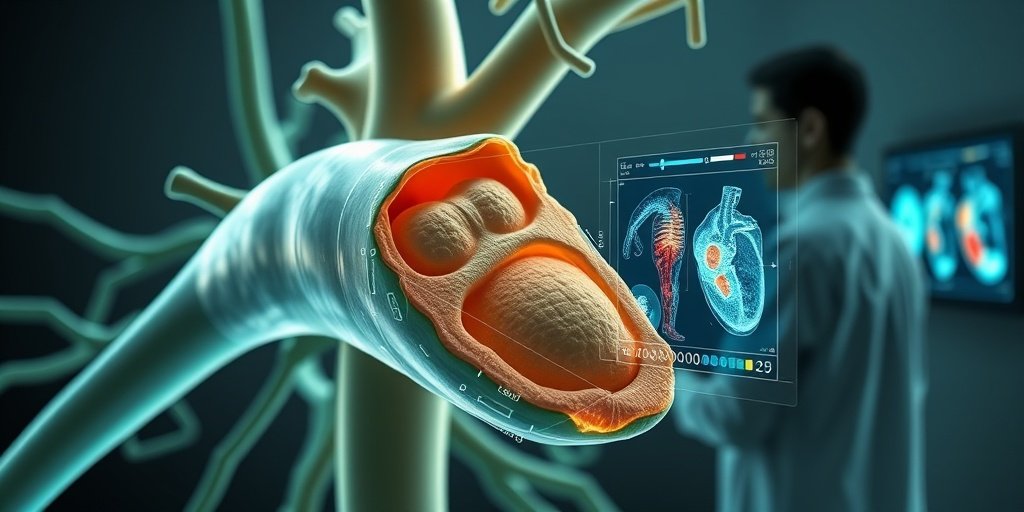
📚 Background
Coronary artery calcification (CAC) has long been associated with cardiovascular diseases, traditionally viewed as a passive indicator of atherosclerosis. Recent research, however, reveals that CAC is an actively regulated process influenced by various biological mechanisms, including inflammation and cellular changes. Understanding these mechanisms is crucial for developing effective management strategies.
🗒️ Study
This comprehensive review synthesizes findings from three decades of research on CAC, focusing on the integration of pathological mechanisms, technological advancements, and clinical evidence. The authors delve into the role of single-cell sequencing in identifying distinct CAC subtypes, which can inform targeted therapeutic approaches.
📈 Results
The review highlights significant advancements, such as the introduction of intravascular lithotripsy (IVL), which boasts a remarkable success rate of ≥ 98% in treating severe calcification. Additionally, the application of AI technologies has led to an impressive imaging accuracy of 99.2% segmentation, enhancing diagnostic capabilities in clinical settings.
🌍 Impact and Implications
The findings from this review underscore the urgent need for a paradigm shift in how we approach CAC management. By embracing innovations like IVL and AI, healthcare providers can transition from reactive treatments to proactive strategies that optimize vascular health. This is particularly vital as the burden of calcific cardiovascular disease continues to rise in aging populations, necessitating more effective and accessible solutions.
🔮 Conclusion
This review illuminates the transformative potential of recent innovations in the understanding and management of coronary artery calcification. By integrating advanced technologies and a deeper understanding of underlying mechanisms, we can enhance patient outcomes and address the growing challenges posed by calcific cardiovascular disease. Continued research and investment in these areas are essential for future advancements in cardiovascular health.
💬 Your comments
What are your thoughts on the advancements in coronary artery calcification management? We invite you to share your insights and engage in a discussion! 💬 Leave your comments below or connect with us on social media:
Coronary Artery Calcification: Decoding Mechanisms, Innovations, and Translational Strategies from Bench to Bedside.
Abstract
Coronary artery calcification (CAC), a key atherosclerotic pathology, has shifted from a passive degenerative marker to an actively regulated process involving osteogenic transdifferentiation, inflammation, and cellular diversity. This review summarizes 30 years of research, integrating pathological mechanisms, technological advances, and clinical evidence for CAC management. Single-cell sequencing identifies distinct intimal (atherosclerosis-linked) and medial (CKD/diabetes-related) subtypes driven by pathways like BMP2/Smad and OPG/RANKL. Innovations include intravascular lithotripsy (IVL, ≥ 98% success in severe calcification) and AI improving imaging accuracy (99.2% segmentation). Challenges remain: statins’ dual effects on calcification, subtype diagnostic gaps, and limited access to advanced tools (IVL unavailable in > 70% of resource-limited facilities). The synthesis highlights needs for multi-omics precision therapy, AI-based risk stratification, and cost-effective solutions to shift from reactive treatment to proactive vascular health optimization, addressing the rising burden of calcific cardiovascular disease in aging populations.
Author: [‘Ma S’, ‘Wu D’, ‘Hu Y’, ‘Wang J’, ‘Zhang K’, ‘Liu S’, ‘Zhu Y’, ‘Yu T’, ‘Wu Y’]
Journal: J Cardiovasc Transl Res
Citation: Ma S, et al. Coronary Artery Calcification: Decoding Mechanisms, Innovations, and Translational Strategies from Bench to Bedside. Coronary Artery Calcification: Decoding Mechanisms, Innovations, and Translational Strategies from Bench to Bedside. 2025; (unknown volume):(unknown pages). doi: 10.1007/s12265-025-10720-0