⚡ Quick Summary
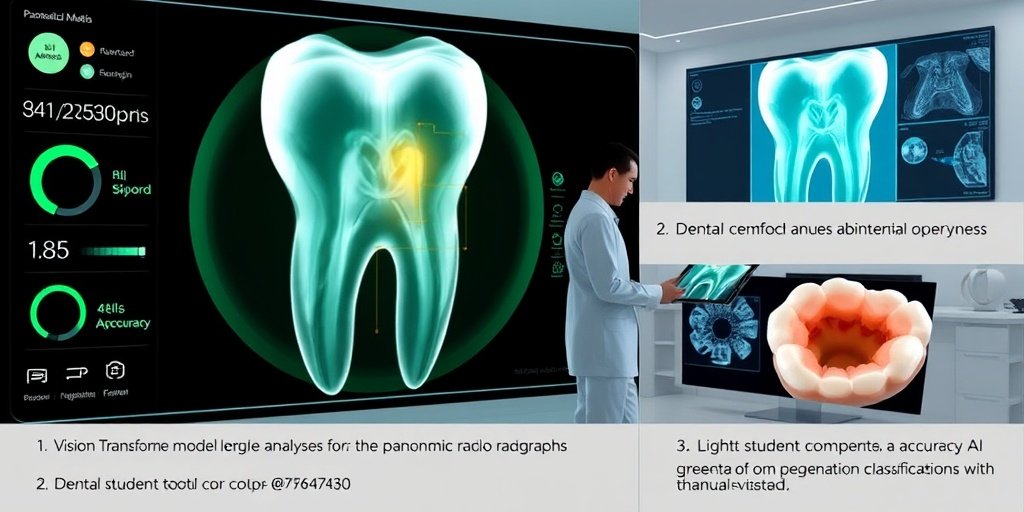
This study explored the use of a Vision Transformer model to classify apical root openness in panoramic radiographs, achieving an impressive 88% accuracy. The model outperformed manual classifications by dental students, indicating its potential as a reliable tool in clinical decision support systems.
🔍 Key Details
- 📊 Dataset: 902 single-rooted permanent teeth from 512 panoramic radiographs
- 🧩 Classification groups: closed apex, anatomically open, pathologically open
- ⚙️ Technology: Vision Transformer model (ViT Base Patch32)
- 🏆 Performance metrics: Accuracy, precision, recall, F1-score all at 88%
🔑 Key Takeaways
- 📊 Apical openness is a crucial indicator of root development in dentistry.
- 🤖 AI-based classification can enhance diagnostic accuracy in dental practices.
- 🏆 The ViT model demonstrated superior consistency compared to less experienced human classifiers.
- 🌍 Potential applications in clinical decision support systems for endodontics and orthodontics.
- 📉 Traditional methods may be less reliable than AI-driven approaches.
- 💡 Image preprocessing was performed using ImageJ to enhance model performance.
- 🧑🎓 Study involved dental specialty students for comparative analysis.
📚 Background
The evaluation of root morphology is essential in dentistry, particularly for diagnosing and planning treatments. Apical openness serves as a significant radiographic indicator of incomplete root development, which can complicate procedures, especially in younger patients. Traditional methods of assessing root morphology can be subjective and inconsistent, highlighting the need for more reliable diagnostic tools.
🗒️ Study
Conducted with a dataset of 902 single-rooted permanent teeth, this study aimed to develop an AI-based method for classifying apical root openness using panoramic radiographs. The researchers utilized a Vision Transformer model to automate the classification process, comparing its performance against manual classifications made by dental specialty students.
📈 Results
The Vision Transformer model achieved an impressive 88% accuracy across all performance metrics, including precision, recall, and F1-score. Notably, the model outperformed manual classifications, particularly from less experienced dental students, demonstrating its potential for consistent and reliable outcomes in clinical settings.
🌍 Impact and Implications
The findings of this study could significantly impact the field of dentistry by providing a robust AI tool for assessing apical root openness. By integrating such technologies into clinical practice, dental professionals can enhance diagnostic accuracy and treatment planning, ultimately improving patient outcomes. The promise of AI in dentistry is becoming increasingly evident, paving the way for more advanced decision support systems.
🔮 Conclusion
This research highlights the transformative potential of artificial intelligence in dental diagnostics. The high accuracy of the Vision Transformer model in classifying apical root openness suggests that AI can play a crucial role in enhancing clinical decision-making. Continued exploration and integration of AI technologies in dentistry will likely lead to improved patient care and treatment efficacy.
💬 Your comments
What are your thoughts on the integration of AI in dental diagnostics? We would love to hear your insights! 💬 Leave your comments below or connect with us on social media:
Classification of Apical Openness Using Vision Transformer: A Comparative Approach with Expert Decisions.
Abstract
Teeth play a key role in essential functions such as mastication and speech. Evaluating root morphology is crucial in both diagnosis and treatment planning. Apical openness is a significant radiographic indicator of incomplete root development, which can complicate endodontic and orthodontic procedures, especially in young individuals. Factors such as caries, trauma, or lesions may interrupt root development, resulting in an open apex and clinical challenges. Panoramic radiographs are commonly used in dentistry due to their low radiation dose and wide anatomical coverage. This study aimed to develop an artificial intelligence (AI)-based method to classify apical root openness in panoramic radiographs. A total of 902 single-rooted permanent teeth were manually cropped from 512 panoramic radiographs archived at XXXX. Teeth were categorized into three groups: closed apex, anatomically open, and pathologically open. Image preprocessing was performed using ImageJ, and classification was conducted using a Vision Transformer model (ViT Base Patch32). Model performance was evaluated based on accuracy, precision, recall, and F1-score. The ViT model achieved 88% in accuracy, precision, recall, and F1-score. Compared with manual classifications performed by dental specialty students, the model provided more consistent outcomes, particularly outperforming less experienced participants. The ViT model demonstrated high accuracy in detecting apical root openness on panoramic radiographs and shows promise as a reliable component of clinical decision support systems.
Author: [‘Daldal M’, ‘Baybars SC’, ‘Baydoğan MP’, ‘Tuncer SA’]
Journal: J Imaging Inform Med
Citation: Daldal M, et al. Classification of Apical Openness Using Vision Transformer: A Comparative Approach with Expert Decisions. Classification of Apical Openness Using Vision Transformer: A Comparative Approach with Expert Decisions. 2025; (unknown volume):(unknown pages). doi: 10.1007/s10278-025-01780-4