⚡ Quick Summary
This critical review explores the role of artificial intelligence (AI) in postural management, highlighting its potential for real-time monitoring and correction of posture. The findings suggest that AI technologies, particularly in human pose estimation (HPE), could significantly enhance clinical applicability and user engagement in postural assessments. 🤖
🔍 Key Details
- 📊 Focus: AI technologies in postural management
- 🧩 Key Technologies: Computer vision and human pose estimation (HPE)
- 🏆 Precision: High accuracy in identifying anatomical landmarks
- 🌐 Applications: Ergonomic risk evaluation, sports performance analysis, tele-rehabilitation
- 📅 Timeframe: Studies reviewed from the past decade
🔑 Key Takeaways
- 📈 AI-based HPE models offer a robust alternative to traditional postural assessment methods.
- 💡 Real-time feedback enhances user engagement and supports personalized interventions.
- 🏥 Clinical applicability is expanding beyond laboratory settings into practical contexts.
- ⚠️ Challenges include limited evidence from large-scale clinical trials and concerns about usability and data privacy.
- 🔍 Future work must focus on rigorous clinical validation and ethical frameworks.
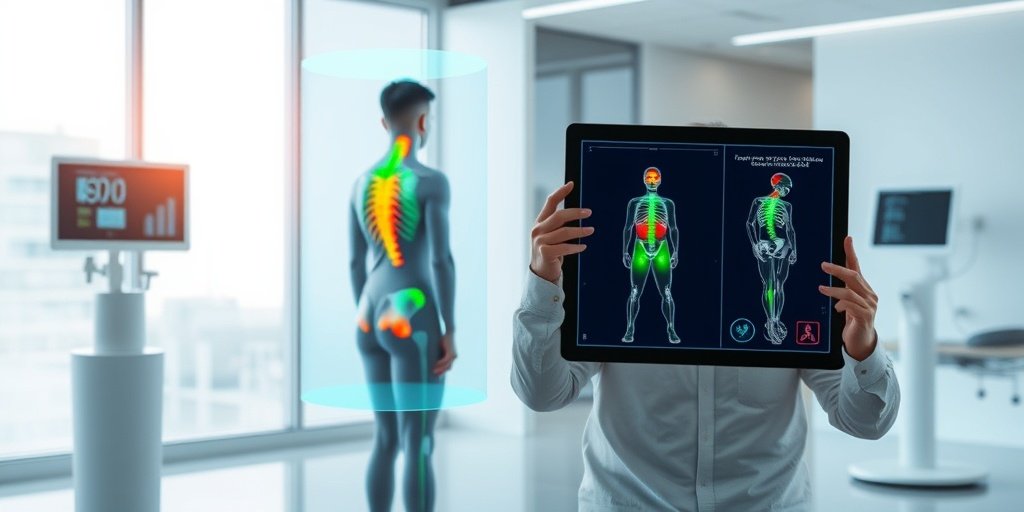
📚 Background
Poor posture and related musculoskeletal conditions are increasingly recognized as significant global health issues. Traditional methods for assessing posture often lack objectivity and continuous monitoring capabilities, leading to a growing need for innovative solutions. The integration of artificial intelligence into postural management presents an exciting opportunity to address these challenges and improve health outcomes. 🌍
🗒️ Study
This review synthesizes recent literature from various fields, including computer science, bioengineering, and clinical research, to evaluate the advancements in AI technologies for postural management. The focus is on studies from the last decade that investigate the use of AI and HPE for detecting, monitoring, and correcting human posture. The findings indicate a shift towards more objective and continuous assessment methods. 📖
📈 Results
AI-driven HPE models have demonstrated high precision in identifying anatomical landmarks and quantifying postural parameters. These advancements suggest that AI can provide a more reliable alternative to conventional assessment methods, with applications extending into ergonomic evaluations and sports performance analysis. However, the review also highlights the need for further research to validate these findings across diverse populations and real-world conditions. 📊
🌍 Impact and Implications
The integration of AI in postural management could revolutionize how we approach musculoskeletal health. By enabling continuous, objective assessments and personalized interventions, AI technologies have the potential to enhance user engagement and improve health outcomes. However, addressing the challenges of clinical validation, usability, and ethical considerations will be crucial for successful implementation in healthcare settings. 🏥
🔮 Conclusion
This review underscores the significant potential of AI to transform postural management through continuous and accessible assessment and intervention. To fully harness this potential, future efforts must prioritize rigorous clinical validation, user-centered design, and the establishment of ethical frameworks. The future of postural management looks promising with the integration of AI technologies! 🌟
💬 Your comments
What are your thoughts on the role of AI in postural management? We would love to hear your insights! 💬 Please share your comments below or connect with us on social media:
Artificial intelligence in postural management: a critical review of detection, correction, and clinical applicability.
Abstract
BACKGROUND: Poor posture and related musculoskeletal conditions represent a growing global health concern. Conventional postural assessment methods are often subjective, intermittent, and insufficient for accurate, continuous monitoring. Advances in artificial intelligence (AI), particularly in computer vision and human pose estimation (HPE), have introduced new possibilities for objective and real-time postural analysis.
MAIN BODY: This critical review synthesizes and evaluates current developments in AI technologies for postural management. The review draws on recent literature from computer science, bioengineering, and clinical research, focusing on studies from the past decade that explore the use of AI and HPE in the detection, monitoring, and correction of human posture. AI-based HPE models demonstrate high precision in identifying anatomical landmarks and quantifying postural parameters, offering a robust alternative to traditional assessment methods. Applications are expanding beyond laboratory environments to practical contexts such as ergonomic risk evaluation and sports performance analysis. In addition, AI-driven systems that deliver real-time feedback and support tele-rehabilitation are enhancing user engagement and enabling personalized interventions. Despite these advancements, the field faces several challenges. Evidence from large-scale clinical trials remains limited, and the generalizability of existing models across diverse populations and real-world conditions is uncertain. Concerns related to usability, data privacy, and integration within healthcare systems also pose significant barriers to clinical translation.
CONCLUSION: AI holds considerable potential to transform postural management through continuous, objective, and accessible assessment and intervention. To fully realize this potential, future work must extend beyond technical innovation to include rigorous clinical validation, user-centered design, and the establishment of ethical and regulatory frameworks that ensure safe, effective, and equitable implementation.
Author: [‘Köroglu Y’, ‘Hosseini E’, ‘Bahadır Z’, ‘Karakus B’, ‘Alimoradi M’, ‘Alghosi M’, ‘Konrad A’]
Journal: J Orthop Surg Res
Citation: Köroglu Y, et al. Artificial intelligence in postural management: a critical review of detection, correction, and clinical applicability. Artificial intelligence in postural management: a critical review of detection, correction, and clinical applicability. 2026; (unknown volume):(unknown pages). doi: 10.1186/s13018-025-06640-z