⚡ Quick Summary
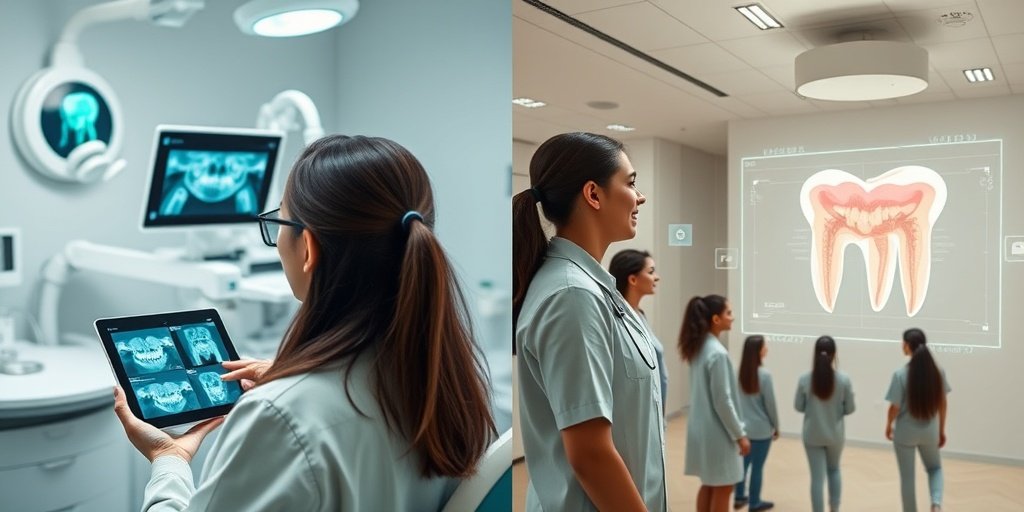
The article explores the transformative role of Artificial Intelligence (AI) in dental hygiene, highlighting its impact on clinical practice, education, research, and corporate operations. With advancements in AI technologies, dental hygienists are poised to enhance diagnostic accuracy and personalized care while navigating ethical considerations.
🔍 Key Details
- 🧠 AI Types: Generative, analytical, predictive, prescriptive, and hybrid AI.
- 🏥 Clinical Applications: Improved diagnostic accuracy in radiographic interpretation and periodontal assessment.
- 📚 Educational Enhancements: Adaptive learning and intelligent tutoring systems.
- 📊 Research Support: Large-scale data analysis and disease surveillance.
- 🌐 Corporate Uses: AI-driven product development and market analysis.
🔑 Key Takeaways
- 🤖 AI is revolutionizing dental hygiene by enhancing diagnostic capabilities and personalized care planning.
- 📈 Educational tools powered by AI are enriching training for dental hygienists.
- 🌍 AI supports public health initiatives through effective disease surveillance and prevention strategies.
- 💼 Corporate applications include workflow optimization and performance management.
- ⚖️ Ethical considerations are crucial as AI technologies evolve in the dental field.
- 📊 Evidence-based practices must guide the integration of AI in clinical settings.
- 💡 Digital literacy is essential for dental hygienists to effectively utilize AI tools.
- 🤝 Emphasis on equity and inclusivity is growing in AI applications within dental hygiene.
📚 Background
The integration of Artificial Intelligence into various fields has been a game-changer, and dental hygiene is no exception. As AI technologies continue to evolve, they offer unprecedented opportunities to enhance clinical care, education, and research. However, with these advancements come challenges that require careful consideration, particularly regarding ethics and access.
🗒️ Study
The article by Hurlbutt M. published in the Journal of Dental Hygiene discusses the multifaceted influence of AI on dental hygiene. It emphasizes the importance of adapting to these changes while maintaining a focus on ethical practices and patient-centered care.
📈 Results
The findings indicate that AI is significantly improving diagnostic accuracy in areas such as radiographic interpretation and periodontal assessment. Additionally, AI tools are enhancing educational experiences for dental hygienists, allowing for more personalized and effective training methods.
🌍 Impact and Implications
The implications of AI in dental hygiene are profound. By improving diagnostic capabilities and educational tools, AI has the potential to enhance patient outcomes and streamline operations within dental practices. However, it is essential to ensure that these technologies are implemented ethically and equitably, promoting access for all patients.
🔮 Conclusion
The integration of Artificial Intelligence into dental hygiene represents a significant advancement in the field. As we embrace these technologies, it is crucial to balance innovation with ethical oversight and patient-centered values. The future of dental hygiene looks promising, with AI poised to enhance both clinical practice and education.
💬 Your comments
What are your thoughts on the role of AI in dental hygiene? We would love to hear your insights! 💬 Share your comments below or connect with us on social media:
Artificial Intelligence and Its Influence on Dental Hygiene.
Abstract
Artificial intelligence (AI) including generative AI, analytical AI, predictive AI, prescriptive AI, and hybrid AI, is rapidly evolving and continues to expand its influence across dental hygiene, transforming clinical care, education, research, public health, corporate operations, administration, and entrepreneurship. In clinical practice, AI is advancing diagnostic accuracy for radiographic interpretation, periodontal assessment, and early detection of oral pathology, while enhancing decision-making and personalized care planning. In education, AI enables adaptive learning, intelligent tutoring, predictive analytics, and generative content creation, enriching both didactic and clinical training. In research and public health, Artificial intelligence supports large-scale data analysis, disease surveillance, teledentistry, and targeted prevention strategies, with a growing emphasis on equity and inclusivity. Corporate and administrative applications include AI-driven product development, market analysis, workflow optimization, and performance management. Entrepreneurial uses span idea generation, content creation, branding, and market engagement. As AI capabilities advance, dental hygienists must balance innovation with ethical oversight, digital literacy, and equitable access. Ensuring AI is integrated through evidence-based practices, transparent decision-making, and patient-centered values will be essential to realizing its benefits while preserving the integrity of the profession.
Author: [‘Hurlbutt M’]
Journal: J Dent Hyg
Citation: Hurlbutt M. Artificial Intelligence and Its Influence on Dental Hygiene. Artificial Intelligence and Its Influence on Dental Hygiene. 2025; 99:49-58.