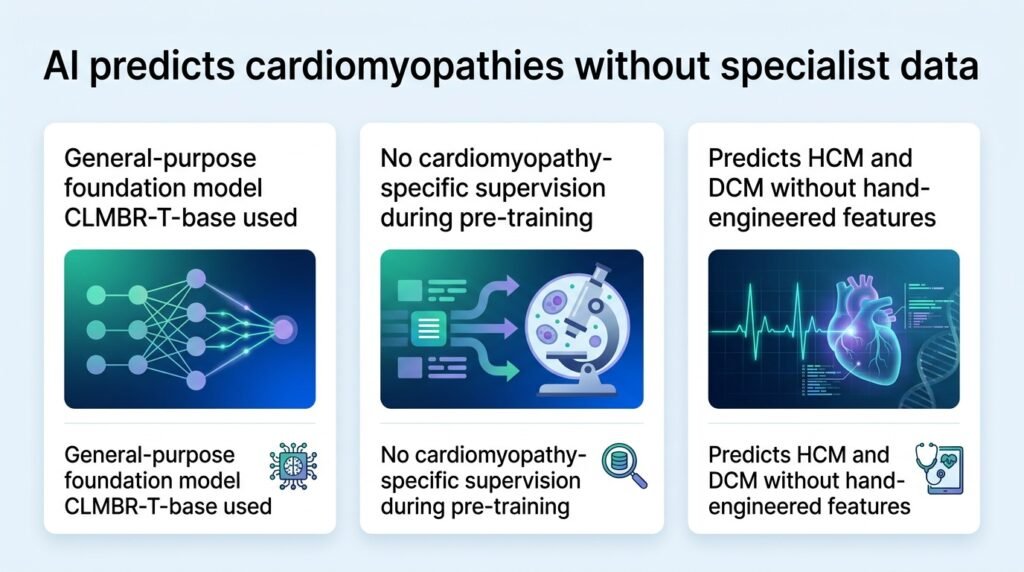
A general-purpose AI model can spot inherited heart disease and predict patient survival using raw medical records, bypassing the need for specialized cardiac imaging.
How do you find a silent killer when the official medical record is looking the wrong way? Cardiologists usually rely on hand-crafted checklists, expensive MRIs, and genetic panels to catch hypertrophic and dilated cardiomyopathy before it causes sudden cardiac arrest. These conditions often develop slowly, hiding behind vague symptoms until it is too late.
A new study flips this approach. It shows that a generic AI model, trained simply to predict the next event in a patient’s record, can flag these deadly heart conditions without any specialized cardiac training. This means we might not need complex, disease-specific pipelines to find high-risk patients.
This challenges the assumption that clinical AI needs highly curated, disease-specific features to be useful. But the real revelation is a glitch in how we define when a patient actually gets sick.
The AI frequently flagged patients as positive months before doctors officially wrote down the diagnosis.
This is not a failure of the algorithm. Instead, it reveals that the official date of diagnosis in electronic health records is an administrative fiction, lagging far behind the biological reality of the disease. The patient journey data encodes the actual disease state more reliably than the administrative timing of clinical care.
Testing the model
Researchers evaluated the model, called CLMBR-T-base, using electronic health record data from the Penn Medicine BioBank. They built cohorts to test the system across three distinct clinical challenges. The tasks ranged from predicting initial disease onset to forecasting survival and identifying genetic carriers.
Instead of building a custom tool for each task, the team applied simple linear classifiers to the model’s existing, frozen data representations. This approach bypasses the need for manual feature engineering. The results showed strong predictive power across multiple clinical endpoints:
- Onset prediction achieved AUROCs of 0.75 to 0.82 at one, three, and six-month horizons.
- Genetic carrier status prediction reached AUROCs of 0.74 to 0.75 for patients with completed gene panels.
- Survival and hospitalization forecasts achieved a Harrell’s concordance index of 0.65 to 0.80 for time-to-event outcomes.
The timing trap
These numbers prove that generic clinical foundation models can handle complex cardiology tasks without expensive, custom-built feature engineering. However, the study has clear limitations. This was a retrospective analysis using a single health system’s biobank, meaning the model’s performance might drop when applied to different hospital networks with different charting habits.
Furthermore, the model’s tendency to misclassify future patients as current cases highlights a deeper systemic issue. If clinical trials train AI using inaccurate diagnosis dates, the software will constantly struggle with timing. We must stop treating the electronic health record as a perfect timeline of human illness.
Read the full preprint on medRxiv.