
The integration of artificial intelligence into clinical microbiology has officially transitioned from basic classification algorithms to autonomous agents and automated workflow optimization. Over the past three months, we have witnessed a shift toward models that can autonomously execute research tasks, accelerate diagnostic turnaround times, and automate complex clinical compliance audits. These advancements are critical for clinical teams facing severe staffing shortages and rising antimicrobial resistance.
By integrating automated image analysis, large language models, and phylogenetic deep learning, clinical microbiology is moving away from manual, time-consuming protocols. This month’s report highlights the key papers, product developments, and regulatory trends that are defining this new era of digital health.
Notable papers
• Autonomous biomedical research with an artificial intelligence agent
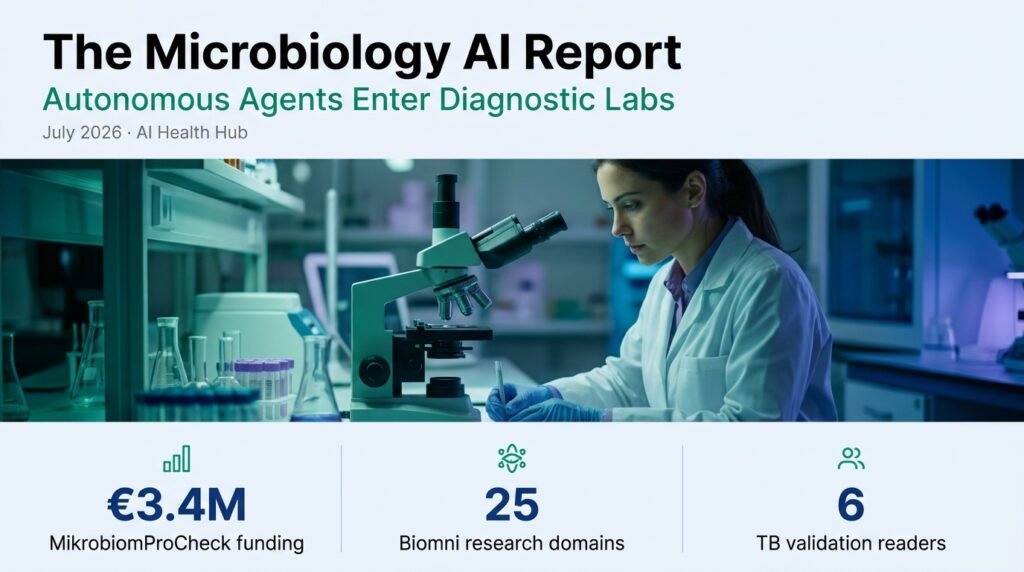
Finding: Researchers introduced Biomni, an autonomous AI agent that mines tools, databases, and protocols across 25 domains to execute diverse biomedical research tasks.
Brand take: Genuinely useful clinically, as it marks the transition from static LLMs to active, task-executing research agents.
• Improving turnaround times with artificial intelligence in microbiology
Finding: A dual-center Canadian study demonstrated that implementing PhenoMATRIX AI software significantly reduced urine culture turnaround times in diagnostic laboratories.
Brand take: Genuinely useful clinically, providing concrete evidence that automated culture sorting directly addresses laboratory bottlenecks.
• Adaptive graph learning of microbial phylogeny enables accurate and interpretable microbiome-based host phenotype prediction
Finding: This study presents an adaptive graph learning framework that incorporates evolutionary relationships to improve microbiome-based disease classification.
Brand take: Underrated, as incorporating phylogenetic trees into deep learning models solves a major interpretability hurdle in microbiome diagnostics.
• Development of an expert-annotated chest X-ray dataset to support AI validation in tuberculosis diagnosis
Finding: Researchers evaluated the diagnostic performance of 6 certified B readers to establish a high-quality, expert-annotated dataset for validating TB-detection AI models.
Brand take: Genuinely useful clinically, because robust external validation datasets are the only way to prevent AI performance drift in real-world clinical settings.
• Rethinking metagenome-assembled genome completeness: are we truly recovering complete genomes?
Finding: The paper challenges current standards for Metagenome-Assembled Genomes (MAGs), warning that current computational pipelines frequently miss critical genomic regions.
Brand take: Genuinely useful clinically, serving as an essential reality check for clinical teams relying on metagenomic sequencing for pathogen discovery.
Products, deals & funding
• MikrobiomProCheck Funding Launch
On June 25, 2026, the collaborative research project MikrobiomProCheck secured €3.4 million in funding from the EU and the North Rhine-Westphalian state government. The project utilizes AI to analyze gut microbiome data to develop personalized therapies and diagnostics for inflammatory bowel disease.
Brand take: Genuinely useful clinically, as it bridges the gap between raw microbiome sequencing and actionable, personalized clinical interventions.
• SENTRY Project Launch
Launched on June 23, 2026, the Horizon Europe-funded SENTRY project integrates autonomous molecular diagnostics, metagenomics, and explainable AI to monitor and forecast plant pathogen risks across the agri-food supply chain.
Brand take: Underrated, as agricultural pathogen forecasting is a critical, often overlooked component of global pandemic preparedness and One Health initiatives.
• KAIST Biomanufacturing AI Roadmap
On July 14, 2026, a research team from the Korea Advanced Institute of Science and Technology (KAIST) proposed a comprehensive AI-driven strategy to optimize microbial metabolic pathways, accelerating the commercialization of bio-based chemical manufacturing.
Brand take: Overhyped, as translating computational metabolic roadmaps into physical, high-yield microbial cell factories remains bottlenecked by physical biology.
Regulatory & clinical adoption
• UC San Diego Health Sepsis AI Study
A clinical study published in JAMA Network Open on June 25, 2026, demonstrated that large language models can dramatically reduce the time and resources needed to evaluate severe sepsis care compliance by automating complex chart reviews and providing near-real-time feedback to physicians.
Brand take: Genuinely useful clinically, as automating administrative compliance reviews frees up critical clinical hours for direct patient care.
• UQ Antimicrobial AI Trust Framework
Researchers at the University of Queensland announced a new framework on June 26, 2026, designed to test the reliability and explainability of AI recommendations during antibiotic development to combat global antimicrobial resistance.
Brand take: Genuinely useful clinically, as clinical adoption of AI-designed antibiotics is entirely dependent on establishing transparent, explainable decision pathways.
Trends & what to watch
The clinical microbiology landscape is moving rapidly toward end-to-end automation. As demonstrated by the PhenoMATRIX study, the integration of AI into routine laboratory workflows is no longer a theoretical exercise; it is actively reducing diagnostic turnaround times. Over the next 1-3 months, expect to see more diagnostic laboratories publishing real-world evidence regarding the operational efficiency gains of automated culture plate sorting and digital microscopy.
Concurrently, the rise of autonomous agents like Biomni suggests that AI will soon play a more active role in experimental design and pathogen analysis. Instead of clinicians querying static databases, autonomous agents will likely begin synthesizing multi-omic data, literature, and clinical histories to suggest targeted antimicrobial regimens. However, as highlighted by the University of Queensland’s trust framework, the industry must establish strict validation standards to ensure these autonomous recommendations are both safe and explainable.
Bottom line
Clinical microbiology is transitioning from AI-assisted diagnostics to autonomous workflow automation, significantly reducing turnaround times and accelerating drug discovery.