⚡ Quick Summary
This study utilized artificial intelligence and AlphaFold 3.0 to elucidate the structure of the bacteriophage KP32, which specifically targets Klebsiella pneumoniae. The findings reveal that KP32 comprises over 500 protein chains, highlighting its potential as a therapeutic tool against antimicrobial resistance (AMR).
🔍 Key Details
- 🔬 Focus: Bacteriophage KP32 targeting Klebsiella pneumoniae
- 🧬 Technology: AlphaFold 3.0 for structural modeling
- ⚙️ Composition: Over 500 protein chains (415 capsid, 104 core-portal-tail complex)
- 🌍 Target Strains: K3 and K21/KL163 capsular serotypes
🔑 Key Takeaways
- 🦠 Klebsiella pneumoniae is a critical Gram-negative bacterium linked to antibiotic resistance.
- 💡 Phage therapy is emerging as a promising alternative to combat AMR.
- 🤖 AI-driven modeling provides insights into the structural biology of bacteriophages.
- 🔍 KP32’s structure was reconstructed using advanced bioinformatics techniques.
- 📊 Understanding phage composition can enhance therapeutic applications.
- ⚠️ Limited knowledge of phage mechanisms poses challenges for their clinical use.
- 🌟 This study represents a significant step in phage research and its potential medical applications.
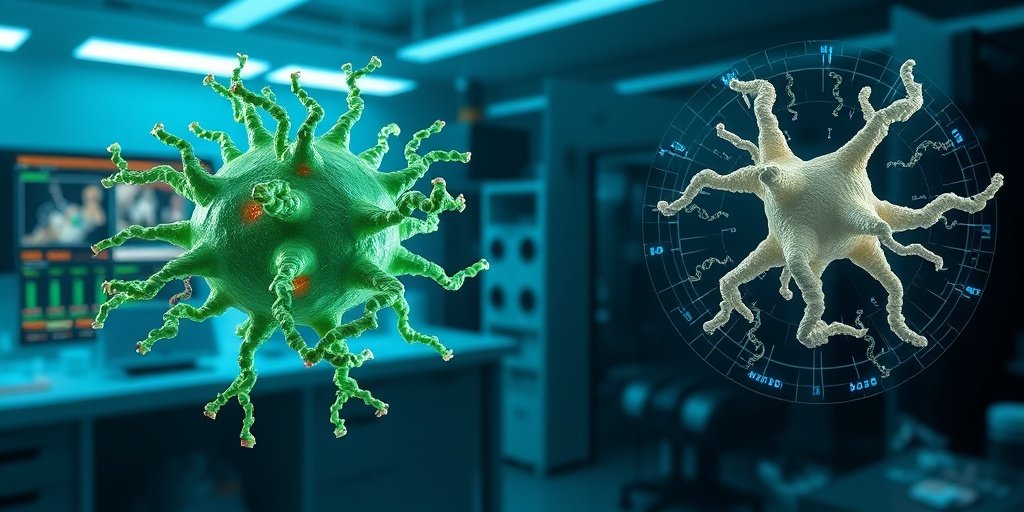
📚 Background
Klebsiella pneumoniae is recognized by the World Health Organization (WHO) as one of the most critical pathogens due to its ability to evade conventional antibiotics. As antibiotic resistance continues to rise, there is an urgent need for innovative therapeutic strategies. Phage therapy, which utilizes bacteriophages to target and destroy bacteria, is gaining traction as a viable alternative. However, the limited understanding of phage structures and mechanisms has hindered its widespread application.
🗒️ Study
The researchers employed AlphaFold 3.0 and bioinformatic analyses to model the structure of the bacteriophage KP32, which specifically targets strains of Klebsiella pneumoniae. This study aimed to provide a comprehensive understanding of the phage’s protein composition and structural organization, which is essential for unlocking its biological functions and therapeutic potential.
📈 Results
The study successfully reconstructed the entire structure of the KP32 phage, revealing that it consists of over 500 protein chains. Notably, 415 chains form the capsid, while 104 chains comprise the core-portal-tail complex. This complex structure enables the phage to adhere to its bacterial target, hydrolyze capsular sugars, and inject its genetic material into the bacterium, showcasing its intricate mechanism of action.
🌍 Impact and Implications
The findings from this study have significant implications for the field of phage therapy. By elucidating the structure of KP32, researchers can better understand how bacteriophages interact with their bacterial targets. This knowledge is crucial for developing effective phage-based treatments, particularly in the context of rising antimicrobial resistance. The reconstruction of phage structures represents a promising strategy for enhancing their therapeutic applications in medicine and biotechnology.
🔮 Conclusion
This study highlights the transformative potential of AI-driven structural biology in understanding bacteriophages like KP32. By decoding the molecular arsenal of these phages, we can pave the way for innovative therapies to combat antimicrobial resistance. Continued research in this area is essential for unlocking the full potential of phage therapy as a viable alternative to traditional antibiotics.
💬 Your comments
What are your thoughts on the potential of phage therapy in combating antibiotic resistance? We would love to hear your insights! 💬 Join the conversation in the comments below or connect with us on social media:
AI-Driven Structural Elucidation of the Bacteriophage KP32: Decoding Its Molecular Arsenal Against Klebsiella Pneumoniae.
Abstract
BACKGROUND: Klebsiella pneumoniae is one of the most critical Gram-negative bacteria according to the World Health Organization (WHO). Due to the ability of this bacterium to evade antibiotics, phage therapy is becoming a promising tool. However, the use of isolated proteins rather than entire phages could reduce several risks associated with phage replication. Thus, understanding the protein composition and structural organization of bacteriophages is crucial for unlocking their biology and holds great potential for medicine and biotechnology.
METHODS: In this study, artificial intelligence with AlphaFold 3.0 (AF3) and bioinformatic analysis were used to model the hitherto unknown structure of the Klebsiella phage KP32 (KP32), a complex and selective phage that targets K. pneumoniae strains with the K3 and K21/KL163 capsular serotypes.
RESULTS: By combining AF3 with sequence and structure analysis, we reconstructed the entire phage KP32. This complex phage is composed of over 500 protein chains, of which 415 compose its capsid and 104 its core-portal-tail complex, a platform that allows the phage to adhere to K. pneumoniae, hydrolyze its capsular sugars and finally inject its genetic code into the bacterium.
CONCLUSIONS: Phage therapy is a potentially promising tool for controlling antimicrobial resistance (AMR). However, one limitation arises from the limited knowledge of their nature and mechanisms of action, as only a few phages have been structurally characterized. The reconstruction of entire phages is currently a viable strategy for elucidating their mechanistic properties, knowledge that will enhance their potential applications as therapeutic alternatives.
Author: [‘Privitera M’, ‘Barra G’, ‘Squeglia F’, ‘Drulis-Kawa Z’, ‘Napolitano V’, ‘Berisio R’]
Journal: Front Biosci (Landmark Ed)
Citation: Privitera M, et al. AI-Driven Structural Elucidation of the Bacteriophage KP32: Decoding Its Molecular Arsenal Against Klebsiella Pneumoniae. AI-Driven Structural Elucidation of the Bacteriophage KP32: Decoding Its Molecular Arsenal Against Klebsiella Pneumoniae. 2025; 30:46489. doi: 10.31083/FBL46489