⚡ Quick Summary
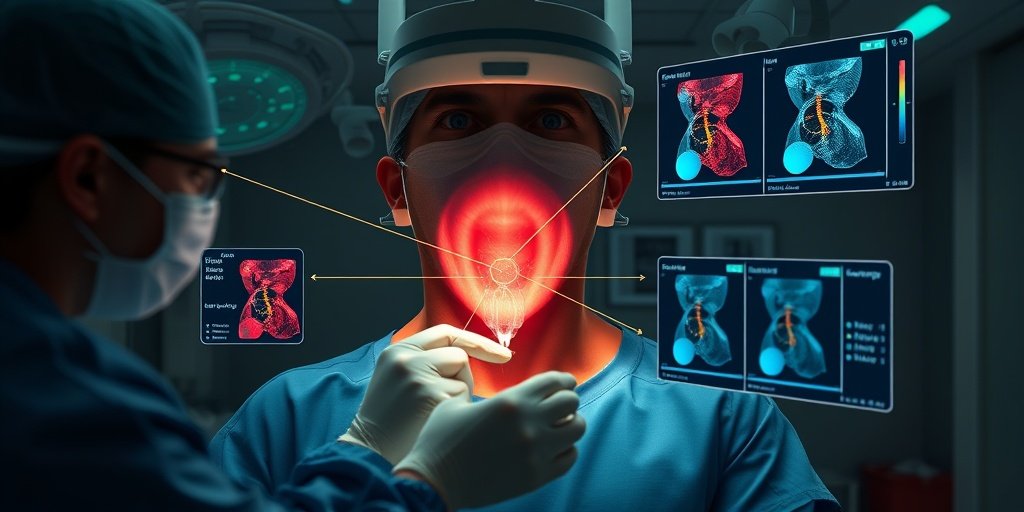
This study introduces ThyRLN-PUMCH, a groundbreaking dataset comprising 18,178 pixel-level annotated frames from 28 surgical cases, aimed at enhancing AI-assisted navigation in thyroid surgery. The dataset addresses the critical need for high-quality, annotated images to improve the safety and efficiency of surgeries involving the recurrent laryngeal nerve (RLN).
🔍 Key Details
- 📊 Dataset: 18,178 pixel-level annotated frames from 28 surgical cases
- 🧩 Annotations: Performed by board-certified endocrine surgeons
- ⚙️ Technology: Deep learning segmentation models
- 🏆 Validation: Multi-stage quality control process for annotations
🔑 Key Takeaways
- 📊 ThyRLN-PUMCH is the first comprehensive dataset for RLN identification in endoscopic thyroid surgery.
- 💡 AI integration in surgical navigation can significantly enhance patient safety.
- 👩🔬 High-quality annotations were validated by experienced surgeons, ensuring dataset reliability.
- 🏆 The dataset supports high-precision RLN segmentation tasks, crucial for surgical success.
- 🌍 Addresses limitations of existing intraoperative nerve monitoring technologies.
- 🤖 Potential for AI-based tools to improve surgical education and efficiency.
- 📈 Benchmarking of segmentation models demonstrated the dataset’s practical applicability.
📚 Background
The recurrent laryngeal nerve (RLN) is a critical structure in thyroid surgery, with injury rates ranging from 3-8%, leading to severe complications such as vocal cord paralysis. Traditional intraoperative nerve monitoring (IONM) methods face challenges, including high costs and operator dependence. The need for a robust, annotated dataset is essential for training effective AI models that can assist in real-time surgical navigation.
🗒️ Study
The study aimed to create a comprehensive dataset, ThyRLN-PUMCH, to facilitate the development of AI-assisted navigation tools in thyroid surgery. Researchers collected and annotated a total of 18,178 frames from 28 diverse surgical cases, ensuring a wide representation of clinical scenarios. The annotations were meticulously validated through a multi-stage quality control process by board-certified endocrine surgeons.
📈 Results
The study successfully benchmarked two segmentation models, demonstrating their effectiveness in performing high-precision RLN segmentation tasks. The results confirmed that the ThyRLN-PUMCH dataset provides a solid foundation for developing AI-based intraoperative navigation tools, enhancing surgical safety and efficiency.
🌍 Impact and Implications
The introduction of the ThyRLN-PUMCH dataset marks a significant advancement in AI-assisted head and neck surgery. By offering a high-quality, annotated resource, this dataset can lead to the development of innovative tools that improve surgical outcomes and patient safety. The implications extend beyond thyroid surgery, potentially influencing various surgical fields where nerve preservation is critical.
🔮 Conclusion
The creation of the ThyRLN-PUMCH dataset represents a pivotal step towards integrating AI into surgical practices. By providing a comprehensive resource for RLN identification, this study paves the way for enhanced surgical navigation tools that can significantly improve patient outcomes. The future of AI in surgery looks promising, and continued research in this area is essential for further advancements.
💬 Your comments
What are your thoughts on the integration of AI in surgical navigation? We would love to hear your insights! 💬 Leave your comments below or connect with us on social media:
A High-Quality Endoscopic Image Dataset with Annotated Recurrent Laryngeal Nerve for AI-Assisted Thyroid Surgery.
Abstract
The integration of artificial intelligence (AI) into surgical navigation represents a pivotal advancement in modern operative medicine. In endoscopic thyroidectomy, safeguarding the recurrent laryngeal nerve (RLN) is of critical importance due to its vulnerability to iatrogenic injury, which affects 3-8% of cases and can lead to serious complications such as vocal cord paralysis. However, existing intraoperative nerve monitoring (IONM) technologies are limited by high costs, operator dependence, and discontinuous signal acquisition. To address the lack of large-scale, annotated datasets essential for training robust deep learning models in real-world surgical settings, we present ThyRLN-PUMCH, the first comprehensive in vivo dataset dedicated to RLN identification in endoscopic thyroid surgery. This dataset comprises 18,178 pixel-level annotated frames from 28 clinically diverse surgical cases. Annotations were performed and validated by board-certified endocrine surgeons through a multi-stage quality control process. We benchmarked two segmentation models to verify their practicability and proved the dataset’s capacity to support high-precision RLN segmentation tasks. ThyRLN-PUMCH fills a critical gap in AI assisted head and neck surgery by offering temporally continuous, clinically representative images and annotations. It provides a robust foundation for developing AI-based intraoperative navigation tools aimed at enhancing surgical safety, education, and efficiency in head and neck surgery.
Author: [‘Zheng H’, ‘Cui R’, ‘Gao J’, ‘Yan Q’, ‘Yang S’, ‘Liao Q’, ‘Hua S’]
Journal: Sci Data
Citation: Zheng H, et al. A High-Quality Endoscopic Image Dataset with Annotated Recurrent Laryngeal Nerve for AI-Assisted Thyroid Surgery. A High-Quality Endoscopic Image Dataset with Annotated Recurrent Laryngeal Nerve for AI-Assisted Thyroid Surgery. 2026; (unknown volume):(unknown pages). doi: 10.1038/s41597-026-06961-6