 Yusuf Yesil, MD, MIS
Cardiovascular risk spikes during hot weather, but traditional clinical models treat high temperatures as a uniform threat to all patients. A new study shifts this focus by identifying individual susceptibility before heat waves hit. The analytical takeaway is clear: ambient temperature alone is a poor proxy for personal risk. Clinical algorithms must integrate systemic biomarkers to make environmental warnings actionable.
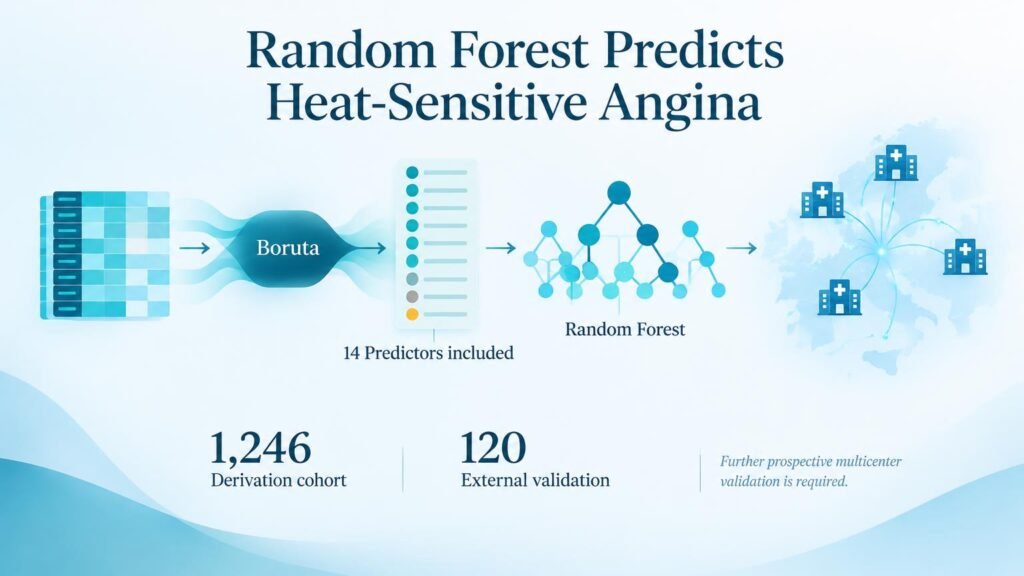
Researchers built machine learning tools using a derivation cohort of 1,246 individuals with stable angina across 43 clinical research centers in China. Using the Boruta algorithm for variable selection, the team narrowed the inputs down to 14 key predictors. These included region, mean platelet activity (MPA), diastolic blood pressure (DBP), body mass index (BMI), constipation, body fat distribution, and seven serological markers tied to inflammation and lipid metabolism.
Among seven algorithms tested, a Random Forest (RF) model delivered the strongest predictive performance across internal and external cohorts. Testing on an independent external validation set of 120 patients across 5 additional centers confirmed the model’s generalizability. A post hoc analysis further showed that patients flagged as high-risk by the RF model experienced a higher frequency of angina attacks during summer months.
Predictive Power Meets Environment
This work moves weather-related cardiac forecasting from crude geographic alerts to patient-specific risk profiles. Prior research has modeled environmental impacts on cardiovascular risks, such as using climate conditions to predict myocardial infarction or evaluating stroke incidence in hot climates. However, this model ties heat vulnerability directly to measurable biological traits.
- 1,246 patients evaluated across 43 centers in the primary derivation cohort.
- 14 specific clinical predictors identified, spanning metabolic, inflammatory, and anatomical metrics.
- 120 patients evaluated in an independent 5-center external validation trial.
Limits and Next Steps
Predictive accuracy is not the same as improved clinical outcomes. While the Random Forest model successfully categorizes susceptible patients, retrospective cohort validation does not prove that algorithmic alerts prevent adverse events or lower hospital admissions. The authors explicitly note that prospective, multi-center trials are required before this tool can enter routine practice.
For care providers, the practical mandate is to move beyond generic weather warnings for vulnerable cardiac populations. Combining routine metabolic and inflammatory markers into individualized risk profiles could help clinicians proactively adjust summer management plans for high-risk patients.
Read the full study in Frontiers in Digital Health.