 Yusuf Yesil, MD, MIS
Closing the early detection gap
Esophageal squamous cell carcinoma (ESCC) carries a high mortality rate because clinicians usually catch it late. Endoscopic screening works, but high costs and invasive procedures prevent its use in broad populations. A reliable liquid biopsy could triage high-risk patients long before symptoms appear.
That is the clinical void this study targets. Instead of relying on a single broad biomarker, researchers built a targeted machine learning classifier around specific serum proteins derived from two independent Chinese cohorts in Taixing and Jinan.
A high-performing machine learning model
Researchers used differential analysis, bulk RNA-seq, and single-cell RNA-seq to cross-validate diagnostic candidates at tissue and cellular levels. Differential analysis across both populations identified 13 proteins with distinct diagnostic value. Most of these markers matched expression patterns seen in mRNA and single-cell data.
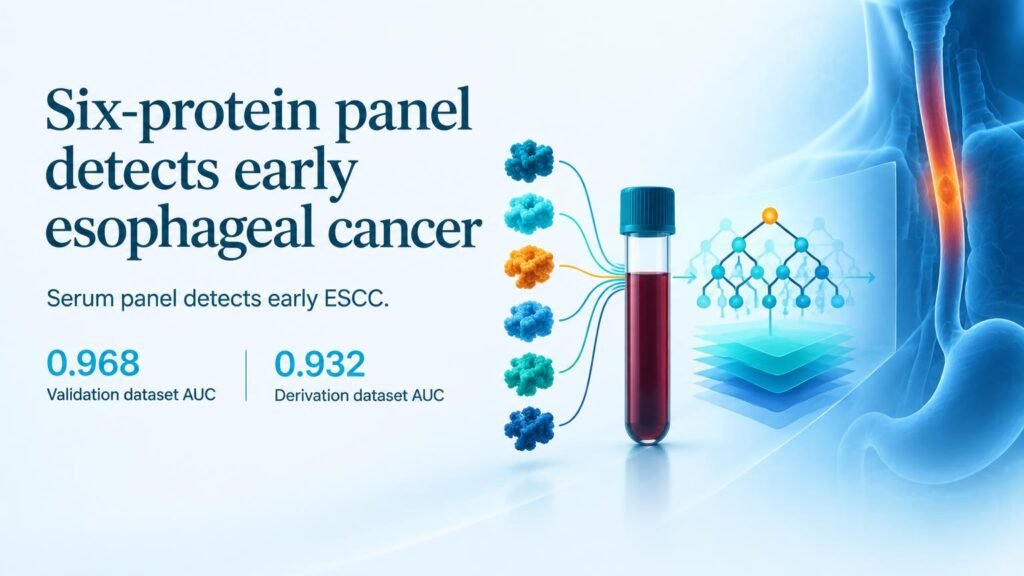
Lasso regression narrowed the panel to six core proteins: CDKN1A, ADAMTS15, KLK13, RSPO3, ANXA1, and MetAP2. A gradient-boosted decision tree algorithm trained on these six markers delivered the highest predictive accuracy.
The model reached an AUC of 0.932 (95% CI: 0.894–0.970) in the derivation dataset and an AUC of 0.968 (95% CI: 0.944–0.992) in the independent validation dataset. Beyond identification, risk scores derived from the transcriptome gene set of these core proteins effectively stratified long-term patient prognosis.
Moving past legacy discovery
Earlier mass-spectrometry studies identified individual markers like Tubulin Beta Chain and Filamin A or broad tumor-associated proteins, but rarely translated into precise algorithmic tools. This study advances targeted proteomic multi-protein classifiers by pairing multi-omic validation directly with modern decision trees.
High area-under-the-curve metrics in retrospective datasets show biological signal, not diagnostic readiness. Retrospective case-control designs tend to overestimate performance compared to real-world screening where early-stage prevalence is low. This tool cannot replace diagnostic endoscopy today.
Prospective trials in unselected screening populations must prove whether this 6-protein panel reduces diagnostic delay or changes overall survival before labs adopt it for routine triage.
Read the full paper in BMC Cancer.