 Yusuf Yesil, MD, MIS
Catheter insertion time dictates infection risk in fragile infants far more than clinical algorithms usually account for. A central line insertion lasting over an hour drives infection probability past 90%. Predicting these bloodstream infections early can save lives, but high algorithm scores on paper do not guarantee clinical safety.
That tension sits at the heart of a new retrospective multicenter study. While the top-performing model reached strong overall validation metrics, its low sensitivity exposes a dangerous operational gap for bedside care.
High Scores Mask Low Sensitivity
Researchers built five algorithms using data from 151 preterm infants with catheter-related bloodstream infections and 302 matched controls treated at a tertiary hospital between 2017 and 2024. The cohort was divided into a training set of 317 infants and an internal validation set of 136 infants, alongside an external validation cohort of 96 infants from four tertiary hospitals. Eight key clinical predictors were evaluated across Logistic Regression, Extreme Gradient Boosting, Decision Tree, Support Vector Machine, and Random Forest models.
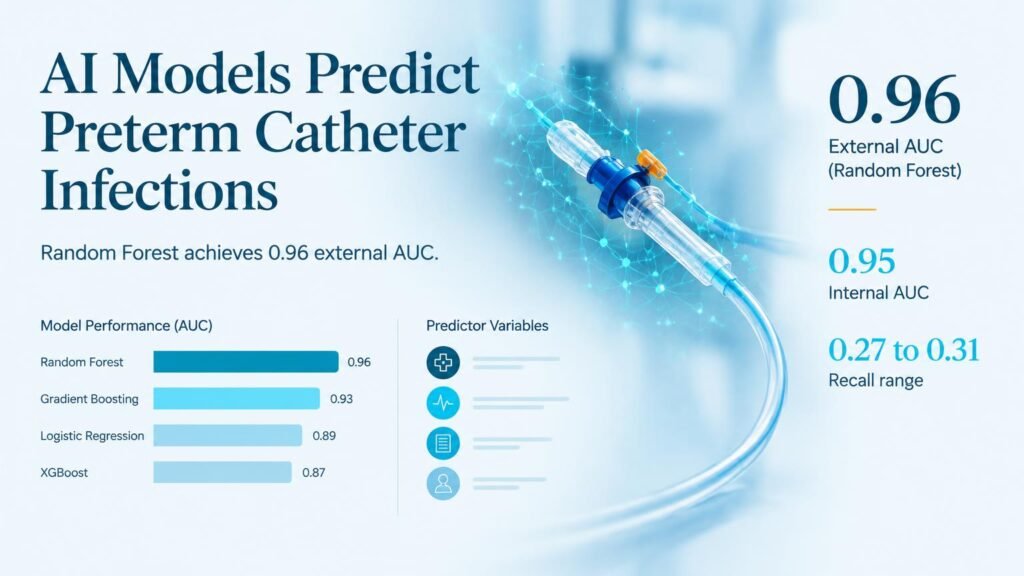
The Random Forest model led the field, scoring an internal AUC of 0.95 and an external AUC of 0.96, with external accuracy reaching 0.90. The Support Vector Machine model posted an external accuracy of 0.92 with an AUC of 0.93. These high curve values reflect trends seen across broader catheter risk prediction models in pediatric care.
However, headlines praising high AUCs obscure a critical failure point. Across all tested models, precision spanned 0.79 to 0.89, but recall collapsed to between 0.27 and 0.31, yielding poor F1 scores of 0.42 to 0.45.
That disconnect is the real story.
An algorithm that misses over two-thirds of infected infants cannot replace clinical vigilance. Retrospective validation success does not mean a tool is ready to manage patient care.
Procedure Metrics Drive Infection Risk
SHAP analysis confirmed that procedural execution weighed heavier than static patient factors. Puncture duration emerged as the primary driver of risk, followed by the chosen vein and mechanical ventilation metrics. Similar feature patterns appear in recent SHAP-based risk assessments for premature infants evaluated at the time of infection suspicion.
The raw clinical data highlights extreme risk shifts based on line placement and duration:
- Puncture duration over 60 minutes carried a 93% infection rate, compared to 78% for 30–60 minutes and 6% for under 30 minutes.
- Catheter dwell time beyond 21 days showed a 47% infection rate, versus 32% for 14–21 days and 21% for under 14 days.
- Femoral vein placement resulted in an infection rate of 82%.
Other key predictors included fetal distress, hypoalbuminemia, mechanical ventilation duration and frequency, and antibiotic use within 24 hours of birth.
Translating Metrics to Bedside Care
This study shows why health systems must look beyond top-line AUC when evaluating clinical AI software. Deploying this model to trigger clinical actions would leave the majority of infected infants undetected due to low recall.
The immediate practical takeaway is procedural rather than algorithmic. Neonatal units should focus on enforcing strict time limits on catheter placements and avoiding the femoral vein whenever possible, rather than relying on software to flag risk after the line is in place.
Data provided by Frontiers in Pediatrics.