 Yusuf Yesil, MD, MIS
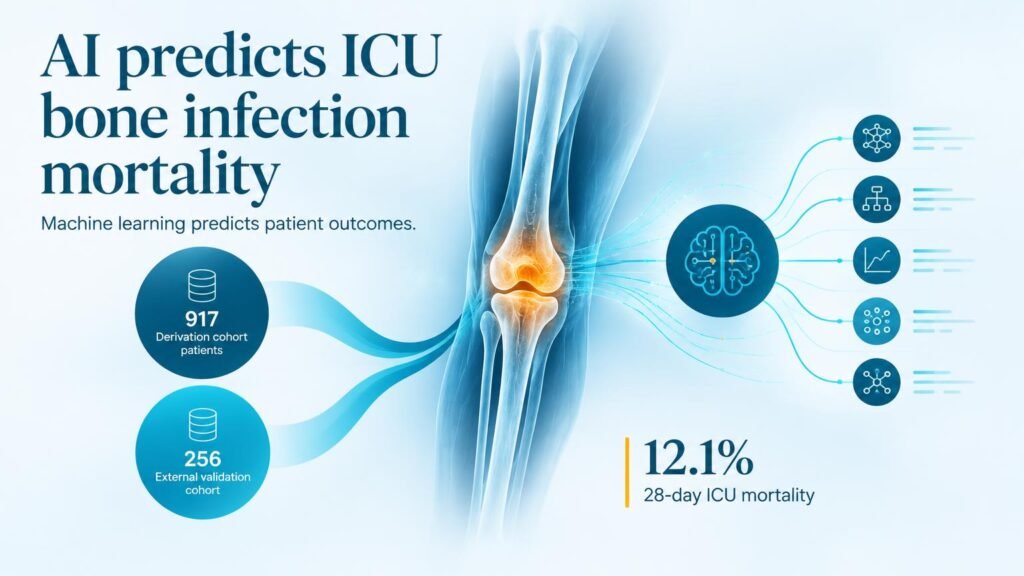
Critically ill patients with severe bone infections face a lethal mix of systemic inflammation and rapid tissue wasting. Clinicians frequently rely on traditional bedside tools like the Geriatric Nutritional Risk Index to spot who is slipping away. But inside the intensive care unit, that standard index breaks down completely.
In a dual-cohort study, researchers evaluated five popular nutrition-inflammation indices in bone infection ICU patients. The Geriatric Nutritional Risk Index proved clinically useless by flagging 94.9% of patients as at-risk. When a clinical score labels virtually an entire ward endangered, it offers zero actionable insight for patient triage.
That failure highlights a broader shift in critical care monitoring. While single lab scores work well in general wards, complex ICU populations demand tools that process multi-system strain in real time.
Only two standalone scores maintained independent predictive value after full multivariable adjustment. Patients in the lowest tertile of the Hemoglobin-Albumin-Lymphocyte-Platelet (HALP) score faced a more than threefold increase in 28-day ICU mortality (OR = 3.41, 95% CI 2.13–5.46). Low Prognostic Nutritional Index (PNI < 45) also independently predicted death (OR = 2.48, 95% CI 1.09–5.66).
Beyond simple bedside scores
Single lab ratios still hit an operational ceiling. PNI achieved an external validation AUROC of 0.742, while HALP reached 0.713. To move beyond modest accuracy, researchers extracted 14 core clinical features to train machine learning models.
A LightGBM model combined routine lab values with organ failure metrics, achieving an external validation AUROC of 0.956 (95% CI 0.921–0.985). SHAP analysis confirmed that acute kidney injury, APS III scores, and arterial oxygen tension drove predictions. This builds on broader research evaluating machine learning for mortality prediction using nutritional and inflammatory markers in intensive care settings.
Key findings at a glance
- HALP and PNI lead single metrics: HALP (lowest tertile ≤ 171.11) and PNI (< 45) were the only traditional scores independently linked to 28-day mortality.
- GNRI loses clinical utility: The index flagged 94.9% of the derivation cohort as at-risk, stripping away its power to stratify high-risk patients.
- LightGBM delivers high accuracy: Integrating 14 routine clinical features yielded an external AUROC of 0.956 in a 256-patient validation cohort.
Limits and real-world deployment
These results do not mean software should automatically direct clinical decisions. The study relied on retrospective data from a U.S. database (MIMIC-IV, n = 917, 28-day mortality 12.1%) and a single external validation hospital in China (n = 256, 28-day mortality 16.0%). Retrospective accuracy is not proof that a tool reduces death rates or lightens clinician workload.
Furthermore, traditional markers often oversimplify outcomes in specialized ICU cohorts, a pattern highlighted in studies comparing nutritional risk indices and HALP scores in older ICU patients. Before deployment, ICUs need prospective trials showing that automated risk alerts actually change clinical management.
For now, intensive care units should drop GNRI for bone infection admissions and evaluate interpretable gradient-boosting tools to catch deteriorating patients earlier.
Source study published in Frontiers in Nutrition.