 Yusuf Yesil, MD, MIS
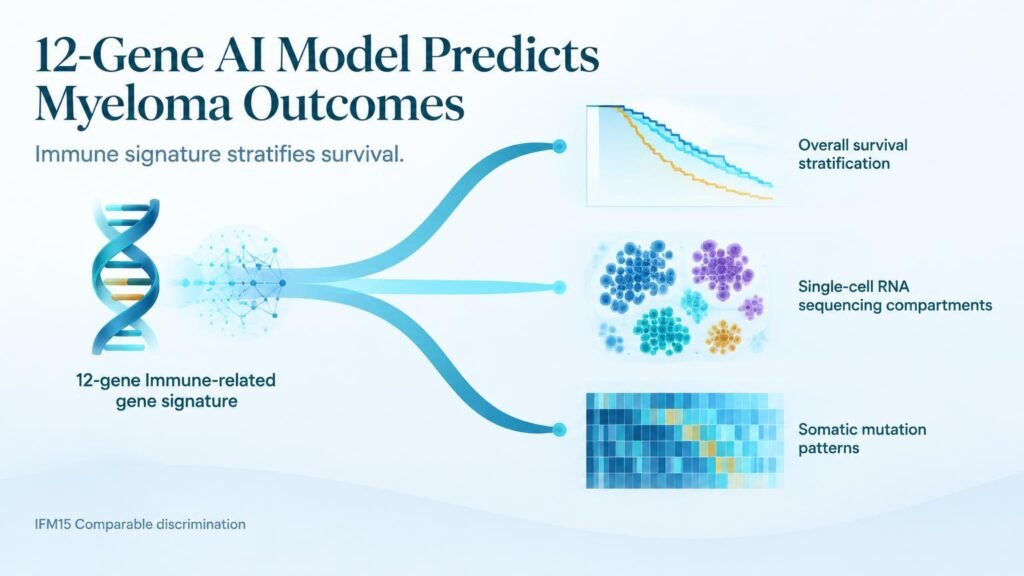
A patient’s multiple myeloma survival depends heavily on the bone marrow microenvironment, yet standard risk models focus primarily on malignant plasma cells. By analyzing whole microenvironments rather than isolated cancer cells, machine learning algorithms are proving that surrounding immune activity dictates disease aggression.
That shift reshapes how clinicians evaluate risk.
Instead of relying solely on tumor-intrinsic mutations, profiling broader immune dysregulation allows oncologists to identify therapeutic vulnerabilities before treatment failure occurs.
Beyond Plasma Cell Signatures
Using an integrative machine learning framework, researchers developed a 12-gene immune-related gene signature (IRGS) to stratify overall survival across multiple clinical cohorts. The score remained an independent prognostic marker after adjusting for established clinical covariates.
Single-cell RNA sequencing revealed marked cell type-dependent variation in the activity of the 12-gene module. The signature showed comparatively low activity in plasma cells and higher activity across non-plasma bone marrow compartments. This confirms the bulk-derived score reflects a multicellular transcriptional context rather than a simple plasma cell intrinsic program.
These results build on broader efforts to map the marrow niche, including a monocyte-driven prognostic model for multiple myeloma and recent work on inflammatory response-related gene signatures.
Key Model Discoveries
The signature revealed distinct mutational profiles and targeted drug vulnerabilities between patient risk tiers:
- Prognostic performance was comparable to the established IFM15 index and exceeded that of MRCIX6 and mitophagy-based signatures.
- The low-risk IRGS group exhibited relative enrichment of DIS3 mutations alongside a modestly higher tumor mutational burden.
- The high-risk IRGS cohort demonstrated relative enrichment of MUC16 mutations.
- Transcriptome-based drug predictions revealed distinct sensitivity patterns across apoptosis, DNA damage, BET, checkpoint, and replication-stress agents.
Limits and Clinical Next Steps
These findings rely on retrospective transcriptomic data and computational drug-response models. Retrospective stratifications do not prove that altering therapy based on 12-gene profiling improves actual clinical outcomes or survival in prospective cohorts.
The practical takeaway is operational. Stratifying clinical trial cohorts by multicellular immune context rather than tumor genomics alone offers a clearer pathway to matching patients with checkpoint inhibitors and DNA damage agents. Prospective clinical trials must now confirm if these predicted vulnerabilities translate to real-world responses.
Full findings are published in Cancer Science.