 Yusuf Yesil, MD, MIS
While benchmark scores for medical AI continue to climb, real-world deployments this week highlight an undeniable gap between raw predictive power and actual clinical safety. As builders and clinicians, we must focus on validation guardrails before letting these tools dictate patient care.
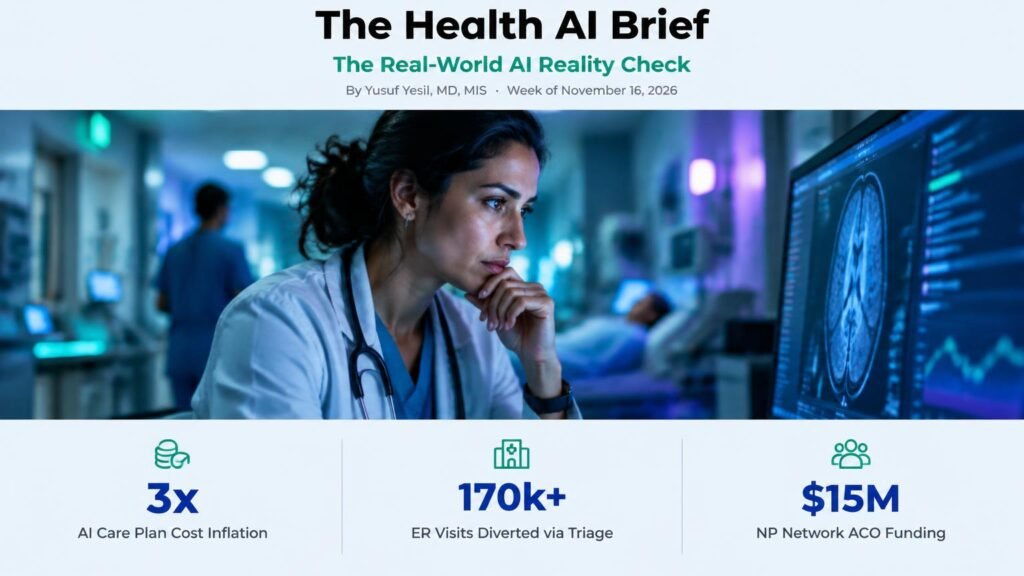
🔹 AI Care Plans Triple Visit Costs — Clinical AI recommendations lead to testing and referrals that cost more than three times human physician orders.
When I was building at Yesil Health, over-defensive algorithmic outputs were a constant hurdle. Defensive medicine built into training data creates massive financial inefficiency.
🔹 170,000+ ER Visits Diverted — Nurse-led phone triage services quietly reshaped acute care access by diverting over 170,000 unnecessary emergency department visits.
Smart routing systems don’t need complex generative models to cut health system congestion—simple structural triage works.
🔹 DeepSeek Fails Safety Tests — Open-source models matched GPT-4 diagnostic accuracy but collapsed under safety red-teaming.
For developers, off-the-shelf open models are attractive for privacy, but guardrails require significant custom alignment work.
🔹 NP Network Secures $15M — Independent nurse practitioners secured $15M in funding to run value-based Medicare ACO networks without physician ownership.
Capital is aggressively backing alternative primary care delivery models, putting software automation at the center of operations.
🔹 High AUC Hides Calibration Flaws — A machine learning model identified sleep apnea cognitive risk accurately but suffered from broken probability scoring.
High AUC gets papers published, but poor calibration leads to dangerous real-world treatment decisions if doctors rely on raw probability numbers.
🔹 Colorectal ICU Model Fails Validation — An ICU mortality model’s predictive power plummeted when evaluated across external hospitals.
Site-specific overfitting remains the quiet killer of clinical AI deployment; single-center retrospective studies are not enough.
🔹 ER Doctors Trust Fake AI Abstracts — Acute care physicians routinely accepted convincing AI-generated fabrications as valid medical evidence.
Syntactically flawless medical language easily tricks time-pressured clinicians, making verification layers mandatory.
🔹 MDCalc CrossCover Verifies AI — A new platform cross-checks clinical generative LLM answers against verified medical calculators and evidence guidelines.
Deterministic verification engines tied to stochastic models are the only viable path to safe bedside AI deployment.
🔹 AI Guides Novices in Ultrasound — Non-specialists using guided handheld ultrasound accurately flagged severe aortic stenosis without formal imaging training.
Decentralizing complex diagnostic skills down to front-line staff is where medical AI delivers immediate clinical ROI.
🔹 Open AI Models Match Commercial LLMs — Open-weight models extracted clinical comorbidities from unstructured notes with accuracy equal to GPT-4.
Running performant extraction models locally eliminates HIPAA cloud pipeline complexity for health systems.