 Yusuf Yesil, MD, MIS
The Blind Spot
General-purpose AI models can effortlessly pass basic multiple-choice medical tests. Yet when forced to evaluate complex drug chemistry or visual diagnostic data, their precision crumbles.
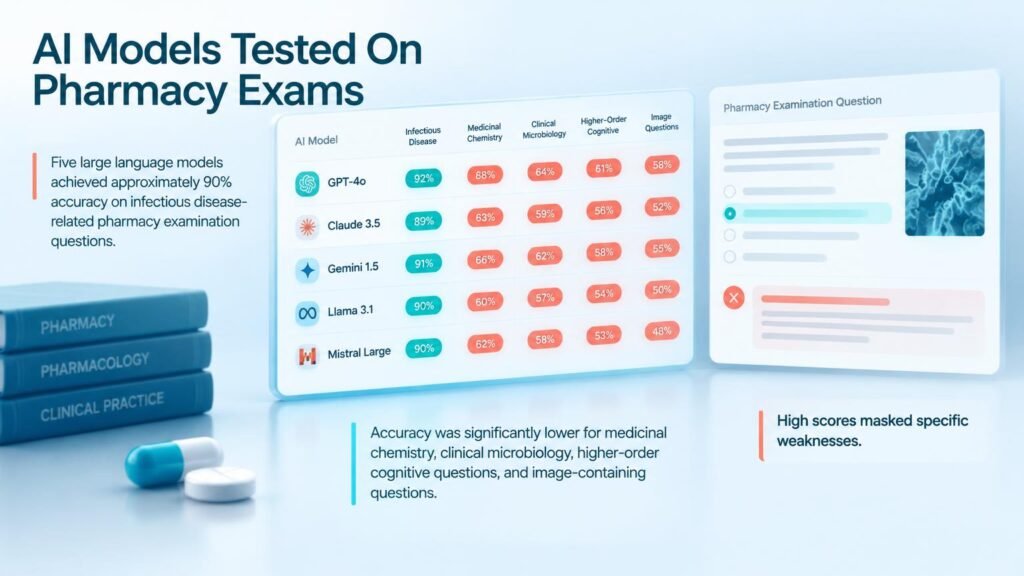
A test of five leading large language models across 227 infectious disease pharmacy exam questions revealed an average accuracy of around 90%. ChatGPT-4o-mini led the group at 91.2% accuracy. However, surface-level success masks serious operational risks.
Performance dropped sharply on questions requiring higher-order cognitive reasoning, clinical microbiology, medicinal chemistry, and image analysis. Models struggled to interpret visual inputs like chemical structures, exposing a core flaw in multimodal processing.
Clinical Reality
High test accuracy does not equal clinical safety.
A 90% score on a standardized exam sounds impressive, but in a real-world clinical pharmacy setting, a 10% error rate in infectious disease management means improper dosing, missed drug interactions, or incorrect antibiotic selection.
These retrospective findings prove that exam performance is a poor proxy for real-world readiness. Unverified AI outputs in pharmacy workflows risk direct patient harm if clinicians rely on them without rigorous manual verification.
The Takeaway
AI tools can assist with basic study recall, but they are not ready for unsupervised clinical decision support. Healthcare institutions must mandate human oversight for any AI application handling complex diagnostic or therapeutic reasoning.