Yusuf Yesil, MD, MIS
Aortic stenosis often goes unnoticed until patients develop overt heart failure. Traditional screening relies on comprehensive echocardiograms and scarce, specialized sonographers. This bottleneck keeps early detection out of reach for primary care clinics and rural health systems.
A new trial published in Mayo Clinic-led research challenges that barrier. By pairing real-time AI guidance during image capture with automated interpretation, non-specialists successfully identified moderate or greater valve narrowing. But the data reveals a critical caveat: software alone creates too many false alarms to stand without expert overread.
That shift alters how health systems must think about point-of-care ultrasound protocols. Deploying AI to task-shift image acquisition works, but true clinical efficiency still hinges on specialist triage.
High Accuracy Across Novice Operators
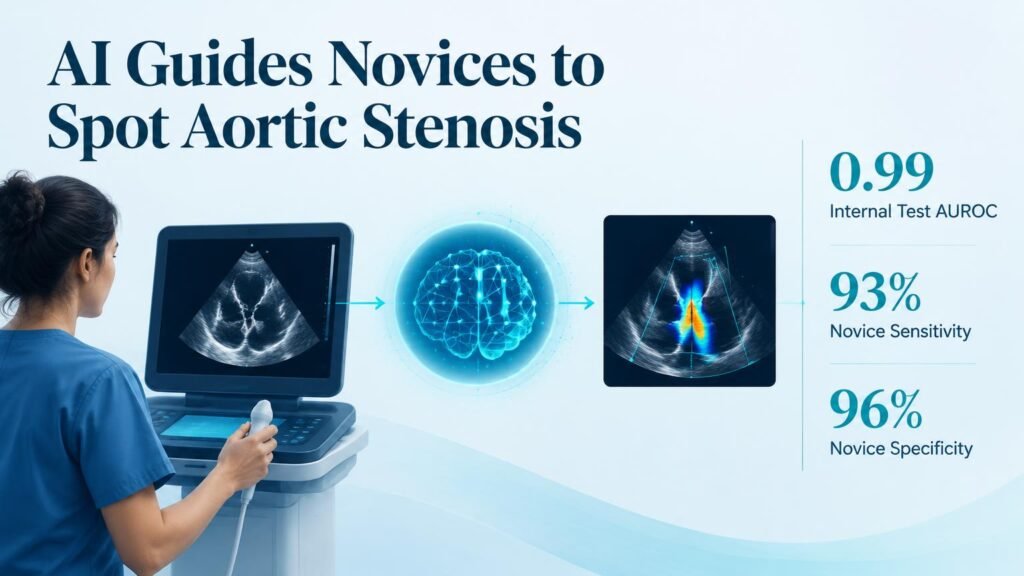
Researchers built the model using data from 6,753 patients and validated it across cohorts in Minnesota, Arizona, and Florida. The algorithm delivered an area under the curve of 0.99 across retrospective test sites.
To test real-world execution, the study prospectively enrolled non-expert users acquiring focused ultrasound scans. Out of 1,302 novice-acquired examinations, 96.6% were high enough quality for automated analysis. This builds on prior efforts to evaluate deep learning applied to echocardiography in structured diagnostic settings.
When novice operators captured the images, the AI maintained strong diagnostic accuracy compared to standard lab workflows:
- Experienced sonographers achieved 95% sensitivity and 97% specificity.
- Novice operators yielded 93% sensitivity and 96% specificity.
- Raw positive predictive value for novice scans sat at just 49.4%.
- Adding expert review to AI-positive scans boosted positive predictive value to 91.1%.
The Human Gatekeeper Requirement
The jump from a 49.4% positive predictive value to 91.1% after cardiologist review is the key operational finding. Without expert secondary triage, half of all patients flagged by the software would face unnecessary follow-up echocardiograms and specialist visits.
This dynamic confirms broader trends in artificial intelligence for aortic stenosis. AI tools excel at ruling out disease at the frontline. Yet human oversight remains essential to filter false positives before writing referrals.
The limitation that changes practical implementation is trial setting. While operators were novices, the study ran within Mayo Clinic sites. Performance in high-volume community clinics with different patient demographics demands separate prospective validation.
Health systems evaluating AI ultrasound tools should not expect to eliminate cardiologist review. Instead, the practical takeaway is a hub-and-spoke screening model. Novices collect scans in primary care, while centralized experts review only the flagged fraction to catch structural heart disease early.
Read the full study in JAMA Cardiology.