

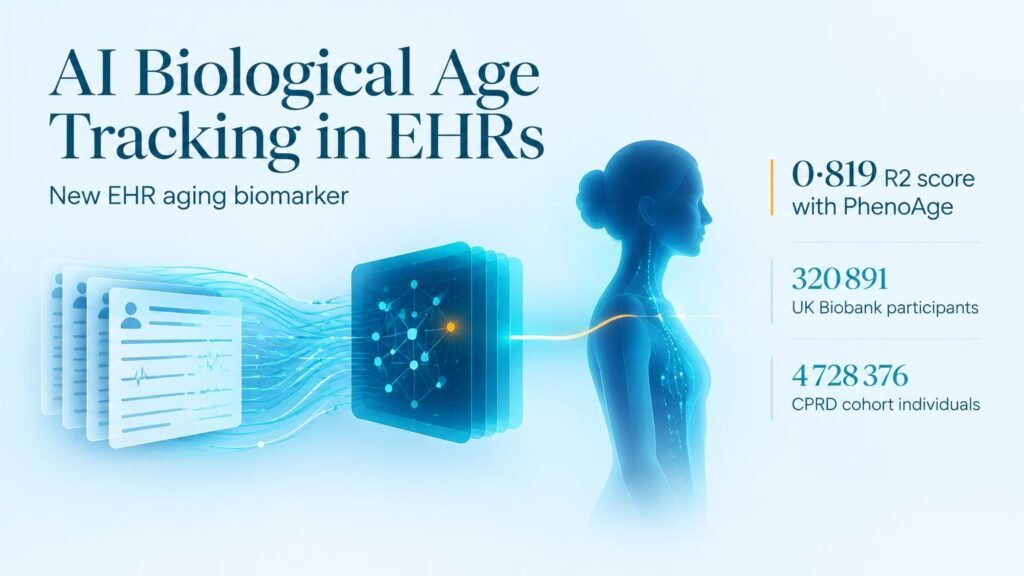
A new transformer model accurately estimates biological age using routine medical records, opening the door to population-scale frailty screening without specialized lab tests.
Doctors know that two 60-year-old patients often have vastly different health profiles. Tracking biological aging usually requires costly blood panels or specialized biomarker kits that health systems cannot run on everyone.
That friction just got smaller.
Researchers trained a transformer-based deep learning model called ClinicalAge using standard medical records. Instead of requiring novel lab panels, it derives biological age directly from routine clinical histories. It turns passive administrative data into an active early warning system for metabolic and physiological decline.
Validating Risk Across Millions
The study built ClinicalAge using the UK Biobank dataset of 320,891 participants with a median age of 58.0 years. Researchers then validated the model externally across 4,728,376 individuals in the CPRD Aurum database.
The tool matched established reference standards, showing an R² score of 0.819 with PhenoAge. It strongly correlated with 17 functional measures and 10 biological biomarkers. It also significantly linked to the incidence of all 20 non-cancer diseases tested.
More importantly, accelerated ClinicalAge directly predicted early death. In the external CPRD cohort, each step up in ClinicalAge carried a higher risk of mortality after controlling for lifestyle factors:
- All-cause mortality: Hazard ratio of 1.36 (95% CI 1.36–1.36).
- Cardiovascular mortality: Hazard ratio of 1.36 (95% CI 1.35–1.36).
- Cancer mortality: Hazard ratio of 1.17 (95% CI 1.16–1.17).
It also predicted 9 of 11 cancers in the UK Biobank and 10 of 11 cancers in the CPRD validation set.
Targeting the Midlife Divergence Window
The data highlighted midlife as the critical period where aging trajectories split. Early acceleration spiked in adults who developed diabetes, hypertension, depression, or lifestyle disorders.
That timing matters for preventative health. Identifying accelerated aging in a patient’s 40s or 50s gives primary care providers a concrete window to escalate cardiometabolic controls, offer mental health support, or prompt aggressive lifestyle changes before organ damage compounds.
Limits in Practical Real-World Deployment
Strong statistical performance in longitudinal UK records is not immediate proof of clinical utility. The model relies on the density and continuity of routine primary care records, which varies wildly across different global health systems.
Retrospective validation does not guarantee that acting on a ClinicalAge score changes long-term patient outcomes. Health systems still need prospective trials to prove that flagging accelerated aging leads to meaningful intervention rather than just added clinical noise.
Read the full peer-reviewed study in The Lancet Digital Health.