
A machine learning model built to predict 28-day ICU mortality for severe colorectal cancer patients saw its predictive power plummet when tested across external hospitals.
Algorithms trained on single-database populations often look flawless on paper. Yet when moved to broader clinical environments, hidden brittle points quickly surface. This gap between internal performance and real-world transferability remains the single largest bottleneck for bedside AI deployment.
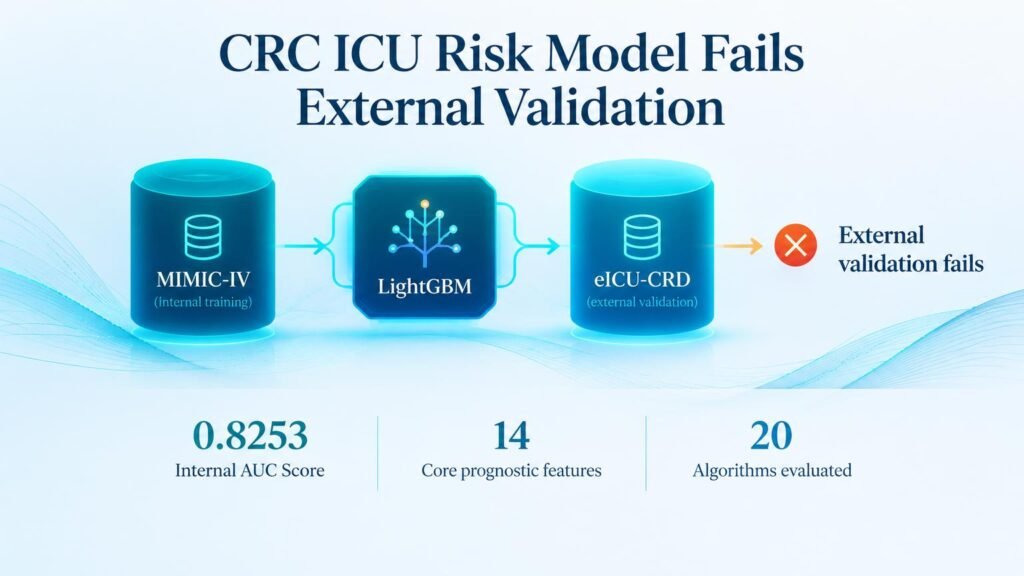
A study published in BMC Cancer highlights this exact breakdown. Researchers pulled data from the MIMIC-IV database to build a 28-day all-cause mortality risk predictor for critically ill elderly colorectal cancer patients. Out of 20 algorithms evaluated using a stratified repeated cross-validation framework, LightGBM emerged as the top candidate.
Strong Internal Scores Mask Transferability Gaps
Using a multi-algorithm feature selection process combining LASSO, Random Forest, and Genetic Algorithms, the team isolated 14 core prognostic features. Key inputs included the Simplified Acute Physiology Score II (sapsii_score), Red Cell Distribution Width (rdw), lactate, and the charlson_comorbidity_index.
During internal testing, LightGBM delivered impressive diagnostic accuracy. It hit an AUC of 0.8253, an accuracy of 0.8434, a specificity of 0.9745, and a low Brier Score of 0.1106. Decision Curve Analysis also showed significant net clinical benefit. These results aligned with broader efforts in machine learning algorithms predicting colorectal cancer mortality across national cohorts.
That strong baseline disappeared during independent external validation.
When evaluated on the eICU Collaborative Research Database (eICU-CRD), the model’s AUC dropped to 0.615. The external cohort suffered from extreme class imbalance and a small sample size, which led to a notable negative bias and systematic risk overestimation. The model essentially lost its ability to reliably stratify high-risk patients outside its primary training site.
Explainable AI Cannot Fix Bad Data
To aid frontline decision-making, the authors integrated SHAP and LIME interpretability frameworks and launched an interactive Streamlit web application. These tools illustrate how specific clinical features drive individual risk scores.
Visual explanations help clinicians audit predictions, but transparent reasoning cannot salvage a model with degraded discrimination. Previous work on 28-day mortality prediction in elderly colorectal cancer patients has similarly shown that algorithm output must hold up across varied health systems before driving direct care interventions. High internal specificity means little if external testing yields false alarms.
What Clinicians and Builders Must Rethink
Retrospective performance is not operational readiness. High internal AUC scores frequently obscure acute sensitivity to site-specific data distributions and missing values.
Developers must prioritize massive, diverse external cohorts prior to clinical deployment. Until risk models prove stable across multiple health systems, web apps and visual dashboards remain experimental research prototypes rather than safe bedside decision tools.
Read the full study in BMC Cancer.