
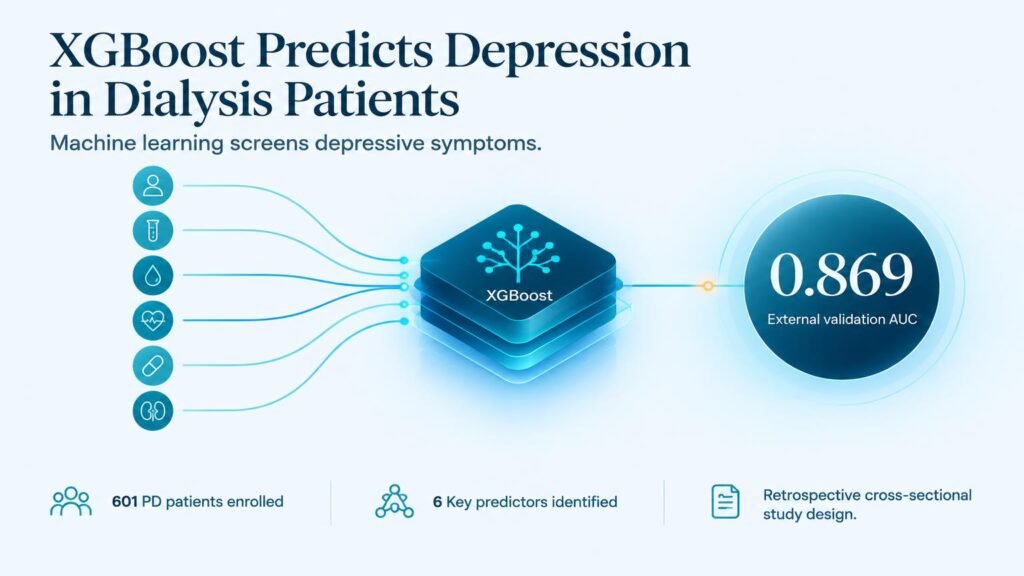
A new machine learning model detects elevated depressive symptoms in peritoneal dialysis patients before routine checkups catch them.
Depression severely undermines survival and quality of life for people undergoing home dialysis. While clinicians know mental health impacts physical outcomes, routine screening in kidney clinics remains sporadic and reactive. Building predictive models directly into clinical workflows shifts the burden from patient self-reporting to automated risk tracking.
Researchers pulled retrospective data from 601 peritoneal dialysis patients across two hospital centers in China. The training set comprised 356 patients from Huangshi Central Hospital, alongside an internal validation group of 126 patients. An independent cohort of 119 patients at Honghu People’s Hospital served as the external test set to prove real-world accuracy.
Predicting Risk Beyond Questionnaire Scores
Using LASSO regression, the study narrowed dozens of health metrics down to six primary indicators. The model evaluated patient age, anxiety status via SAS score, social support via SSRS score, total peritoneal dialysis vintage, and history of peritonitis or catheter-related complications.
While previous work published in BMC Nephrology confirmed that clinical factors correlate with mood disorders, this algorithm ranks their combined predictive weight automatically.
Among nine machine learning architectures tested, the XGBoost model delivered the strongest accuracy across hospital cohorts:
- External validation Area Under the Curve (AUC): 0.869
- External validation F-measure: 0.63
- Primary screening target: Self-Rating Depression Scale (SDS) score ≥53
- Predictive variables isolated: 6 key clinical and psychological factors
The team wrapped the XGBoost algorithm into a web-based R Shiny application for real-time scoring. Clinicians input routine lab and history metrics to generate instant risk profiles during patient visits.
Separating Risk Tools From Actual Care
The strong external AUC demonstrates that machine learning can reliably identify high-risk patients outside the original training hospital. This addresses a major weakness seen in prior risk nomograms, such as those evaluated in Clinics, which often struggle when applied to new geographic regions.
However, accurate risk scoring does not equal clinical improvement. An F-measure of 0.63 leaves room for false positives and missed cases, meaning the software cannot replace formal psychiatric evaluation. Furthermore, historical data from cross-sectional cohorts cannot prove that flagging these patients early leads to effective intervention or lower mortality.
Depression correlates with higher mortality in dialysis populations, as established in early landmark studies in Peritoneal Dialysis International. But software alone will not fix the care gap. Clinics adopting this system must pair risk alerts with concrete behavioral health referral pathways, ensuring high scores trigger actual medical support rather than administrative noise.
Data provided by Frontiers in Public Health.