
A machine learning model predicts post-surgical tumor recurrence in young patients seeking to preserve fertility, giving surgeons a concrete data tool where clinical guesswork used to reign.
Replacing guesswork after surgery
Surgeons performing fertility-sparing surgery for borderline ovarian tumors face a grueling tradeoff. Preserving reproductive organs keeps family planning alive, but it leaves patients exposed to potential disease relapse. Without precise prognostic tools, post-surgical surveillance often relies on broad clinical intuition rather than individualized risk scoring.
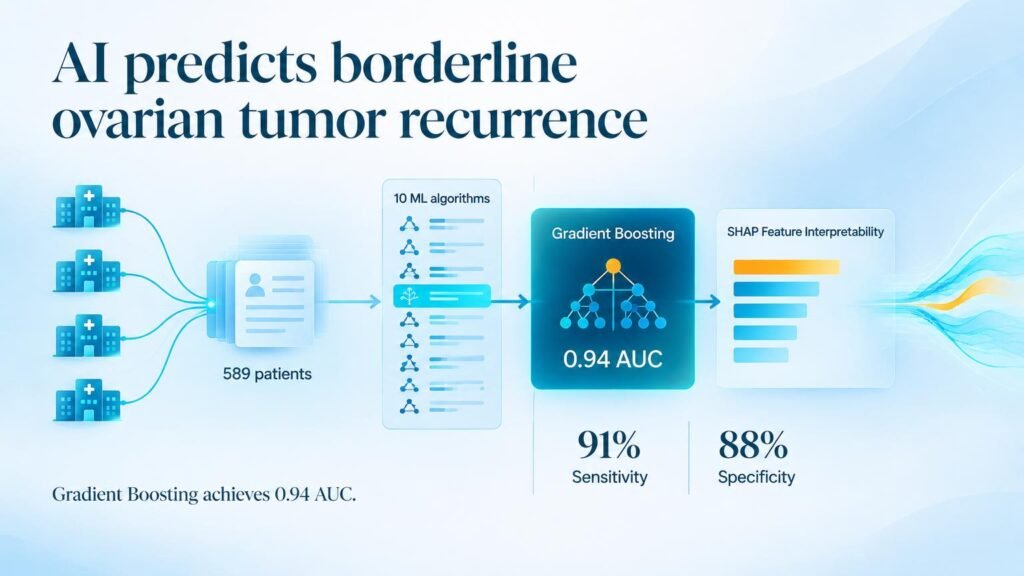
That uncertainty may be narrowing. A multi-center retrospective study evaluated ten machine learning algorithms on 589 patients who underwent fertility-sparing surgery between 2010 and 2023. By combining clinical, pathological, and laboratory variables, researchers trained models to flag individuals at elevated risk of recurrence.
The clear top performer was the Gradient Boosting algorithm. It achieved an AUC of 0.94, a sensitivity of 91%, and a specificity of 88% in identifying relapse risk.
Key drivers of surgical risk
Model interpretability analysis using SHAP values showed that risk prediction does not depend on obscure biomarkers. Instead, four standard clinical variables drove the predictions:
- Histological subtype of the tumor
- Age at diagnosis
- Primary tumor size
- Specific surgical approach used
The team deployed the algorithm into a web-based calculator, allowing physicians to input patient data at the point of care. Rather than relying on static guidelines, oncologists can view a dynamic risk profile before deciding on aggressive monitoring or follow-up procedures.
Validation hurdles remain
This result complicates the narrative that complex genomic profiling is strictly necessary for accurate surgical risk stratification. Standard clinical metadata, when integrated effectively, carries strong predictive weight. Yet high predictive accuracy in a retrospective cohort does not prove that algorithmic guidance improves long-term survival or pregnancy outcomes.
The trial relies entirely on retrospective data from 2010 to 2023. Retrospective models often suffer from historical practice variations, changes in surgical technique, and missing longitudinal follow-up. Until prospective trials show that acting on these scores reduces actual recurrences without triggering unnecessary secondary surgeries, the calculator remains a decision support aid, not a clinical directive.
The clinical takeaway is straightforward: high risk scores should prompt tighter imaging schedules, while low risk scores can reassure patients pursuing pregnancy. The research was published in the Journal of Ovarian Research.