
Hospitals face unprecedented legal exposure when clinical AI causes harm if data logs cannot prove human oversight.
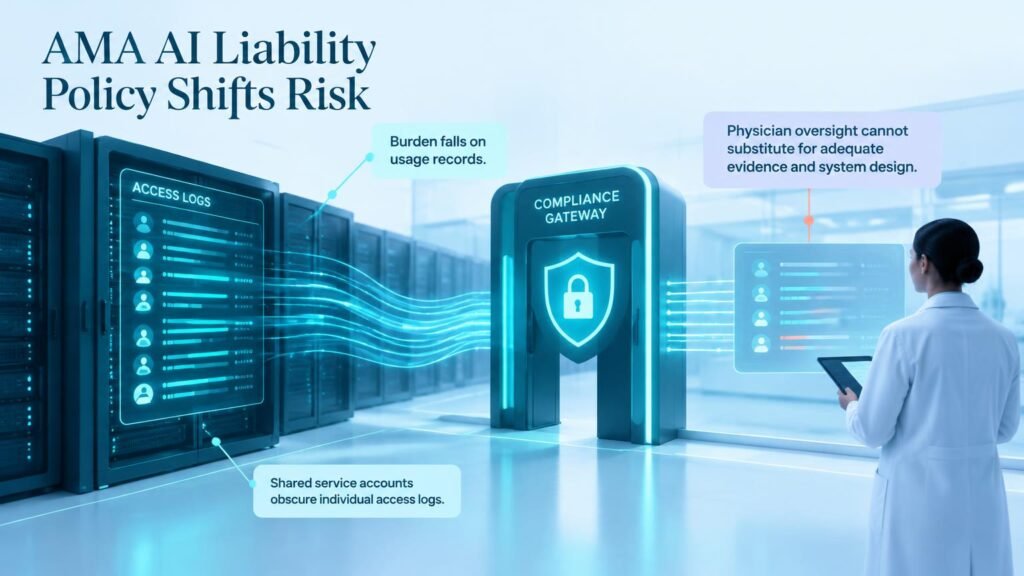
Physician sign-off no longer shields health systems from clinical AI liability. The American Medical Association’s updated policy framework explicitly states that human oversight cannot compensate for inadequate system design or lack of underlying evidence.
Where Liability Scrutiny Shifts
This policy repositioning places direct legal risk on health system IT infrastructure. Legal accountability now hinges on system control, real-world monitoring, and traceable usage. When AI-driven patient harm occurs, defense strategies require proving exactly what data the algorithm accessed and which clinician acted on it.
Many current deployments fail this standard. Clinical AI tools routinely query electronic health records through shared service accounts, masking individual user interactions behind generic system credentials. If a health system cannot produce attributable usage logs, it cannot prove whether a failure stemmed from algorithmic error, poor integration, or clinician misuse.
The Operational Imperative
Diagnostic accuracy and algorithmic validation are insufficient protections in court without strict auditability. Chief information security officers must immediately audit clinical AI data access pathways to enforce individual user attribution, eliminating anonymous shared credentials before liability claims arise.