
A dynamic deep learning architecture accurately flags surgical mortality risk before an operation ends, but site-specific calibration issues prevent immediate clinical deployment.
Static surgical risk scores often miss the sudden physiological shifts that happen on the operating table. When a patient’s vitals drop mid-procedure, traditional preoperative metrics fail to update the risk profile. This leaves surgical teams relying on intuition rather than continuous data when planning post-acute care transfers.
The PRIME-MoE model changes that dynamic by processing continuous intraoperative signals. By routing live data through four unidirectional long short-term memory (LSTM) experts using static surgical context, the system updates risk trajectories dynamically during surgery.
High Accuracy Across Institutions
Researchers built and validated the model using a retrospective cohort of 173,990 surgical cases drawn from the INSPIRE and HUAXI databases. Across diverse surgical specialties and institutions, the architecture maintained strong diagnostic discrimination.
The primary performance metrics demonstrate strong baseline predictive power:
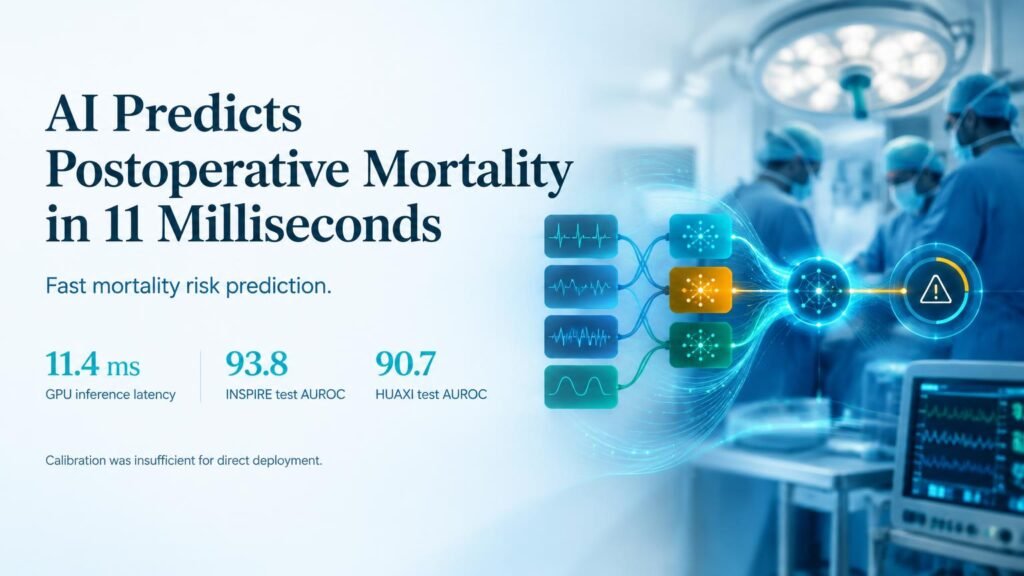
- Internal validation achieved an area under the receiver operating characteristic curve (AUROC) of 93.8 (95% CI 92.3-96.0) in the INSPIRE dataset.
- Validation on the HUAXI database yielded an AUROC of 90.7 (95% CI 87.1-94.8).
- Cross-database evaluation retained discrimination with AUROCs of 90.8 and 87.8 when applied reciprocal-style between institutions.
- The model operates with a median graphics processing unit inference latency of just 11.4 ms per case.
That speed matters for clinical workflow integration. When tested by truncating the final 30 minutes of intraoperative data without retraining, the model still achieved AUROCs of 93.1 in INSPIRE and 90.2 in HUAXI. Clinicians can receive an accurate risk score half an hour before the final suture, giving intensive care units critical lead time to prepare beds.
The Calibration Bottleneck
Pure predictive power does not equal clinical readiness. The disconnect between discrimination and real-world utility is where this model faces its biggest hurdle.
While PRIME-MoE successfully ranked high-risk patients ahead of low-risk ones across institutions, its probability estimates drifted severely outside its original training environment. Cross-database validation revealed poor calibration, marked by Brier scores ranging from 0.035 to 0.049 and calibration slopes dropping between 0.28 and 0.49. A slope so far below 1.0 means the model drastically overestimates risk in new settings, which could trigger unnecessary ICU transfers and overburden hospital staff.
Retrospective results on historical datasets cannot prove that automated risk scoring improves patient outcomes or reduces clinician workload. Until health systems perform local recalibration, establish strict decision thresholds, and complete prospective trial evaluations, PRIME-MoE remains a promising research architecture rather than an operational bedside tool.
Full results were published in the Journal of Medical Internet Research.