

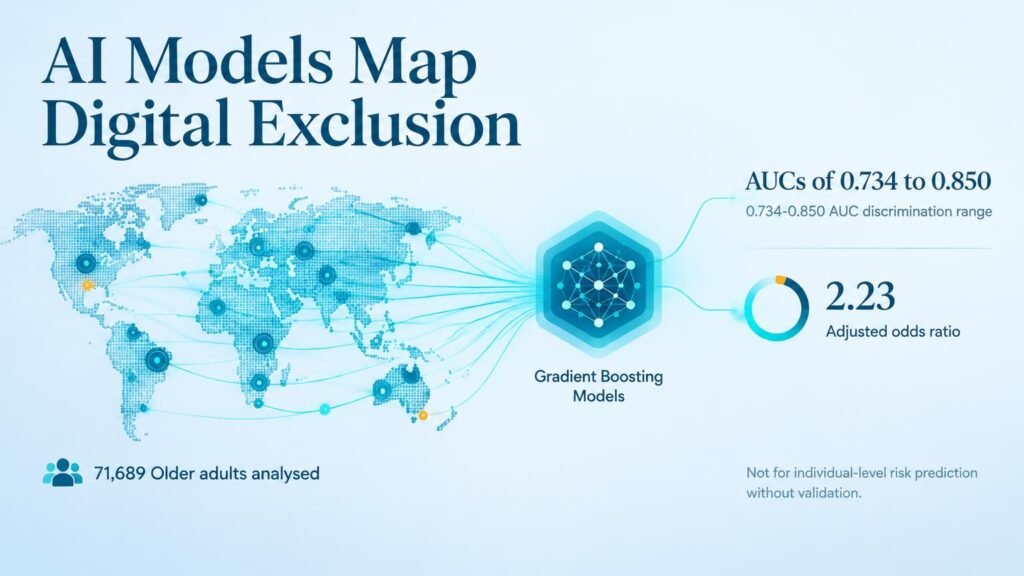
Complex machine learning adds almost no predictive power over simple regression when identifying older adults cut off from digital healthcare.
Health systems increasingly assume patients can log into portals, schedule telehealth appointments, and navigate digital tools. A cross-national study shows that identifying which older adults get left behind does not require sophisticated software.
Researchers analyzed harmonized data from 71,689 middle-aged and older adults across five major international cohorts: CHARLS in China, ELSA in the UK, HRS in the US, MHAS in Mexico, and SHARE across Europe. They defined digital exclusion as reporting no active internet or email use.
Simple models match AI
Gradient Boosting models discriminated digital exclusion with AUC scores ranging from 0.734 to 0.850 across cohorts. However, standard logistic regression models performed almost identically, yielding AUCs between 0.721 and 0.846.
The performance difference between the complex models and standard regression was negligible, spanning just 0.001 to 0.013.
This finding challenges the push to deploy complex machine learning for social risk screening. Advanced algorithms add implementation overhead and maintenance costs without offering a true predictive edge over basic statistical tools.
Key results across the global datasets demonstrate clear regional disparities and health associations:
- National exclusion varied dramatically, ranging from 20.1% in Denmark to 79.2% in Poland within the European SHARE cohort.
- Cross-border model transportability remained stable, showing a mean AUC attenuation of 0.026 under leave-one-cohort-out validation.
- Digitally excluded adults faced higher odds of poor mental health, with a pooled adjusted odds ratio of 2.23 (95% CI 1.83–2.71) for concurrent depression.
Population tools, not individual triage
The strong correlation with depression underscores that digital isolation is a serious health equity issue. Patients unable to access online health portals face compounded barriers to care.
Yet health systems should not mistake these models for clinical risk predictors. Because the study relies entirely on cross-sectional data, it cannot establish whether digital exclusion causes depression or merely accompanies it.
The authors explicitly state that these statistical scores suit population-level resource allocation, not prospective individual screening or automated clinical triage without external validation. Retrospective cohort analysis cannot prove that an algorithmic flag will improve patient outcomes or streamline clinic workflows.
Health operations teams should avoid over-engineering digital equity programs. Simple demographic and administrative markers are enough to spot vulnerable patient groups, saving IT budgets for direct intervention and technical support.
Read the full study in npj Digital Medicine.