
A new software workflow combines three AI models with human experts to automatically spot conflicting medical guidelines and missing research.
The Guideline Problem
When clinical practice guidelines disagree, doctors face a quiet crisis. In rare conditions where large clinical trials are scarce, expert panels often produce conflicting advice that leads to varied patient care. Resolving these contradictions usually takes months of painstaking manual review.
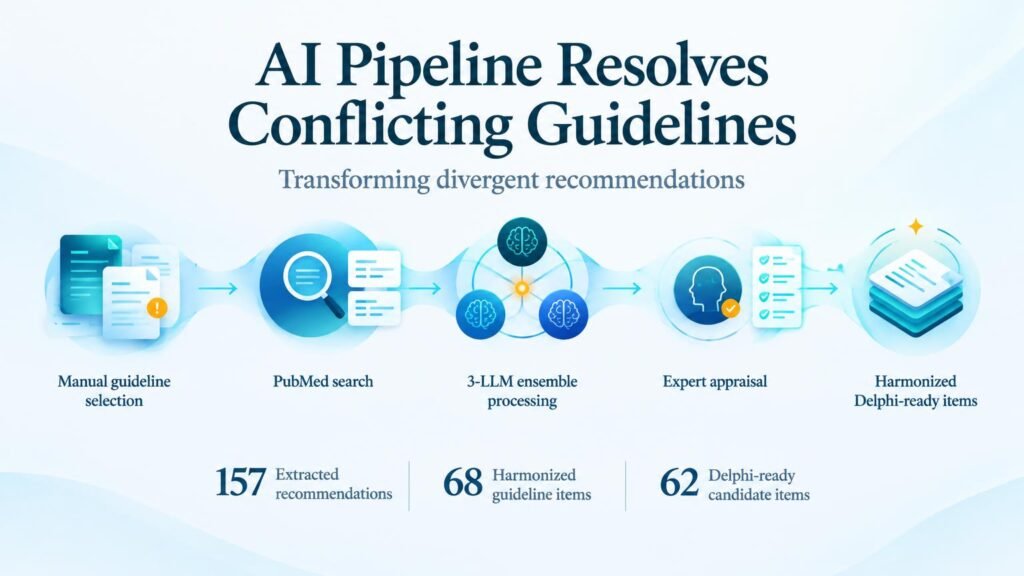
A research team tested whether artificial intelligence can clean up this process without sacrificing rigor. They targeted penile cancer as a high-stakes test case, building a pipeline to extract, group, and flag contradictory recommendations across multiple medical authorities. Rather than relying on a single algorithm, the authors combined a three-model ensemble check with independent scoring from four medical specialists.
Extracting Conflicting Advice
The system processed 157 clinical recommendations from 5 guidelines and consolidated them into 68 harmonized guideline-derived items. The AI then mapped how well those guidelines agreed with one another.
The analysis revealed deep split opinions across existing medical literature:
- Only 15 items showed uniform agreement across all guidelines.
- A total of 53 items were flagged as divergent, ambiguous, or incompletely addressed.
- Literature searches generated 95 harmonized white-area items covering unaddressed clinical issues.
- Expert reviewers confirmed 9 true white-area items that no current guideline covers.
After expert appraisal using a 5-point suitability scale, the pipeline delivered 62 human-reviewed candidate items ready for formal consensus voting. The process highlights how automated tools can convert scattered medical documents into actionable survey questions for panels.
Human Oversight Matters
This result shows AI can organize medical data, but it does not replace expert consensus. The pipeline relied heavily on human clinicians to filter out erroneous AI outputs and set suitability thresholds. Without human clinical experts directing the final cut, automated text synthesis risks amplifying noise rather than resolving clinical ambiguity.
Critics often fear that artificial intelligence-assisted care in medicine could act as a blunt weapon when deployed without clinical boundaries. Here, the tool functioned as a prep worker rather than a decision-maker. It handled the tedious task of reading hundreds of pages, leaving human doctors to debate actual medical policy.
The real value of this method lies in speed and structure. By turning messy guidelines into structured items for expert panels, health networks can update recommendations faster. Smaller medical fields that lack massive funding can use this pipeline to surface blind spots and keep guidance up to date.
Read the complete study in the Journal of Medical Internet Research.