
Public medical imaging datasets frequently lack the basic technical features needed to train artificial intelligence models.
Thousands of open medical imaging datasets promise to speed up algorithm development. Yet behind the download links, missing files and broken metadata halt progress before coding even starts. Developers waste months cleaning open data that turns out to be missing critical structure.
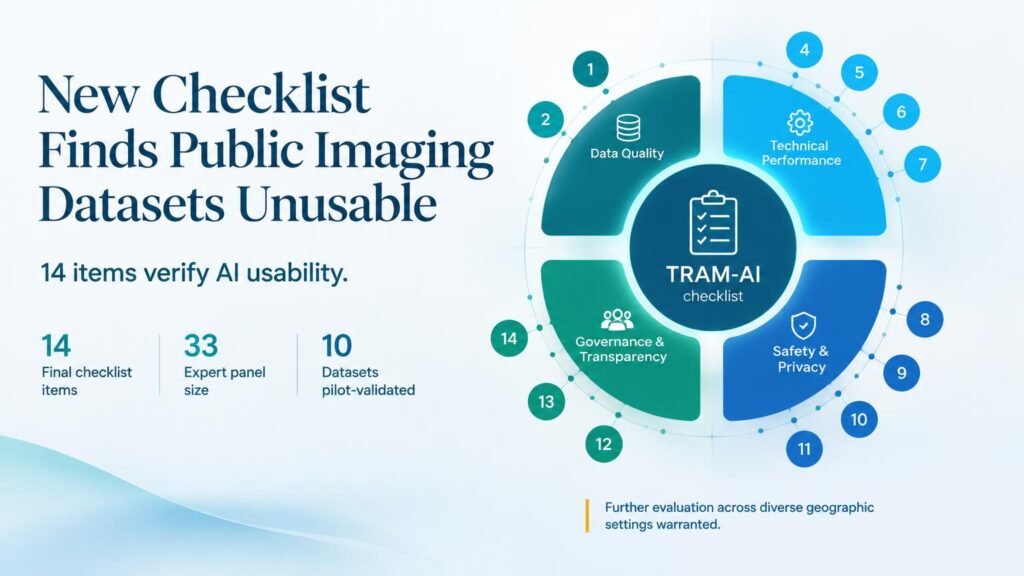
A consensus panel of 33 international experts developed the TRAM-AI checklist to fix this gap. Published in Radiology: Artificial Intelligence, the tool verifies whether datasets marked as public are functionally usable for engineers.
A steering committee initially drafted 16 candidate items. After two rounds of rating, 14 final items reached the required 75% agreement threshold for both criticality and feasibility. One item was removed due to feasibility concerns, while another was merged to eliminate redundancy.
Testing the New Checklist
Researchers pilot-tested the 14-item checklist across 10 publicly available datasets. While top-level privacy and access controls scored high, deep technical preparation fell flat. This aligns with broader efforts to enforce reporting standards in AI research to catch structural flaws before training begins.
- 90% compliance for trusted repositories, de-identification, and subject-level mapping.
- 30% compliance for standardized dataset partition keys.
- 10% compliance for automated archive validation.
High privacy scores mean patient data is safe. Low technical compliance means the data remains unusable.
Without clear partition keys, developers cannot reliably split data into training and test sets without leaking information across groups. Poor archive validation means corrupted files trigger errors mid-training, wasting expensive compute time. As highlighted in recent work on reproducibility in medical imaging AI, open access means little if external teams cannot rebuild the pipeline.
Fixing Data Quality First
The pilot evaluation covered just 10 datasets, so compliance rates across thousands of open repositories remain unmeasured. An advisory group of 4 experts from Latin America and sub-Saharan Africa endorsed the guidelines, but cross-regional utility requires broader testing.
Software teams should adopt the TRAM-AI framework before downloading external data. Verifying archive integrity and data partitions early prevents costly delays in model development.
Read the full paper in Radiology: Artificial Intelligence.