
Open-weight medical AI models are proving that domain-specific fine-tuning can outperform massive general systems while requiring significantly less training data.
Building specialized healthcare AI usually requires millions of labeled clinical images and vast computational power. MedGemma, a collection of medical vision-language foundation models adapted from Gemma 3, challenges that requirement. By pairing open base architectures with targeted medical tuning, researchers showed that localized clinical adaptation achieves superior diagnostic accuracy without starting from scratch.
That efficiency shifts how healthcare institutions might build custom diagnostic tools.
Instead of relying on monolithic closed API models, smaller technical teams can adapt open weights to niche clinical workflows. As highlighted in research on multimodal large language models in medicine, open foundations allow lower-resource health systems to deploy tailored AI without massive compute budgets.
Stronger performance on unseen tasks
The core vision component, MedSigLIP, was derived directly from the SigLIP vision encoder. When combined into the full MedGemma model, the fine-tuned architecture significantly outpaced its base general-purpose model across several out-of-distribution diagnostic tasks.
The performance gains across unlearned imaging sets were substantial:
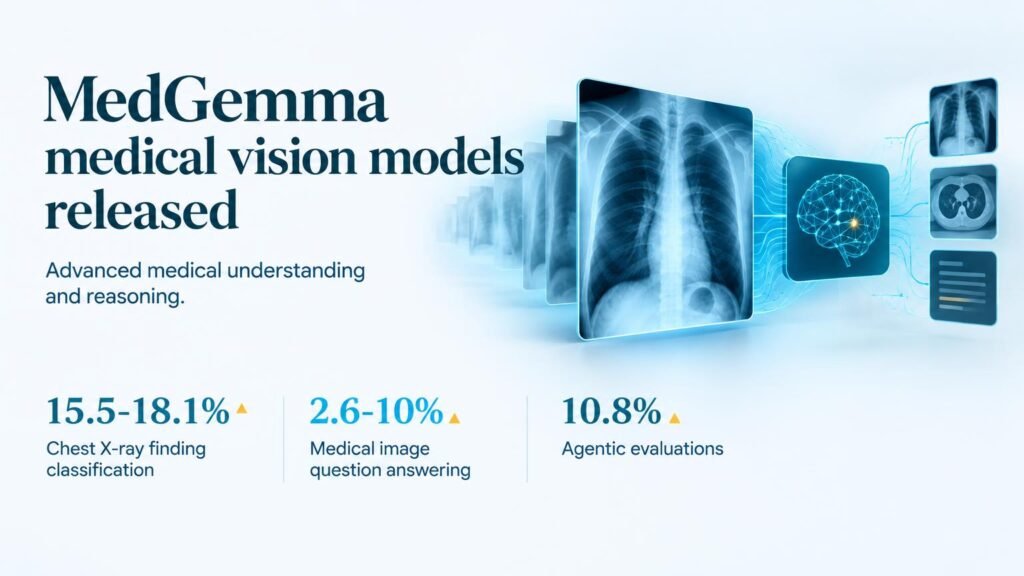
- Chest X-ray finding classification improved by 15.5% to 18.1% over the base Gemma 3 model.
- Agentic evaluations saw a 10.8% increase in complex workflow tests.
- Medical image question answering accuracy rose by 2.6% to 10.0% across diverse domains.
These numbers matter because clinical deployment relies heavily on out-of-distribution reliability. Hospitals rarely operate on clean, uniform training sets. A model that maintains high performance when faced with novel imaging hardware or variable clinical formatting directly reduces misdiagnosis risks.
From benchmarks to bedside
The rise of autonomous decision tools, often framed as agentic AI systems for healthcare, hinges on accurate multi-step reasoning. MedGemma’s 10.8% gain in agentic evaluations suggests that domain-tuned vision encoders help AI agents make safer multi-step clinical choices.
Yet strong benchmark performance is not a substitute for clinical outcome trials. Retrospective evaluations on fixed datasets show diagnostic accuracy, not real-world utility.
These results do not prove MedGemma can replace radiologist oversight or operate safely without clinician supervision. Performance metrics on curated image sets rarely capture clinical workflow interruptions, user fatigue, or systemic bias in real care environments.
The practical takeaway is structural rather than operational. MedGemma offers a data-efficient starter kit for developers building medical software. Health tech developers can now train specialized image classifiers using far fewer patient records, drastically lowering the barrier to clinical validation trials.
Read the full paper in Nature Medicine.