
Algorithms spot critically ill emergency patients better than standard triage, but they come with a high operational tax.
Emergency departments trade accuracy for speed every minute. Standard intake relies on quick clinical judgment, which occasionally misses subtle signs of rapid deterioration. AI models promise a sharper safety net, but high diagnostic accuracy does not automatically mean a tool is ready for the front lines.
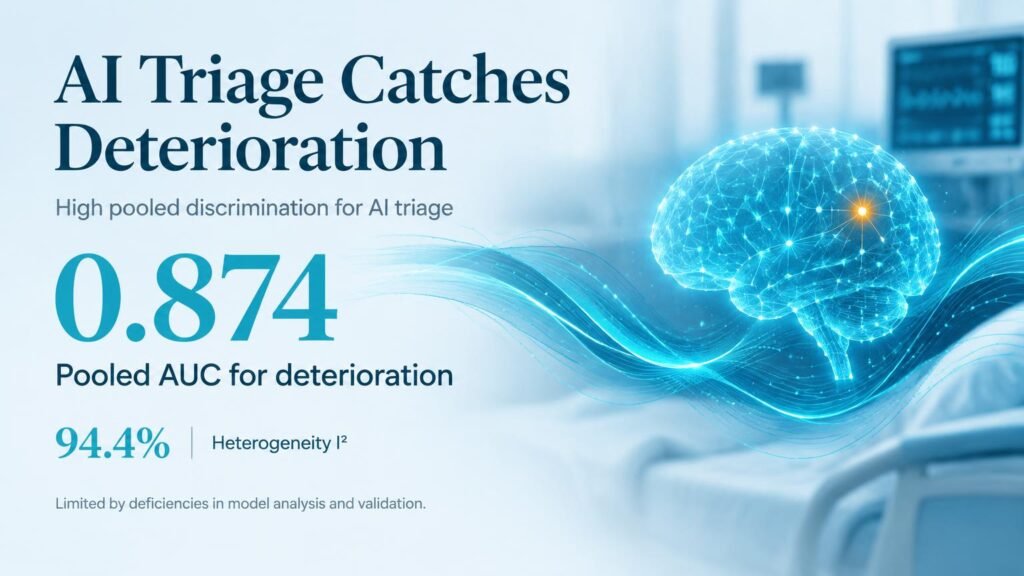
A systematic review published in the Journal of Medical Internet Research analyzed 27 studies evaluating digital triage tools across acute care settings. Looking at four adult emergency department studies tracking critical illness, AI-assisted models demonstrated strong overall discrimination with a pooled area under the curve of 0.874 (95% CI 0.845-0.898). Four direct comparison studies showed model performance improvements of 0.097, 0.120, 0.108, and 0.065 over conventional triage.
That accuracy boost alters how clinicians catch collapsing patients.
Fewer Misses, More Noise
Operational modeling per 10,000 emergency department visits reveals the true clinical trade-off. Algorithms could prevent 12 to 38 missed cases of critical illness. However, achieving that sensitivity generates 45 to 120 additional false-positive escalations.
That surge in false alarms risks overloading trauma bays and exhausting staff. Similar operational friction is highlighted in recent research on artificial intelligence for early diagnosis in emergency departments, where gains in sensitivity often strain downstream resources.
By the Numbers
- Admission prediction models achieved discrimination scores between 0.80 and 0.93.
- Two pediatric studies recorded high discrimination ranging from 0.85 to 0.99.
- Tele-triage tools reduced time to clinical assessment by 15% to 40%.
- Digital routing dropped left-without-being-seen rates by 2 to 8 percentage points.
The Calibration Deficit
Paper performance can be deceptive. The study revealed massive statistical variation across sites, marked by an I² heterogeneity value of 94.4%. Most prediction models suffered from poor calibration reporting and lacked external validation on independent patient populations.
Furthermore, economic and equity benefits remain theoretical projections rather than proven real-world outcomes. Broad evidence synthesized in an umbrella review on AI in emergency management reinforces that strong retrospective metrics rarely translate directly to safer care without rigorous real-time testing.
Retrospective accuracy cannot justify immediate rollout. Hospital administrators should require prospective multicenter trials and local threshold calibration before integrating risk algorithms into emergency workflows.
Read the full systematic review in the Journal of Medical Internet Research.