

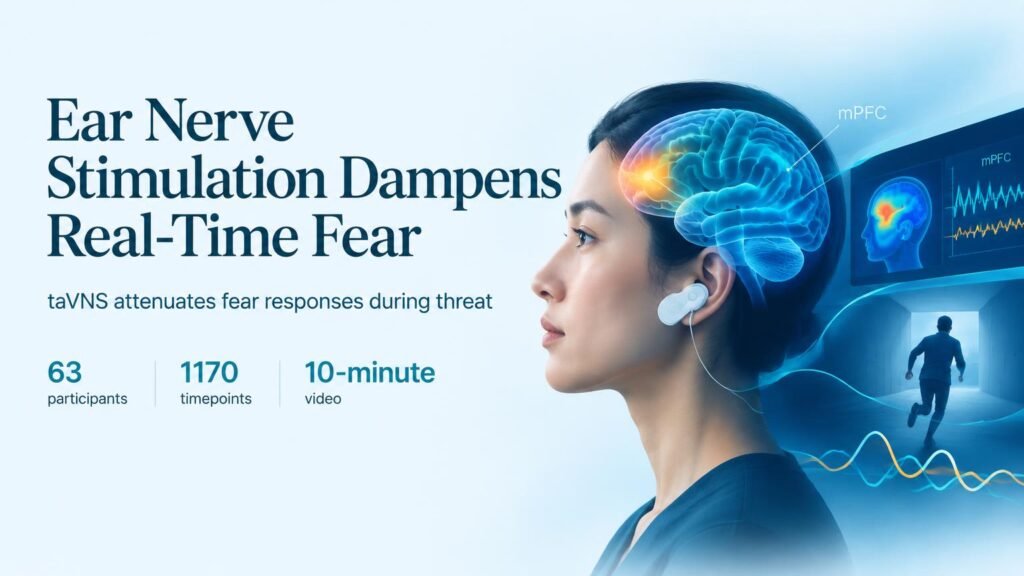
A non-invasive ear stimulation device flattened subjective fear spikes during threat scenes by altering prefrontal brain activity.
Exposure therapy often fails when acute panic overpowers a patient before habituation takes hold. Non-invasive transcutaneous auricular vagus nerve stimulation (taVNS) offers a potential electrical circuit breaker for that distress. However, its direct impact on continuous neural activity during realistic threat processing has remained unclear.
A new trial shows that electrical stimulation through the outer ear dampens subjective fear and disrupts the expected link between panic feelings and brain reactivity. Instead of simply accelerating recovery after a shock, the device actively alters how the prefrontal cortex processes sustained terror as it happens.
Mapping fear in real time
To test the technology under realistic conditions, researchers ran a randomized trial on 63 healthy participants divided into active taVNS (n = 33) and sham control (n = 30) groups. Subjects watched a 10-minute fear-inducing video while providing continuous subjective fear ratings across 1,170 timepoints. Researchers recorded prefrontal blood flow throughout the task using functional near-infrared spectroscopy (fNIRS).
The active stimulation group experienced lower subjective fear during intense scenes. Neurally, the device targeted the medial prefrontal cortex (mPFC), altering the brain network dynamics that drive acute threat appraisal.
- Subjective fear fell significantly across four distinct threat phases: a ghost appearance (T1), an escape sequence (T2), a sudden threat emergence (T3), and a suicide scene (T4).
- Active taVNS suppressed mPFC activation during the escape sequence (T2), breaking the standard coupling between subjective dread and prefrontal neural spikes.
- The stimulation increased functional connectivity within intra-mPFC networks, while individual state anxiety significantly moderated these brain-behavior shifts.
Rethinking threat appraisal
These results challenge the assumption that managing acute panic requires strengthening top-down prefrontal executive control. Instead, taVNS appears to work by uncoupling conscious fear from immediate neural reactivity during high-stress moments.
That mechanism makes taVNS a promising candidate as an early companion tool for exposure-based anxiety treatments. Applying stimulation right before exposure sessions could allow patients to confront phobic triggers without being instantly overwhelmed by distress spikes. That shift could lower therapy dropouts and speed up extinction learning.
Early clinical limits
Important limitations restrict how clinicians should interpret these findings. The study tested healthy subjects watching passive video clips rather than clinical anxiety patients facing personalized, interactive phobias.
Furthermore, fNIRS imaging lacks the spatial resolution of fMRI, preventing researchers from directly measuring deeper structures like the amygdala. While this preprint confirms a distinct neurobiological effect, it remains proof of concept rather than evidence that ear stimulation can replace existing clinical protocols.
Read the full study in medRxiv.