A new end-to-end framework extracts and ranks rare disease terms directly from clinical text to streamline undiagnosed case reviews.
Manual curation of rare disease symptoms from medical records remains a major bottleneck in clinical genetics. Clinicians must read through dense progress notes, standardize patient symptoms into Human Phenotype Ontology terms, and rank those terms to pinpoint a potential diagnosis. Early work in EHR-driven phenotyping tackled individual steps of this workflow, but standalone tools still required significant manual handoffs.
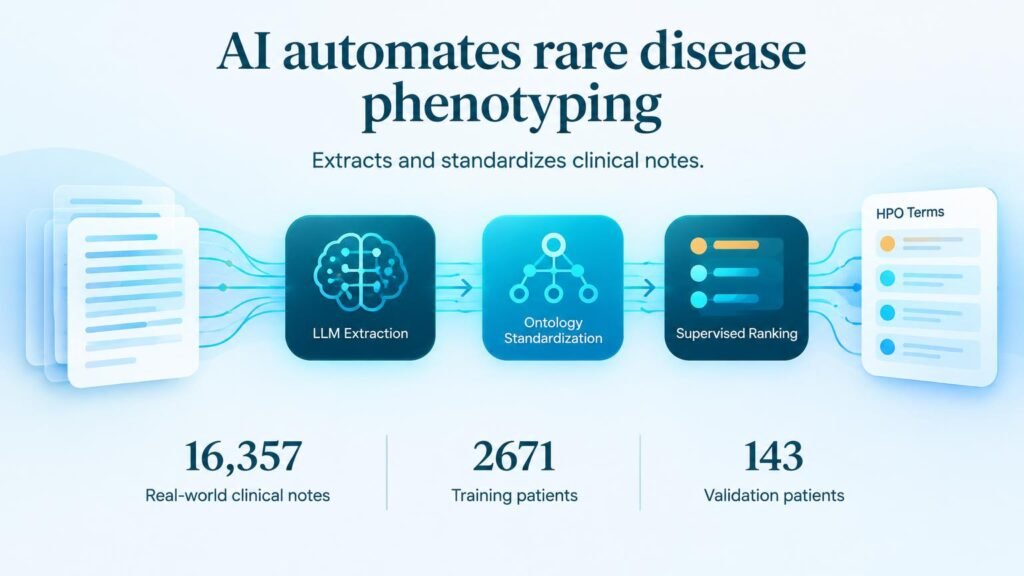
A research team developed RARE-PHENIX to bridge this operational gap. The framework uses large language models to automate the entire phenotyping pipeline, taking raw narrative clinical notes and turning them into standardized, prioritized diagnostic terms.
Integrated pipelines like this shift clinical AI from targeted text parsing to real workflow automation.
Validation and performance
To train the system, researchers used data from 2,671 patients across 11 Undiagnosed Diseases Network clinical sites. They then conducted an external validation using 16,357 real-world clinical notes from 143 patients at Vanderbilt University Medical Center.
- High concordance: Output matched expert clinician curation across structured ontology terms.
- Disease signal: Generated clear downstream signals to assist in prioritizing candidate rare conditions.
- End-to-end coverage: Operationalized extraction, ontology mapping, and term ranking within a single software architecture.
These findings build directly on past advances in ontology-driven rare disease identification. Instead of requiring human staff to re-enter extracted terms into separate ranking systems, the unified model handles feature extraction and prioritization together, reducing administrative drag for clinical geneticists.
Limitations and clinical outlook
Despite strong retrospective results, algorithmic accuracy does not equal clinical impact. The external evaluation relied on 143 patients at a single medical center, meaning performance across different electronic health record setups remains unproven. Furthermore, retrospective concordance shows that the AI mimics historical decision-making, but it does not prove that deploying the software speeds up diagnosis or improves patient outcomes in practice.
For health system leaders, the actionable takeaway is to treat this tool as a human-in-the-loop assistant rather than an autonomous diagnostic engine. Deploying automated phenotyping can accelerate expert review and eliminate clerical overhead, provided clinicians maintain oversight of the final diagnostic selection.
Read the original study in npj Digital Medicine.