Doctors are turning to artificial intelligence for complex treatment decisions rather than basic diagnostic tasks.
Clinicians are not using AI platforms as simple diagnostic oracles. Instead, frontline care teams rely on large language models to manage complex treatment plans and navigate care outside their primary specialty expertise.
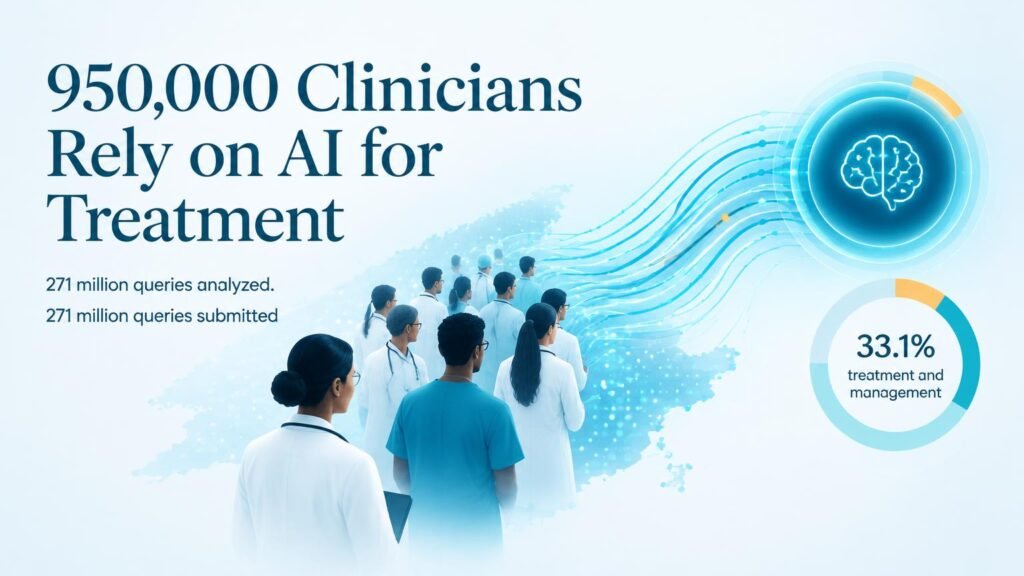
A cross-sectional study published in JAMA analyzed 271 million queries submitted by 952,008 verified US clinicians between January 2024 and June 2026. During this period, monthly active users jumped from 355 to 703,265, while average monthly queries per user doubled from 18.0 to 39.5. The user base included 556,200 physicians and was 58.5% female.
This rapid shift shows that generative software is actively reshaping daily clinical reference habits. Early research evaluated AI-generated suggestions for decision support in controlled environments, but real-world practice shows clinicians taking the initiative directly at the point of care.
Where AI gets used
The study highlights clear differences in adoption across clinician roles, career stages, and medical specialties.
- Nurse practitioners and physician assistants averaged 44.5 monthly queries per user, compared to 37.1 among physicians.
- Physicians within ten years of graduation used the platform at 2.54 times their workforce representation, while residents and fellows reached a 1.84 ratio.
- Oncology and hematology led specialty use with a 2.00 use ratio, followed by internal medicine at 1.88 and family medicine at 1.80.
- Procedural specialties showed minimal uptake, including radiology at 0.24, orthopedics at 0.24, and ophthalmology at 0.23.
Treatment over diagnosis
The intent behind these queries challenges common assumptions about medical software. A total of 51.9% of prompts focused on clinical decision-making, led by treatment and management at 33.1%, whereas diagnostic questions comprised just 13.9%.
Clinicians also used the tool as a bridge across medical domains. Searches addressing topics outside a physician’s primary specialty ranged from 35% among oncologists to 88% among emergency department physicians.
That pattern exposes a significant clinical reality. While broader evaluations examined utility across the clinical workflow, high search volume does not guarantee safer patient outcomes or factual accuracy. The study relied on automated prompt classification and could not verify whether the platform generated correct advice or reduced medical errors. Health systems must focus on validating answer accuracy rather than assuming higher engagement equals better care.
Source: JAMA