Running medical artificial intelligence directly inside hospital servers can protect patient privacy while safely handling half of routine diagnostic cases.
Hospitals hesitate to send sensitive health records to commercial cloud providers. Yet running complex diagnostic agents on local hardware often means sacrificing reliability and speed. A recent study published in Nature Medicine demonstrates a practical workaround by pairing an on-premise clinical agent with a smart filter that knows when to trust its own decisions.
Instead of guessing blindly, the system measures its own behavioral consistency before outputting a diagnosis. If the model reaches the same conclusion across repeated internal runs, it acts autonomously. If its reasoning wobbles, it flags the file for human review.
Reliable Local Performance
Tested on two benchmarks derived from the Medical Information Mart for Intensive Care IV dataset, the local agent delivered performance comparable to cloud-based systems. It evaluated complex intensive care records without transferring patient records outside the hospital network.
The researchers tracked internal likelihoods, language patterns, and behavioral consistency across multiple diagnostic scenarios. Key findings include:
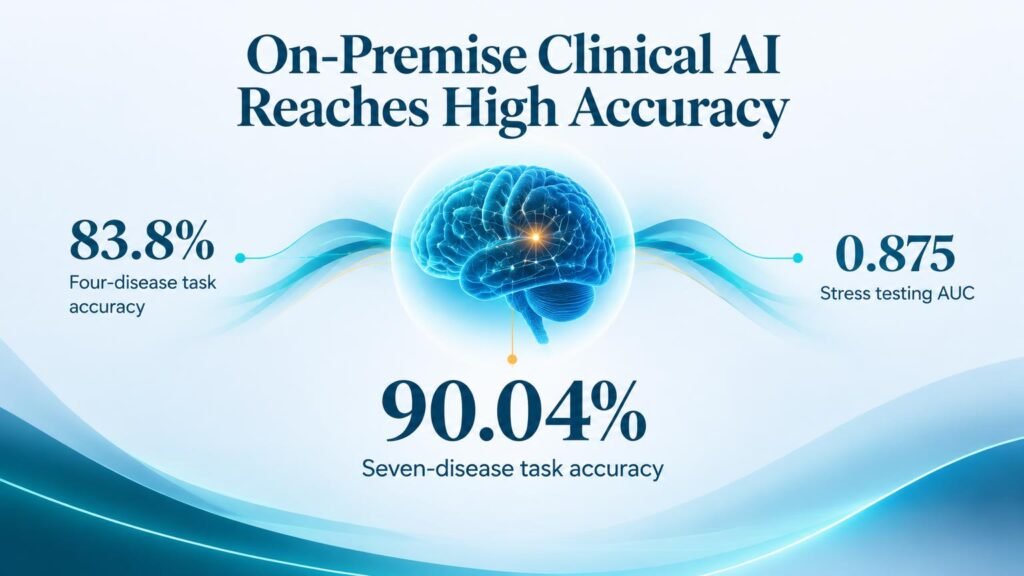
- Achieved 90.04% diagnostic accuracy on a seven-disease benchmark task.
- Reached 83.8% accuracy on a separate four-disease benchmark task.
- Diagnostic behavioral consistency separated correct from incorrect decisions with an area under the curve of 0.860, which rose to 0.875 during stress testing.
- Setting a consistency threshold of 0.90 allowed the system to autonomously retain 49.4% of cases with an exceptional diagnostic accuracy of 98.9%.
That safety margin changes the operational equation for overstretched care teams.
By safely offloading roughly half the diagnostic workload, clinicians can focus their time on complex cases deferred by the agent. This approach aligns with broader developments in agentic AI systems for second opinions and multi-modal clinical decision support, such as the HEAL-LLMF explainable framework.
Limits to Clinical Translation
These findings do not prove that autonomous agents are ready to replace doctors at the bedside. The evaluation relied on retrospective data from a single intensive care repository, which cannot capture real-world workflow interruptions or missing data.
Furthermore, high diagnostic accuracy on retrospective datasets does not automatically translate to improved patient outcomes. High reliability signals indicate when a model is confident, but prospective clinical trials are still required to verify whether selective autonomy actually reduces physician burnout or prevents medical errors.
For hospital leaders, the actionable lesson is clear. Deploying local AI does not require choosing between data privacy and clinical accuracy. Implementing strict decision-time reliability thresholds creates a safe path toward partial automation today.
Read the full study in Nature Medicine.