Routine blood tests and simple clinical models can spot hidden cardiometabolic danger in rheumatoid arthritis long before standard lab panels show trouble.
Rheumatoid arthritis patients face a silent cardiovascular threat. Even when standard blood sugar and cholesterol panels look normal, underlying metabolic strain often builds undetected. A common blood marker—neutrophil count—might reveal who is actually at risk.
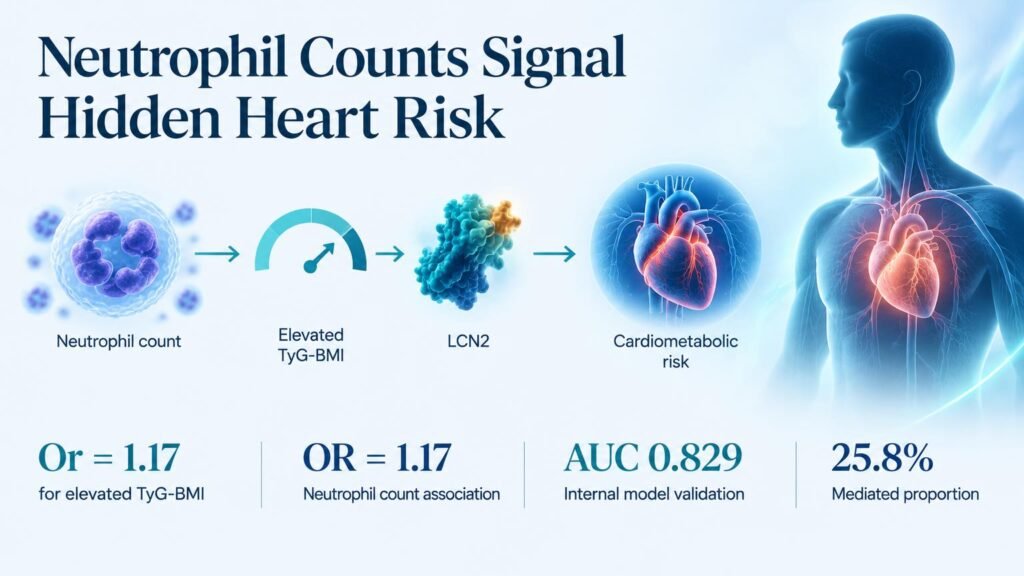
In an analysis of 1,028 patients with rheumatoid arthritis, researchers tracked factors tied to the triglyceride-glucose body mass index, an indicator of metabolic risk. Higher neutrophil counts were independently associated with elevated metabolic strain (odds ratio 1.17, 95% CI 1.08–1.27; P < 0.001), even after adjusting for antirheumatic drugs.
That link carries direct clinical consequences.
Among patients who entered a 12-month follow-up with completely normal baseline metabolic indicators, those in the highest risk quartile were twice as likely to develop new physician-diagnosed cardiometabolic conditions (21.3% versus 10.7%, relative risk 1.98, 95% CI 1.02–3.87; P = 0.044).
Key study findings
- Neutrophil counts independently predicted elevated metabolic risk with an odds ratio of 1.17 (P < 0.001).
- A logistic regression model using routine clinical variables achieved an area under the curve of 0.829 in internal validation.
- Patients in the highest risk quartile developed new cardiometabolic conditions at nearly double the rate of those in the lowest quartile (21.3% vs 10.7%).
- Adding lipocalin-2 raised model performance from 0.799 to 0.812 in a prospective cohort of 502 patients, explaining 25.8% of the biological link (P < 0.001).
Mapping the biological driver
To understand what drives this connection, researchers performed transcriptomic analyses. They identified lipocalin-2, a protein linked to neutrophil activity, as a candidate molecular bridge between systemic inflammation and metabolic disease.
In an independent prospective validation cohort of 502 patients, adding lipocalin-2 modestly improved discrimination, raising the area under the curve from 0.799 to 0.812. Net reclassification improvement was not statistically significant, but integrated discrimination improvement reached significance (P = 0.008). Exploratory mediation analysis indicated that lipocalin-2 accounted for 25.8% of the relationship between neutrophils and cardiometabolic risk.
What clinicians should reconsider
These findings complicate how care teams monitor metabolic health in chronic inflammatory conditions. Relying solely on conventional lipid panels leaves a wide blind spot for early risk.
However, clear limitations exist. The 12-month follow-up was exploratory, and adding lipocalin-2 yielded only a modest increase in accuracy without significant net reclassification. Observational cohorts cannot prove that targeting lipocalin-2 or neutrophils directly prevents heart disease or replaces standard clinical care.
The practical takeaway is clear. Routine blood counts already contain unmapped signals that can flag vulnerable patients long before metabolic disease becomes overt.
Read the original research in Scientific Reports.